There is no shortage of published collections of William Shakespeare’s plays. An estimated two- to four-billion copies of the playwright’s works have been printed in the past four centuries. So when the owner of a three-volume nineteenth-century Shakespeare edition reached out to the UW about donating his books, the UW’s initial response was… noncommittal.
The owner’s initial contact was his longtime friend Ricky German, manager of the UW School of Drama costume shop. He told German that the three volumes, published in 1847, were in good condition and filled with illustrations. But even antique illustrated volumes of Shakespeare are far from rare, so German wasn’t sure UW Libraries would be interested. (Adding volumes to the library’s collection is not as simple as placing them on a shelf.)
“I thought that either this offer was something silly to consider or something very interesting,” recalls German. “And it turned out to be very interesting.”
A First Edition, Then a Fire
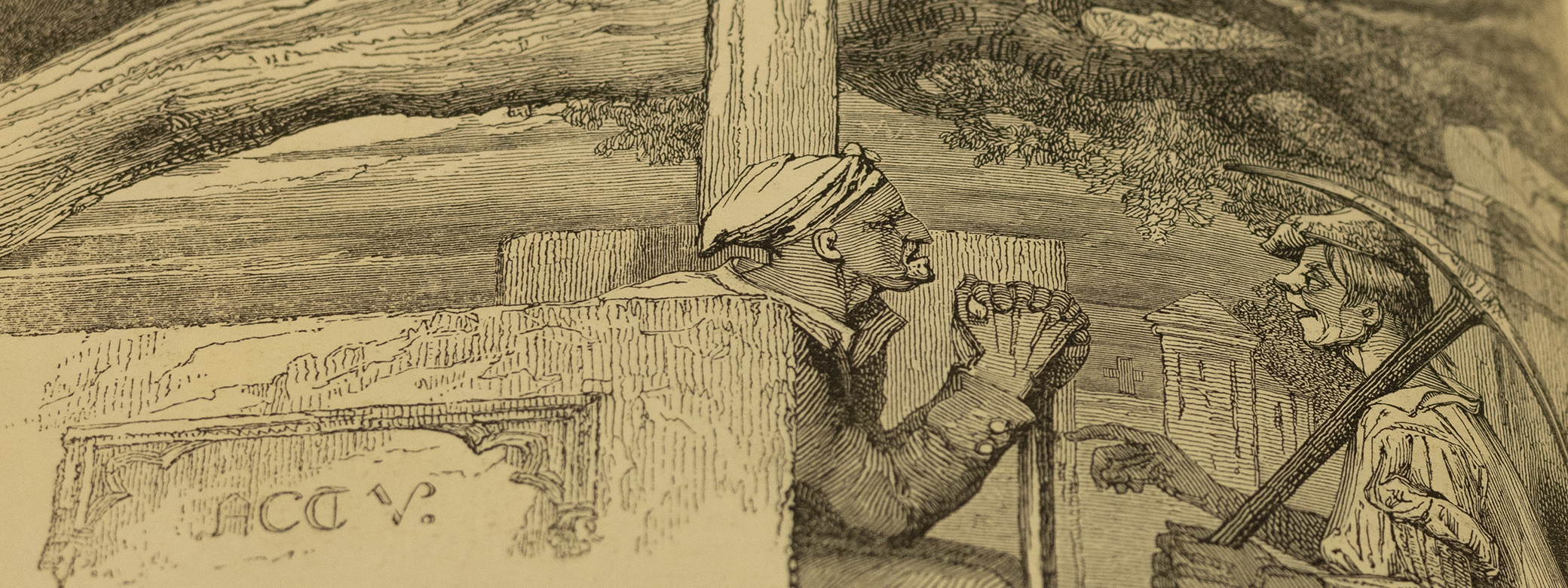
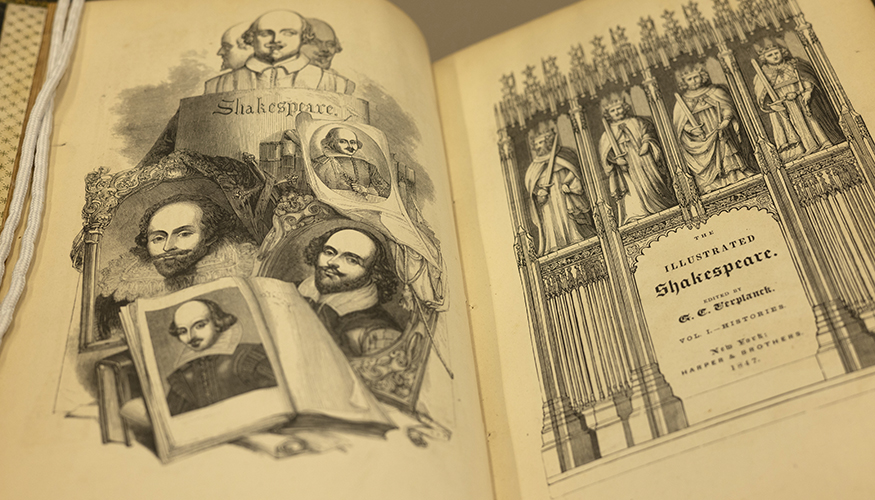
German reached out to School of Drama director Scott Magelssen, who contacted Julie Tanaka, UW Libraries associate dean for distinctive collections, about the potential gift. Magelssen shared that the three books were published by Harper Brothers in New York, with separate volumes for Shakespeare’s comedies, tragedies, and history plays. Hundreds of woodcut illustrations interspersed throughout the volumes feature characters and events from the plays, historical locales, and decorative flourishes.
“For plays set in a magical world, like ‘A Midsummer Night’s Dream’, the illustrations are of scenery and fairies and those kinds of things, sometimes in exotic locations,” says Magelssen. “This is definitely a product of the nineteenth century, and so there are a lot of Western-imagined exotic locales and exotic people.”
With that information, Tanaka began researching the books. She learned that the illustrations were original woodblock prints inspired by the work of Kenny Meadows, a prominent British illustrator at the time, and that a fire at Harper Brothers in 1853 destroyed the carved woodblocks after the first print run. That meant the books were never printed again.
Tanaka’s interest was piqued.
“I also learned that this edition is regarded as the first American illustrated Shakespeare,” Tanaka says. “These books are not the rarest thing out there – I don’t have numbers on the original print run, but it seems like it was fairly widely distributed – but as copies either get lost, destroyed, or buried in someone’s basement, the number of copies get fewer and fewer.”
Opportunities for Discovery
Beyond its unusual history, Tanaka also had to consider whether the Shakespeare collection would serve the campus community. “One of the things I think about when I bring materials in is whether they support teaching and research on campus,” she says. “If a book is just going to sit on the shelf, that doesn’t warrant taking up space that could be used to bring in another volume that would support student discovery and new research inquiries beyond what our existing collections provide.”
One of the things I think about when I bring materials in is whether they support teaching and research on campus.
Given the age of the Shakespeare volumes and their illustrations, Tanaka believes they could be of interest to faculty and students in English and drama but also art historians studying nineteenth-century woodcut prints, historians and textual studies scholars interested in advancements in books and printing, and chemists interested in the chemistry of the inks and other materials used. “The books fit in with the University’s emphasis on multidisciplinary work,” she says.
Tanaka recently added the books to the queue of items to be prepared for UW Libraries Special Collections. After an intake specialist creates an initial record, the library’s rare book cataloguer will catalogue the books, a flag will be made for each volume (to avoid attaching the call-number sticker to the books themselves), and the preservation team will create archival quality boxes to protect the volumes. Because they are nearly 200 years old, the Libraries’ book conservator will examine the volumes and address any small tears, stains, or other damage sustained during their lifetime.
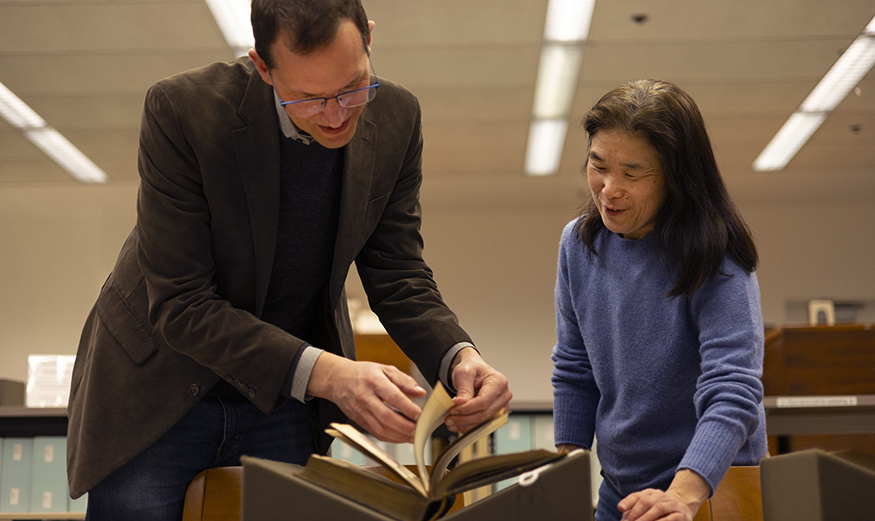
“When you walk into the library and see the books on the shelves or digital materials on the online platform, no one sees all the different steps involved in getting them there,” says Tanaka. She estimates that the Shakespeare volumes should be ready by summer and encourages anyone interested in viewing them to submit a request and schedule an appointment to view the books in the Special Collections Reading Room.
“Special Collections is an incredible resource for the UW community, and these books will be a great addition,” she says. “We hope they inspire researchers and Shakespeare enthusiasts for years to come.”
More Stories
A Healing Heart Returns
In February, the UW Symphony will perform a symphony that Coast Salish elder Vi Hilbert commissioned years ago to heal the world after the heartbreak of 9/11. The symphony was first performed by the Seattle Symphony in 2006.
A Transformative Gift for Arts & Sciences
To honor his wife and support the college that has meant so much to both of them, former Arts & Sciences dean John Simpson created the Katherine and John Simpson Endowed Deanship.
Can Machines Learn Morality?
UW researchers at the Institute for Learning & Brain Sciences and in the Allen School are exploring the potential for training AI to value altruism.