Mathematics is a vast and vibrant enterprise with theory at its core. It thrives today on its traditional interaction with the physical sciences and engineering, as well as the more recent connections to computing, information, and communication. It is increasingly inspired by emerging applications in fields as diverse as biology and finance.
VISIT DEPARTMENT WEBSITEHIGHLIGHTS
Recent faculty honors include an election to the National Academy of Sciences, the Gödel Prize, the Michael and Sheila Held Prize, the Solomon Lefschetz Medal, a Sloan Research Fellowship, and the Trevisan Prize.
The department’s Math Study Center and Math Lab provide a supportive and active learning environment for precalculus, calculus, differential equations and matrix algebra students. Graduate and advanced undergraduate students help them get unstuck, in a model that has since been adopted elsewhere.
Through the department’s Washington Experimental Mathematics Lab, faculty collaborate with graduate students, undergraduates, and community members on projects that are experimental, computational, and often visual, coming to understand mathematics as a creative discipline.
The department now houses the Math AI Lab, where faculty and students collaborate on cutting-edge projects and research at the intersection of mathematics and artificial intelligence.
498
Undergraduate majors
(including ACMS majors)
EDUCATION
The department offers an undergraduate degree program in Mathematics and an interdisciplinary program — joint with the Department of Applied Mathematics, the Allen School of Computer Science & Engineering, and the Department of Statistics — in Applied and Computational Mathematical Sciences. The department is also a major service department, with over 21,000 students enrolled in its courses annually.
Students
Winter 2026
- 336 Undergraduate majors
- 162 ACMS Undergraduate majors
- 105 Graduate students
Degrees Awarded
2024-2025
- 155 Bachelor’s degrees
- 59 ACMS Bachelor’s degrees
- 50 Math minors
- 19 Master’s degrees
- 15 PhD degrees
Major Student Awards
Our students have consistently earned some of the most competitive academic honors in the university and across the country, including major university medals, NSF fellowships, Husky 100 recognition, and national awards in mathematics. Their success reflects both the caliber of our students and the supportive environment that empowers them to achieve at the highest level.
RESEARCH
Department faculty do fundamental research in classical fields of mathematics and lead the way in newer areas (see Areas of Research below). In addition to intrinsic mathematical research, they collaborate on interdisciplinary projects with Art + Art History + Design, Applied Mathematics, Statistics, Computer Science and Engineering, Bioengineering, Genome Sciences, Electrical Engineering, Mechanical Engineering, Physics, and the Applied Physics Laboratory. Some examples:
- One faculty member has solved a longstanding open problem in the geometry of Riemannian manifolds, showing that knowledge of the distance function on the boundary determines distance overall. This work, featured in Nature, would allow one in principle to determine what is inside an object — the earth for instance — without destroying it.
- Another recently discovered a formula for counting all tanglegrams of a given size. Tanglegrams are combinatorial objects that arise in subjects as varied as the study of cospeciation in biology and analysis of software projects in computer science.
- In work with chemists at UW and beyond, a faculty member solved a probability problem about crystal deposits on a flat surface, thereby providing the theoretical justification for a procedure that may be used for cancer detection.
- To develop a procedure for packing objects of different weights and sizes into the smallest number of boxes in the fastest time, a suitable algorithm will be slow and inefficient. One of our faculty made a major advance by finding an efficient algorithm producing solutions that, if not optimal, are demonstrably close to optimal ones.
Areas of Research
- Algebraic geometry
- Algebraic topology
- Combinatorics
- Complex Analysis
- Differential geometry
- Ergodic Theory and Dynamical Systems
- Inverse Problems
- Noncommutative algebra
- Non-smooth analysis
- Number theory
- Numerical analysis
- Optimization
- Partial differential equations
- Probability
- Representation theory
FACULTY
Winter 2026
- 30 Professors
- 1 Teaching Professor
- 2 Associate Professors
- 7 Associate Teaching Professors
- 7 Assistant Professors
- 2 Assistant Teaching Professors
- 2 Acting Assistant Professors
- 5 Postdoctoral Scholars
Faculty awards include:
- 7 Guggenheim Foundation Fellows
- 11 Sloan Research Foundation Fellows
- 10 Simons Foundation Fellows
- NSF: 8 NSF CAREER grants; 1 NSF TRIPODS grant; NSF Presidential Early Career Award for Scientists & Engineers
- AMS: 4 Centennial Research Fellows; 11 AMS Fellows; 1 Birman Fellow; Stefan Bergman Prize; Bôcher Memorial Prize; Leroy P. Steele Prizes; AMS-SIAM George David Birkhoff Prize
- AWM: AWM Fellow; Humphreys Award; Louise Hay Award
- SIAM: SIAM Fellow; SIAM Kleinman Prize
- IMS: President of IMS; Carver Medal
- UW: Distinguished Teaching Awards; Landolt Distinguished Graduate Mentor
- 1 Packard Foundation Fellow
- 1 Karen EDGE Fellow
- 1 Member, National Academy of Sciences
- 2 American Academy of Arts & Sciences Fellows
- 2 Washington State Academy of Sciences Members
- Foreign Member of the Finnish Academy of Sciences
- Director of the Mathematical Sciences Research Institute
- Wacław Sierpiński Medal
- Vietnamese Friendship Medal
- Solomon Lefschetz Medal
- Gödel Prize
- INFORMS John von Neumann Theory Prize
- Levchin Prize Blackwell-Tapia Prize
- PIMS Education Prize
- Fulkerson Prize
- Rollo Davidson Prize
- Elsevier Itô Prize
- MAA Haimo Award
OUTREACH
Our outreach programs open doors to mathematical discovery for students of all ages. Through the Washington Directed Reading Program, undergraduates work one‑on‑one with graduate mentors to explore advanced ideas and experience the excitement of mathematical inquiry firsthand. Additionally, our undergraduates explore their future career paths through the Y Math lecture series. Y Math connects classroom learning with real‑world impact, showcasing how mathematics drives innovation across industries.
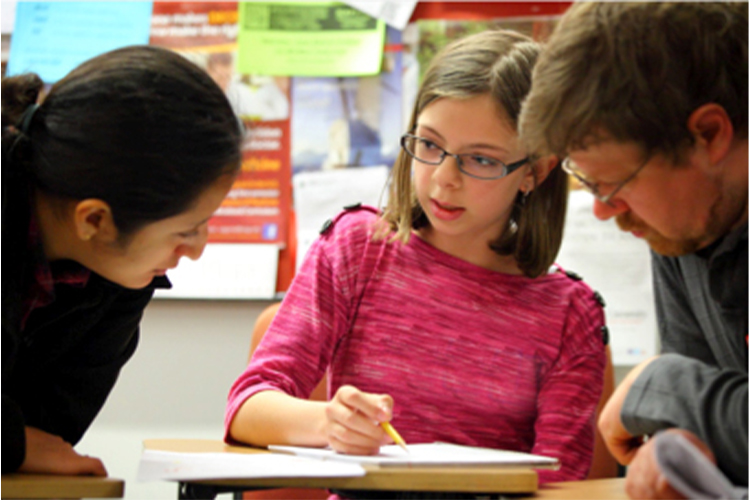
Beyond campus, we nurture the next generation of problem‑solvers through enrichment opportunities such as the UW Math Circle and the Husky Math Academy, where middle and high school students build confidence, curiosity, and a sense of belonging in mathematics. Monthly Math Hour invites young learners and their families into the wonder of mathematical thinking through accessible, engaging talks.
These programs reflect our commitment to inspiring students, expanding access, and strengthening the mathematical community across Washington.
CONTACT
Department of Mathematics
Box 354350
University of Washington
Seattle, WA 98195
(206) 543-1150
math.washington.edu
last update: January 2026