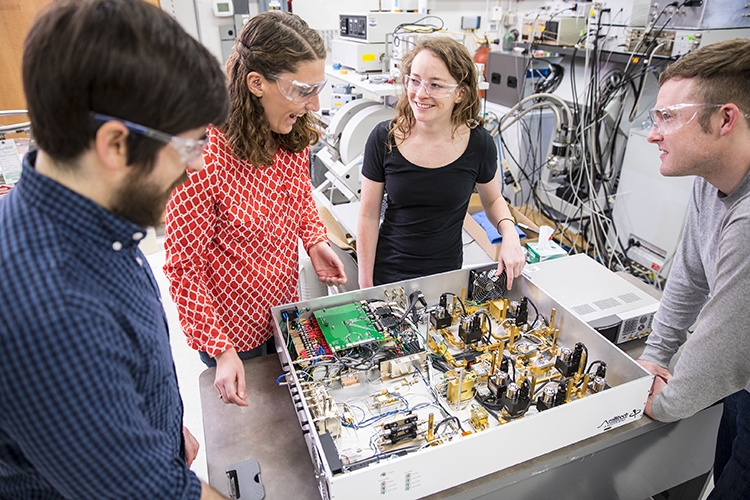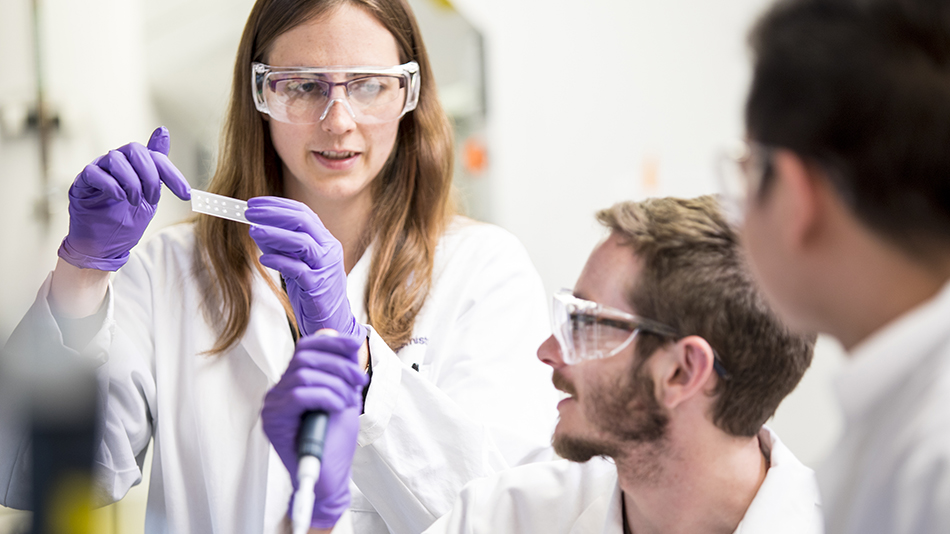
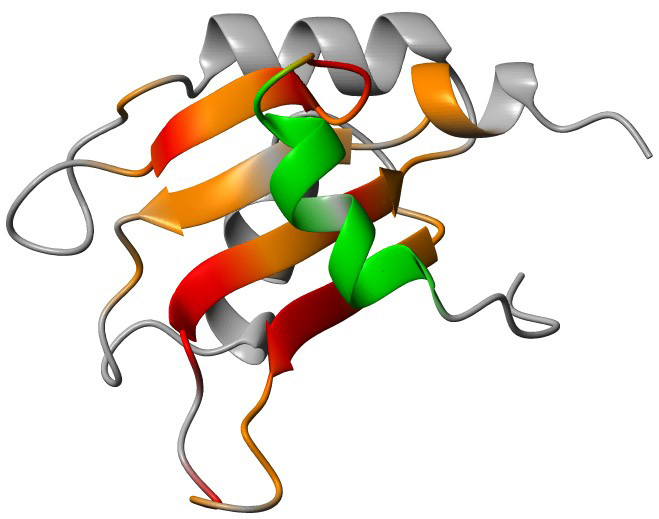
Chemists study the atoms and molecules that compose the world (and universe). Our atomic and nano-scale investigations include, for example, the air we breathe, sources of energy, and molecules related to human health and disease. Chemists generate new fundamental knowledge related to the composition, structure, properties, and reactions of molecules. Chemists also discover and synthesize entirely new materials. With this information in hand, chemists can address the grand challenges that the world faces today. Chemistry is often referred to as the “central science” because it is foundational to understanding phenomena in other scientific disciplines, engineering, and medicine. As a result, chemists are collaborative and interdisciplinary, often working on teams to provide critical solutions to important scientific problems.
VISIT DEPARTMENT WEBSITERESEARCH HIGHLIGHTS
The Department of Chemistry manages a research portfolio of $28 million (FY25), supported by the National Science Foundation, National Institutes of Health, Department of Energy, Department of Defense, industry sponsors, and foundations. The Department is the home to two major NSF funded interdisciplinary centers: the Center for Integration of Modern Optoelectronic Materials on Demand (IMOD) and the UW Molecular Engineering Materials Center (MEM-C). Together, these centers fuel collaborative research in the Department of Chemistry, the College of Arts and Sciences, and the College of Engineering, while also supporting student travel, shared instrumentation, and professional and educational training. In addition, many Chemistry faculty are active members of the UW Clean Energy Institute (CEI), the UW Molecular Engineering & Sciences Institute (MolES), and the joint UW-PNNL Northwest Institute for Materials Physics, Chemistry and Technology (NW IMPACT), further expanding opportunities for cross-disciplinary research and training.
Faculty research highlights include:
-
Theberge and Sniadecki (BioE) developed a 3D-printed device known as STOMP (Suspended Tissue Open Microfluidic Patterning) that provides tissue engineers with the ability to examine how cells respond to various mechanical and physical cues, while creating distinct regions in a suspended tissue (Advanced Science).
-
Vaughan and Chiu developed a highly multiplexed fluorescence microscopy method using semiconducting polymer dots (Pdots) in a single round of staining and imaging. Pdots are small, bright, and photostable fluorescent probes with a wide range of tunable Stokes shifts (20 to 450 nanometers). Multiple series of Pdots with varying excitation wavelengths allow for fast (<1 minute) and single-round imaging of up to 21 targets in the brain and kidney. This method is based on a simple immunofluorescence workflow, efficient use of spectral space, standard hardware, and straightforward analysis, making it widely applicable for bioimaging laboratories (Advanced Science).
-
Zalatan and Carothers (ChemE) correlate efficacy of modified guide RNAs (scRNAs) for CRISPR activation in E. coli with a computational kinetic parameter describing scRNA folding rate into the active structure. This RNA design approach aids combinatorial optimization of metabolic pathways and may accelerate routine design of effective multi-gene regulation programs in bacterial hosts (Nature Communications).
-
Lalic developed a novel approach for synthesizing tri- and tetrasubstituted alkenes through the catalytic coupling of terminal alkynes with alkylboranes and organohalides. The unique reaction mechanism ties the relative positioning of substituents in the alkene products to specific coupling partners that deliver them, enabling the efficient and precise generation of multiple isomers of tri- and tetrasubstituted alkenes from readily available precursors (JACS).
-
Velian developed an atomically precise Fe/Co/Se nanocluster platform in which allosteric interadsorbate effects give rise to pronounced site-differentiation. This study provides an unprecedented atom-scale glimpse into how interfacial metal–support interactions mediate a collective and regiospecific path for substrate exchange across multiple active sites (ACS Central Science).
Areas of Research
-
Analytical chemistry
-
Bioanalytical chemistry
-
Bioinorganic chemistry
-
Bioorganic chemistry
-
Biophysical chemistry
-
Catalysis
-
Chemical biology
-
Chemical data science
-
Chemistry education
-
Clean energy
-
Computational chemistry
-
Electronic spectroscopy
-
Inorganic chemistry
-
Laser spectroscopy
-
Mass spectrometry
-
Materials chemistry
-
Nanotechnology
-
NMR spectroscopy
-
Opto-electronics
-
Organic chemistry
-
Organic materials
-
Organic synthesis
-
Photonics
-
Physical chemistry
-
Polymers
-
Surface science
-
Theoretical chemistry
985
Undergraduate majors
EDUCATION
The Department of Chemistry at the University of Washington is a nationally and internationally recognized institution for studying chemistry and biochemistry in the Pacific Northwest. We offer bachelor’s degrees in chemistry and biochemistry, a chemistry minor, a master’s in applied chemical science & technology (MSACST), and the Ph.D.
The Department serves many non-majors, with more than 3,000 undergraduates taking at least one chemistry course annually. It has the largest undergraduate instructional laboratory program at the UW.
Many of our undergraduate majors enrich their educational experience through undergraduate research with our faculty.
Students
Autumn 2025
- 985 Undergraduate majors
- 51 MS ACST students
- 234 Ph.D. students
- 35 Postdoctoral scholars
Degrees Awarded
Summer 2024 - Spring 2025
- 342 Bachelor's degrees
- 28 MSACST degrees
- 33 MS Chemistry degrees
- 45 Ph.D. degrees
Major Student Awards
since 2023
-
Astronaut Scholarship, Astronaut Scholarship Foundation
-
Churchill Scholarship
-
Council of Graduate Schools / ProQuest Distinguished Dissertation Award
-
Gates Cambridge Scholarship
-
Goldwater Scholarships
-
Howard Hughes Medical Institute Gilliam Fellowship
-
Husky 100
-
Graduate Research Fellowships from DoE, NIH, and NSF
-
NIH Ruth L. Kirschstein National Research Service Awards
-
Truman Scholarship
-
UW Dean’s Medal in the Natural Sciences
-
UW Excellence in Teaching Award
-
UW Gonfaloniere
-
UW President’s Medals
-
Washington NASA Space Grant Summer Undergraduate Research Program
Major Postdoc Awards
since 2022
- Clean Energy Institute Distinguished Postdoctoral Fellowship
- Intelligence Community Postdoctoral Research Fellowship, Oak Ridge Institute for Science and Education (ORISE)
- Mistletoe Research Fellowship, Momental Foundation
- United States-Israel Education Foundation (Fulbright Israel)
- Washington Research Foundation Postdoctoral Fellowships
- Zuckerman Postdoctoral Scholar, Mortimer B. Zuckerman STEM Leadership Program
FACULTY
The Department of Chemistry has 45 faculty who have received numerous awards from a wide variety of organizations.
Faculty honors include:
-
American Academy of Arts & Sciences
-
ACS National Awards
-
Fellows of the American Association for the Advancement of Science, American Chemical Society and American Physical Society
-
Beckman Young Investigator Awards
-
Cottrell Scholars awards
-
Dreyfus Teacher-Scholar Awards
-
Kavli Microbiome Award
-
National Academy of Sciences
-
NSF CAREER Awards
-
Packard Fellowships
-
PECASE Awards
-
Schmidt Science Polymath
-
Sloan Fellowships
-
UW Distinguished Teaching Awards
-
UW Faculty Lecture
-
Washington State Academy of Sciences
DIVERSITY, EQUITY, AND INCLUSION
In the UW Department of Chemistry, our courses and research programs leverage fundamental chemical principles and the diverse expertise of our students, staff, and faculty to shape a sustainable, resilient, and just future. Together we tackle some of the biggest challenges facing science and society: clean water and energy for all, eradicating disease and promoting global public health, advancing the next generation of efficient, sustainable, and accessible technologies, and educating to advance scientific literacy, among others.
We embrace the rich perspectives and experiences that arise from racial, ethnic, socio-economic, sexual, gender, religious, ability, and other differences that embody diversity. We know that our best work will happen when members of our community are affirmed, empowered, and committed to our shared CHEM ideals:
COLLABORATION that brings all people and ideas to the table
HONOR AND RESPECT for the people and lands in and around our community
ENGAGEMENT with tough questions and curiosity that drives discovery and change in science and society
MOTIVATION to strive for excellence in education and research at the frontiers of chemical science
The Department of Chemistry is an ACS Bridge Partner and supports professional and student organizations that builds inclusive communities. Students in the Department of Chemistry formed Inclusion in the Chemical Sciences (InCS-UW) in 2012 to educate and empower people in science by providing a safe and open space for dialogue, mentorship, collaboration, camaraderie, and skill building through activities including guest speakers and panels, student-facilitated discussions, workshops, and outreach.
SUPPORT CHEMISTRY
Private philanthropy plays a vital role in advancing our education, research, and training missions. We are deeply grateful to our donors who provide annual support through the Friends of Chemistry Fund and to those who have established endowments that sustain our work over the long term. These gifts fund student scholarships and fellowships, conference travel, and the recruitment of outstanding students and faculty – support that cannot be provided by state funding alone. We invite you to join our community of alumni and friends by making a tax-deductible gift to the Department of Chemistry. Please contact us if we can be of assistance.
CONTACT
Department of Chemistry
Box 351700
University of Washington
Seattle, WA 98195
(206) 543-1610
chem.washington.edu
last update: December 2025