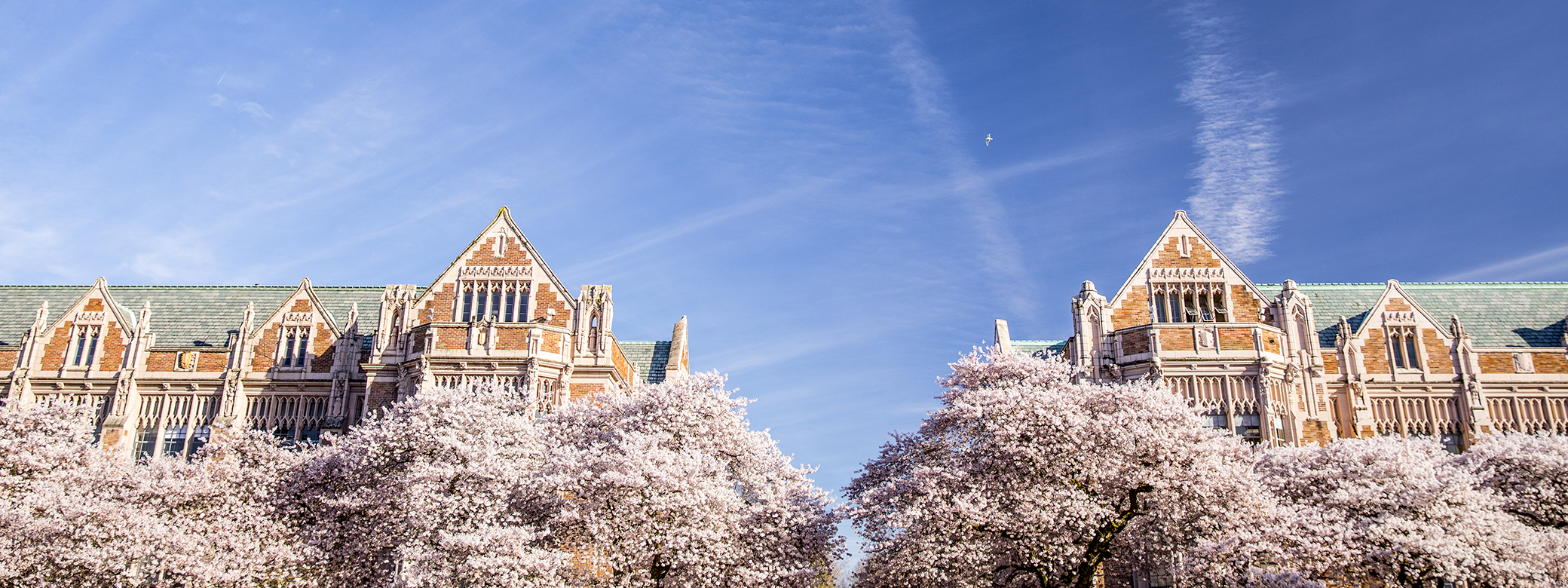
Two brick buildings in UW quad, with blooming cherry trees in front

A Conversation with Dean Maeda

Back to All Perspectives Stories
Cody Bowie 10/08/2026 October 2026 Perspectives
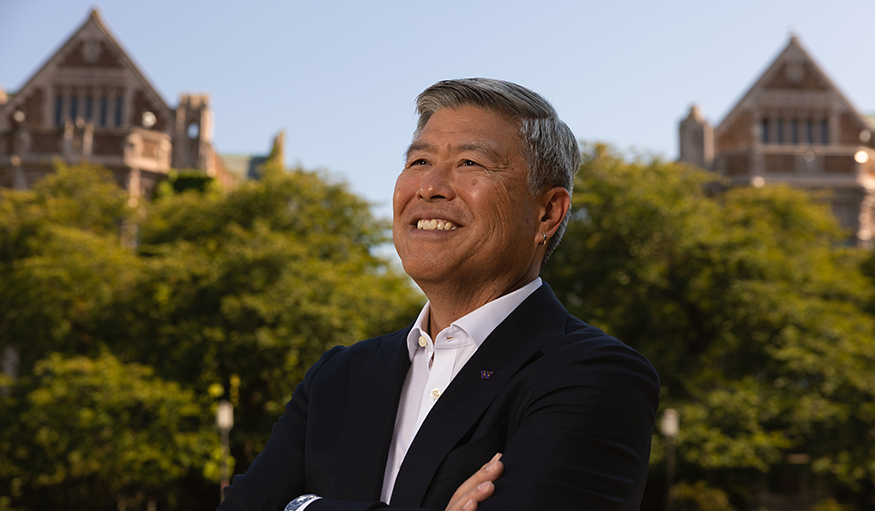
Dean Maeda poses smiling on the UW quad.
Daryl Joji Maeda, the Katherine and John Simpson Endowed Dean of the College of Arts & Sciences. Photo by Juan Rodriguez.

“I remember seeing the UW cherry blossoms on a rare, sunny spring day,” says Daryl Joji Maeda, the Katherine and John Simpson Endowed Dean of the College of Arts & Sciences. “That memory has stuck with me.” 

When Maeda arrived on campus this July, he was also returning. He spent the 2001-2002 academic year at the UW as an acting assistant professor in the UW Department of History and later worked at the Densho Project, a Seattle non-profit focused on the legacy of Japanese Americans incarcerated during World War II. He also spent time here researching his latest book, Like Water: A Cultural History of Bruce Lee. 

A professor of American Ethnic Studies, Maeda was previously dean of the College of Arts and Sciences at the University of Colorado Boulder. Under his leadership, CU Boulder’s College of Arts and Sciences established new records for first-year retention and six-year graduate rates and set a record for the highest annual fundraising in the college’s history. 

Cody Bowie, college communications specialist, chatted with Maeda to learn more about his vision for the College and the importance of a broad liberal arts education in the 21st century. 

You’ve been in academia for more than 20 years. Were you always interested in an academic career? 

I never thought that I was going to be an academic. I was in a software startup starting at age 16, and I really thought that tech was going to be my life. In college, I majored in math with an emphasis in computer science. But along the way I got really interested in questions of identity and power and race. I started to deeply explore Japanese American history and Asian American literature. After college I started a career as a software developer, but I continued to explore these topics on my own.  

My spouse and I decided that we were going to have an adventure.  She was working as a schoolteacher at the time, and I was still in software development. She quit her job, I started working remotely, and we moved to San Francisco to get master's degrees. That was the first time I had the opportunity to teach and I found out that I loved it. I was teaching Asian American immigration history to students whose families were themselves immigrants. Being able to talk to them and about how their families’ choices and experiences matter to our understanding of American history and culture was just so incredible to me. I decided then that I was going to teach college. 

In every step of my journey, I came to understand how important institutions of higher learning are and how it's incumbent upon us as professors, as leaders, to ensure that the academy is evolving so it can remain sustainable and relevant to the 21st century.  

What did you learn from your pivot from software development to academia? 

Being ready, willing, and able to follow new paths has been instrumental in my life. Even within the academy, I've had multiple career paths, from being a professor to an academic leader, from focusing on research to concentrating on student success. Every path that I've pursued has offered opportunities for personal growth, to learn new things, and to make a difference. Life is a journey, and the same is true of careers. Journeys don't always end up where you think they will, and in fact, can be most rewarding when they don't. 

Your first two books examined the social and cultural movement for justice by Asian Americans in the 1960s and 70s. Your most recent book explores the life and cultural history of Bruce Lee, a 1970s martial arts icon. What drew you to the 60s and 70s as a moment to explore?  

I got into the 60s and 70s because I was trying to answer this question of what it means to be Asian American. The idea of “Asian American” is an artificial concept. People in Asia don't think of themselves necessarily as Asian. They think of themselves as Chinese or Vietnamese or Filipino or Malaysian, right? They think of themselves as having national or ethnic identities. It's only in the United States that we have this idea, somehow, that people of various Asian ancestries should have something in common.  

This idea really started in 1968, and it took hold among people who were active in social movements for justice and peace of that time, like the Black Power movement or the anti-Vietnam War movement. I became very interested in this era as a time of change and possibility, an era of people imagining the world differently than it existed and taking action to create the change they wanted to see. And indeed, it's the case that arguably the most thorough critique  of racism, inequality, and U.S. imperialism emerged in the 1960s and 1970s.  

A photo of 'Bruce Lee Ascending' created by Han Edward So Eckelberg, American Ethnic Studies alumnus.
'Bruce Lee Ascending,' a mural created by American Ethnic Studies alumnus Han Edward So Eckelberg, is located in the Odegaard Undergraduate Library. Photo by Smugmug.

And Bruce Lee? 

I kind of fell into the Bruce Lee piece, which started because of his role as an Asian American hero to so many. I was interested in him as this singular figure. And of course, his rise to fame happened in the 60s and 70s. But what I found was that his rise to global prominence was really scaffolded by more than a century of travel and migration, of commerce, and of militarism in the Pacific that came to a head in the 60s and the 70s. This was the moment, probably for the first time in the history of the world, where it was actually possible for someone of Chinese ancestry to rise to global prominence. 

In addition to this research and your teaching, you’ve held many leadership roles in academia. What excites you about your new role in the UW College of Arts and Sciences?  

The College of Arts & Sciences at the University of Washington is a world-class institution. I think what I

admire the most about this college is its research prowess. There is so much depth of research strength and breadth of research endeavors. Arts & Sciences has expertise in all the areas that make up what we would call the liberal arts, and that's a rare thing.  

I also love the dedication that people have to the University of Washington. Huskies are very proud of their education, and the people of Seattle and Washington are rightfully proud of this university. 

Thinking about the liberal arts in the same terms that we thought of them 20, 30, or 40 years ago just isn’t going to work anymore. 

Daryl Joji Maeda Katherine and John Simpson Endowed Dean, College of Arts & Sciences

Speaking of the liberal arts, what challenges do you feel that higher education—and the liberal arts in particular—are facing in this current moment?  

Thinking about the liberal arts in the same terms that we thought of them 20, 30, or 40 years ago just isn’t going to work anymore.  

There is a perceived loss of faith by the public in higher education, a sense that we have lost our way. This has led to public disinvestment from higher education, and at times a loss of funding. That’s true in the state of Washington and nationwide as well. So, our mission needs to be working towards restoring that faith and strengthening it. One of the critiques of higher education has become that we're overly politicized and are not providing a balanced education to the students who come to us. And I think it's a fundamental challenge for us to overcome that perception.  

A liberal arts education is not aimed at teaching students what to think, but how to think. It is dedicated to ensuring that students are broadly educated, that they understand problems from a variety of angles, that they come to realize that there's more than one way of thinking. The best thinkers are people who can combine different ways of approaching the world, of asking questions, and of applying methodologies to answer questions. They are effective communicators who can connect with people who are like them and people who are not like them, craft thoughtful arguments, and discern fact from fiction. These are the qualities that a broad liberal arts education conveys.  

What would you say to those who don’t see a clear career path for liberal arts students? 

A liberal arts education is a phenomenal way to prepare for a rewarding career, both personally and financially. The data show that liberal arts majors may not earn as much as their friends who graduate from professional schools upon graduation, but by mid-career, their earnings equal or in many cases outstrip those friends. So, we know that majors in the liberal arts are rewarding. Our job is to convey that value to students and to ensure that they have all the opportunities they need to hit the ground running when they graduate. We also need to up the ante when it comes to providing experiential and real-world learning opportunities for our students, and that's one of the things I'm most excited to work on.  

What are your top priorities in your first year as dean? 

Dean Maeda speaks to students at the  wǝɫǝbʔaltxʷ – Intellectual House
Dean Maeda addresses College Edge students at the wǝɫǝbʔaltxʷ – Intellectual House.

My number one priority is to establish relationships of collaboration, partnership, and trust with the many stakeholders and community members within the College. I want to ensure that faculty, staff, and students are confident that I value their perspectives, that I want them to be part of charting the future for this College.  

I also want to continue the work that began last year that will ensure the long-term financial viability of the College. I am enormously grateful for the work that went into addressing the budget last year on the part of Dean Harris, the College Council, divisional deans, and faculty and staff, and I also know that our work is not done. We will continue to face challenges and be called upon to make decisions regarding the best use of the College’s resources going forward. How do we balance our need for strong research, graduate education, undergraduate education, and fair wages for staff and faculty? These are not decisions a dean should make alone. These are the kinds of decisions that the College as a whole needs to have input into.  

We also need to up our game on student success. We need to ensure that our students have abundant opportunities to connect with faculty, staff, and other students, build a sense of belonging and membership in the College, succeed in their classes, and have the opportunity to gain real-world learning experiences that are going to set them up for successful life after college.