Over the course of my 30+-year career in higher education, I have had the privilege of leading and participating in many initiatives— generating new programs, directing research centers, and designing large-scale partnerships and collaborations. Most were designed with clear goals, defined outcomes, and a strong sense of what success would look like.
The Dean’s Academy Futurists was not one of those efforts.
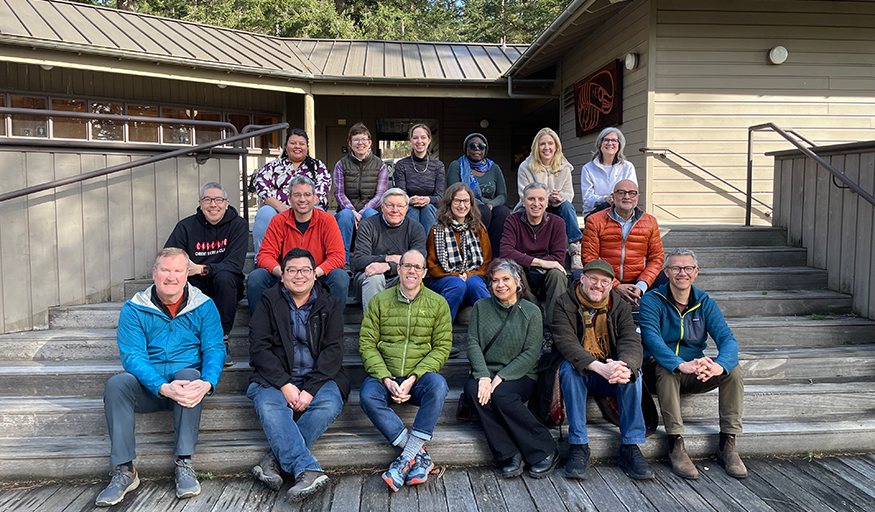
Launched in 2023 as one component of the Rethinking the Academy initiative I started in 2022, the Futurists began as the most open-ended experiment of my career. We (myself and my collaborators Greta Essig and Kevin Mihata) invited nominations for a small group of faculty from across disciplines in the College of Arts & Sciences to take on a complex, creatively demanding charge: to imagine the future of higher education and the liberal arts fifty years from now. We asked them to set aside, as much as possible, the immediate pressures of the present and instead consider what the university might become—and what it should become, what we needed it to become—over the long term of at least five decades hence.
What we discovered was both more challenging and more illuminating than I anticipated.
Over the course of this experiment in faculty-centered institutional imagination, I have written essays, posted to my Dean’s blog, to share snapshots of the Futurists’ work as it unfolded, highlighting particular ideas, experiments, and moments of insight along the way. Those reflections captured the evolving texture of the work in real time. What follows here is something different: an effort to step back and reflect more broadly on what we have learned. For those interested in the fuller arc of the Futurists’ thinking, I encourage you to explore those earlier writings on my blog. Here, I focus on the themes, lessons, and questions that have emerged most clearly over time.
The Difficulty of Imagining the Future
One of the earliest lessons of this work is that imagining a future that does not closely resemble the present can be extraordinarily difficult.
That this is so is not an indication of failure of intelligence, imagination, or creativity. Our faculty are among the most imaginative people I know. But their imaginative and creative capacities are, understandably, cultivated within the contexts of their disciplines—within the structures, methods, and questions that define their fields. Imagining future models for the university itself is something fundamentally different. Institutional imagination requires a different kind of thinking, one that is rarely asked of faculty in their professional lives.
Moreover, many of the faculty participants in this initiative came to recognize how little visibility they have into the broader workings of the university beyond their own departments. Without a shared understanding of how various layers of the institution function, it was even more difficult to imagine how it might change.
In this sense, the Futurists work quickly focused on understanding the limits of our present ways of thinking and our current institutional structures.
There were at least two distinctive aspects of this work that we recognized immediately: It moved at a
slower pace than would be expected for other kinds of institutional planning or design efforts, and not all the outcomes would be tangible. I describe below some of the tangible outcomes of this experiment, but those would not have been possible had we not also focused much of our work on mindset shifts. These included efforts to position ourselves as novices (none of us had expertise in futurist thinking and a novice-mindset aids learning and creative thinking); ensuring that everyone in the group had a shared understanding of the fundamental workings of the college and its relationship to the university; developing receptivity to process and outcome uncertainty, and to creative risk-taking; and–we hoped–to some greater levels of change receptivity. All of these are difficult to measure and are important, if less tangible outcome goals that were an essential aspect of the work, even if we only realized some of them along the way.
From Abstraction to Experimentation
As the work progressed, it became clear that speculation about distant futures–which is a key aspect of traditional Futurist endeavors—was not sufficient on its own and that it would not end up being the most productive goal for this group. Instead, we shifted our focus, from imagining fully realized future models to experimenting with smaller, more immediate interventions.
This shift emerged gradually as we wrestled with the difficulty of translating expansive ideas into meaningful action. Mid-way through the first year, we adopted Peter Sims’ “Little Bets” framework from his 2009 book of the same title because it provided a model for creative, rapidly iterated risk-taking that leads towards productive and unforeseen outcomes. Through small, low-risk experiments that allow for learning through doing, we could chart paths forward without waiting for fully formed solutions.
This way of working also reflects a different theory of change that is quite distinct from the ways large institutions generally conceptualize change—one that is slower, more distributed, and less linear than traditional models of institutional reform. Rather than attempting to redesign the university as a whole, which would not have been possible in any case, the group explored how change might emerge through a series of interconnected experiments, each one generating insight, momentum, and, at times, new questions.
Rather than attempting to redesign the university as a whole, which would not have been possible in any case, the group explored how change might emerge through a series of interconnected experiments, each one generating insight, momentum, and, at times, new questions.
For many in our group, the classroom and pedagogical experimentation became the most natural site for this Little Bets work. They began experimenting with new forms of teaching and learning, including the development of Curiosity Clinics—short-duration, joyful, experience-based learning environments–often also place-based– designed to foster a sense of wonder, curiosity, connection, and intellectual risk-taking. We wanted these experimental courses to be memorable, and transformational for the students who took them, to transcend disciplinary boundaries and to permit exploration of and with expertise. The Futurists designed Curiosity Clinics and experiments that are embedded in our College Edge program, where faculty are beginning to explore how emerging technologies, including AI, and an emphasis on place-based learning might shape undergraduate education in meaningful ways.
These efforts did not represent large-scale institutional change. They may not appear to be particularly futuristic. But they did represent something important: the cultivation of a practice—of little bets risk-taking, iterating, and experimenting—that may be essential to any meaningful transformation over time.
What We Learned
First, mindset matters. Many of the faculty Futurists described experiencing a shift in how they think about their work and the institution, noting a greater openness to experimentation, a deeper interest in cross-disciplinary thinking, and a stronger sense of their own capacity to engage with institutional questions. They also articulated a much greater receptivity to institutional change–becoming, as one of them put it, a community of practice with a change mindset. Moreover, the ability to be a novice again, to sit with uncertainty, to rapidly explore ideas that are not yet fully formed, to take small-bets risks, and to engage in iterative thinking–what I have called a sketch-paper ethos— are essential for creatively imagining change. Yet these capacities are not consistently cultivated—or rewarded—in academic environments. To engage in future-oriented thinking about the institution, faculty have to understand how the institution works. They have to shift from a mindset focused on one’s own areas of expertise and on the unit of the department to one that understands its place within the broader institutional context in an accurate and more robust way. We need to find more time and more opportunities to support the development of these mindset shifts.
Second, structure matters. Faculty operate within systems of incentives and expectations that shape what feels possible. Even when new ideas emerge, faculty are often acutely aware of how those ideas might be received within their departments, and the institutional barriers that might prevent, slow, or complicate implementation. In some cases, this awareness limits the extent to which they feel comfortable pursuing or sharing more unconventional approaches. We need to open up structures that permit not just the creative exploration of possibilities, but also the pathways that make enactment possible.
Third, community matters. One of the most powerful aspects of the Futurists experience has been the opportunity for sustained, cross-disciplinary conversation. The Futurists consistently noted how rare it is to have the time and space to think together in this way, and how valuable it is to learn how other parts of the university–and the university itself–function. We need to make spaces and time for such communities to form, and the apparatus to help them foster and grow.
Finally, pedagogy matters. While large-scale institutional transformation is difficult to achieve directly and at the level of the individual or small group, the classroom offers a space where innovation is both possible and deeply meaningful. And the classroom is, after all, our primary space, our raison d’etre in the university. Through teaching, faculty can experiment, reflect, and engage students in new ways of thinking about knowledge and learning. But they need to be given the freedom to take risks, to fail, to try again, and to do so in ways that are neither prohibitively burdensome, nor administratively blocked. Incentives are helpful; Encouragement and support are required. As one of our Futurists, Anis Barwashi said, Little Bets experiments help us incrementally move towards a future that we are designing.
A Tension Worth Noting
Perhaps the most striking outcome of this work is a tension that remains unresolved.
As I noted above, the group has articulated a change-receptive mindset that they feel this work helped them cultivate, along with a range of skills they can apply to institutional problem-solving. However, they are also hesitant to bring their acquired skills and learned practices into the broader university community.
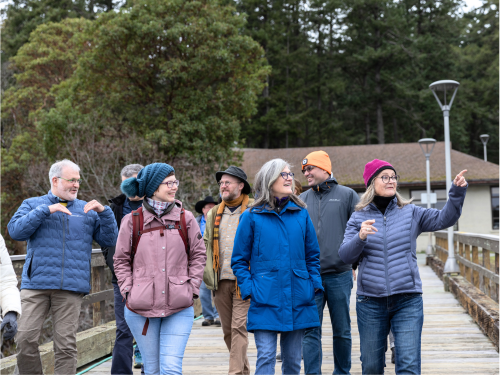
Their hesitation reflects a broader and unresolved reality of academic life. It is, in some respects, a political tension, one made more acute in this instance because the group was led by me, the dean, leading to some (relatively few) misunderstandings about the group’s purpose. Universities are complex organizations, shaped by longstanding norms, incentive structures, and cultures of evaluation. These structures provide stability and continuity, but they can also make it difficult to introduce new ways of thinking or working, particularly when those approaches challenge established practices. Moreover, the structures of authority within the university can make it difficult for faculty to introduce new practices.
The Futurists did not resolve this tension. But they made it visible, and in doing so, provided an important insight into the conditions under which change does—or does not—take hold, and how they can–or cannot–use their newly acquired skills to lead the institution forward in spheres of influence beyond the classroom.
Looking Ahead
I began this experiment in faculty-centered institutional imagination without knowing exactly what the outcomes would be. In that respect, it has been a truly unusual and highly energizing experiment. I have a high tolerance for ambiguity in problem-solving and in research, likely as a result of my training as a designer before becoming a historian. That served me well in this instance, and I think it largely served the faculty participants as well, even as it also created periods of vexation for some.
What has become clear to me, is that this kind of work is essential. It is the work of stepping back from the immediate demands of the present to better understand how we think, how we change, and what enables us to imagine the new possibilities we need if higher education is to survive the decades to come. The Futurists did not produce a single, unified vision of the future. Instead, they surfaced something more fundamental: the conditions that support—or constrain—meaningful faculty-led innovation in the academy.
At a moment when higher education faces significant challenges—financial, political, and cultural—it is tempting to focus only on immediate solutions. These are, of course, necessary. But it is equally important to create space for a different kind of work that allows us to step back, to question the fundamental assumptions that guide our work, and to imagine what might be possible; To understand that the structures we have need not be the structures of the future, and to generate new possibilities even if they are incremental little bets.
As this phase of the work comes to a close, the experiment itself does not end. Elements of what we have been exploring will continue through the College’s Center for 21st Century Liberal Learning (C21) and through College Edge, where faculty are actively experimenting with new approaches to teaching, learning, and the integration of AI in undergraduate education. These efforts are, in many ways, a natural continuation of the Futurists’ work—grounded in practice, oriented toward students, and open to iteration.
In the months ahead, there will be opportunities for faculty to engage with this work through College Edge and related initiatives. I hope you will consider participating or learning more about this ongoing work.
The future of higher education will likely not be determined by a single initiative or idea. It will not emerge from traditional strategic planning efforts or the known theories of organizational change. Finding and moving towards the future we want and need will require courage, curiosity, creative risk-taking, imagination, and vision. We will need to get better at generating ideas, taking little bet risks and rapidly iterating until we find meaningful solutions. We will have to become a community of practice with a change mindset, working as novices with a shared commitment to understanding how the university works and moving it forward together for the good of our students and society. This sounds idealistic. This experiment showed me that it need not be, and that creating those conditions may be one of the most important things we can now do.
Note: I gratefully acknowledge my creative, imaginative and brilliant collaborators in leading this initiative, Greta Essig and Kevin Mihata. My sincere thanks goes to the 19 faculty members who gave their time, intellectual prowess, energy, creativity, and good faith to this effort: Angelica Amezcua, Anis Bawarshi, Berry Brosi, Tony Gill, Michelle Habell-Pallan, Stephanie Kerschbaum, Adrian KC Lee, Whitney Lynn, Nicole McNichols, Miguel Morales, David Perkel, Vikram Prakash, Abel Rodriguez, Adair Rounthwaite, Ian Schnee, Christina Sunardi, Chris Teuton, Josephine Walwema, and Ellwood Wiggins. I also wish to thank the Mellon Foundation and the University of Washington’s Population Health Initiative for providing the resources that made this effort possible.