
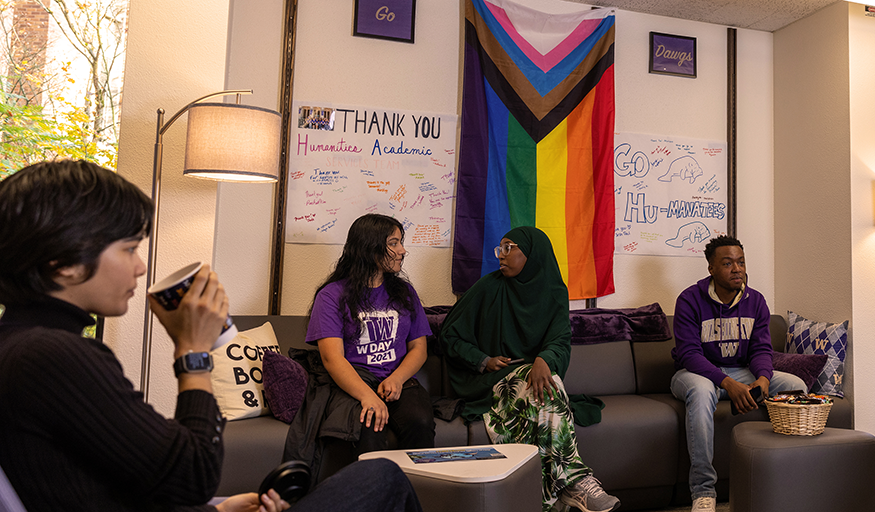
The Arts & Sciences news team recently sat down with Brian Reed, Divisional Dean of Humanities and Professor of English, to learn how the Humanities Academic Services Center supports students, faculty and staff in the Humanities Division.
What is the Humanities Academic Services Center (HAS)?
The Humanities Academic Services Center (HAS) is a crucial part of the student experience for humanities-inclined undergraduates. Since 2020, it has served as a hub for undergraduate student and faculty services within the Humanities Division of the College. From student advising and support resources to course management and curriculum coordination, HAS works to advance the humanities experience and ensure student success. HAS also provides proficiency and placement testing for our fifty plus language programs
Early on during my tenure serving as divisional dean, we conducted studies to find out from our students what they thought about the humanities. We discovered that admitted students and pre-majors had no sense of what the word “humanities” meant. HAS emerged out of an effort to think about the pipeline experience of students coming to a large public university and not necessarily having things well signposted for them. We wanted to give students a clearer sense of what the humanities can be and help them find pathways to success in the areas that most interested them.
What distinguishes HAS from other advising models?
HAS provides a single point of contact for students interested in the humanities, with staff who are able to talk with them about all the phases of their time here, from being a prospective student, to an admitted student, to a pre-major, to a major, to their life as alumni. Our advisors are familiar with all the opportunities that are out there for our students, such as study abroad programs and internships, major and minor options, and courses they may find interesting, allowing them to effectively guide students toward success.
The Humanities Academic Services Center emerged out of an effort to think about the pipeline experience of students coming to a large public university...we wanted to give students a clearer sense of what the humanities can be and help them find pathways to success.
How do students make appointments with HAS? What can they talk to advisors about?
HAS offers a range of different opportunities for students to engage: drop-in appointments, online appointments, and scheduled appointments. Students can schedule urgent appointments to speak with an advisor immediately or schedule a meeting far in advance. They know where to find their advisors online and in the physical space. They know exactly how to reach them. This has proved to be aligned with student interest in what advisors can supply. HAS surveys indicate that 95% of students say they are happy with their appointments, which is extraordinary.
In the Winter 2026 quarter, students made appointments to discuss a range of topics with HAS advisors: from degree planning, to declaring a major, to planning their study abroad.
How does HAS benefit staff members in the Division?
What we've seen in our decentralized University is that the work of an advisor varies tremendously, and that there has been a lot of job-duty creep. Advisors may not have backup, so if they're sick, go on leave, or take vacation, it can be hard to find a replacement.
In HAS, there are always multiple people who have been cross-trained in all elements of the work. Each department also has an assigned liaison who represents them. These liaisons work directly with the departments they serve, meeting regularly with department stakeholders.
HAS has a lot of good onboarding materials that help new employees quickly get up to speed. These onboarding materials include the specifics of how to sign students up for a major, how to conduct an advising meeting, but also more granular details and duties of the role. Now, instead of one person serving as historical memory for a department, we have a team amassing a range of information about the division that new employees can access. This allows for professional development because people can spend time learning about different aspects of the world of advising. It enables our employees to grow in their positions over time. A number of HAS employees have moved on to other positions at the University and beyond that have permitted professional growth—that's something we should want for all our staff at the UW. So HAS gives something that our staff have asked for, which is greater knowledge about and opportunities for professional advancement.
Please visit the Humanities Academic Services Center website to learn more about HAS.
Staff at HAS have been collecting data on student visits since 2022. Their data archive includes historical departmental census reports and an engagement dashboard that is updated quarterly. This data illustrates the demand students had for HAS services, what days of the week and appointment modalities were most attractive to students, and other trends.