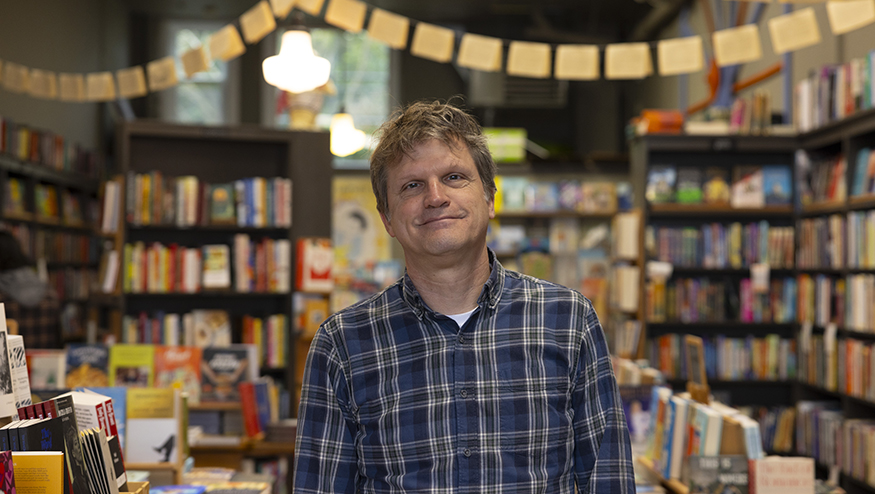
When Tom Nissley earned his PhD in English from the University of Washington, he could not have predicted that his academic studies would help him win Jeopardy!, the televised game show. Or that his earnings from Jeopardy! would enable him to buy a bookstore. But today, thanks to the show, Nissley owns Phinney Books in Seattle’s Phinney Ridge neighborhood.
Nissley (PhD, 1999) always loved books, even as an adolescent obsessed with baseball. His early reading was “99% about sports,” but by high school he broadened his reading choices. In college, he majored in economics -- “the closest thing to baseball statistics” -- but added a second major in English. After graduating, he worked as an editor for technical journals while trying to write fiction. Then came the decision to pursue a PhD in literature at the UW.
“I wasn’t sure I wanted to become a professor, but I knew I wanted to learn what it takes to be an expert in something, and literature is the thing I’m most passionate about,” Nissley says.
At the UW, Nissley’s focus was American literature from the post-Civil War to World War I. Though he loved the deep dive into literature, he decided a career in academia was not for him, so after earning his PhD he did the most Seattle thing imaginable: He worked at Microsoft and Amazon.
Answer: Philip Roth, Lorrie Moore, and Jimmy Carter.
Question: Who are authors Tom Nissley interviewed as an Amazon editor?
For two years, Nissley worked on Encarta, Microsoft’s now defunct multi-media encyclopedia. He also wrote book reviews for The Stranger, which helped him then land a job at Amazon interviewing authors and writing book reviews for the company’s Canadian website.
“My job title was book editor, which became more confusing once Amazon started publishing books,” Nissley says. “When I got there, Amazon was an editorially driven place. They had 30 book editors. Amazon was reviewing, either with freelancers or the editors themselves, pretty much every book that came out, though that didn’t last.”
The job was a great fit for such an avid reader, but over time the pace became stressful. “I was pretty burned out after ten years,” Nissley says. “And then I went on a game show.”
Nissley has always had a talent for trivia games. Playing Trivial Pursuit as a teenager, “I just destroyed all my friends,” he says. “I was really good at it.” Though he was not a dedicated Jeopardy! viewer, he’d watched the show often enough that he thought he’d do well as a contestant, so he applied.
Answer: Twentieth-century literature as a Final Jeopardy category.
Question: What was a lucky break for Tom Nissley on Jeopardy?
Competing on Jeopardy! in 2010, Nissley racked up an eight-game winning streak that earned him the third highest total winnings in the show’s history at that time.
“It happened very fast because they shoot five shows in a day,” he says. “By the end of the first day I had made $100,000, and I knew I was going to quit my job. I knew my life had changed in those eight hours.”
Nissley was usually in the lead going into the Final Jeopardy round, but in one episode he lagged behind another player. He had to ace Final Jeopardy to win. Then the category popped up: twentieth-century literature. Hello, literature PhD! (Although, Nissley notes, the answer was Somerset Maugham, whose work he’s never read.)
Nissley won that game and more after that. The following year, he made it to the finals of the show’s Tournament of Champions. Years later, people are still excited to discover that he’s a Jeopardy! champion.
“Telling people you won on Jeopardy! beats winning the Pulitzer Prize,” Nissley laughs. “People understand it. Everybody knows the show.”
Thanks to his Jeopardy winnings, Nissley left his job at Amazon and began work on “A Reader’s Book of Days,” a literary almanac that features stories from writer’s lives and events in fiction connected to each day of the year. He conducted most of his research for the book at the UW’s Suzzallo Library.
After the book was published by W. W. Norton & Company in 2013, Nissley once again had to decide what to do next. That’s when serendipity struck.
Answer: No one talked him out of it.
Question: Why did Tom Nissley buy a bookstore?
After spending an evening with two friends who are independent bookstore owners, he told his wife, “I think I would really like everything about owning a bookstore.” The next day, a friend in real estate mentioned that the owner of a bookstore in Nissley’s neighborhood was retiring and wanted to sell the store.
“It felt like the universe was talking to me,’” Nissley recalls.
As a lifelong book lover, Nissley had spent endless hours in Seattle bookstores and frequented bookstores wherever he traveled. But he knew that the business of selling books could be challenging, so he hadn’t previously aspired to own a bookstore. Even now the prospect seemed risky, so he ran the idea by his bookseller friends.
“I was waiting for somebody to talk me out of it,” he says. “Instead they said, ‘Actually, you’d be really good at it.’”
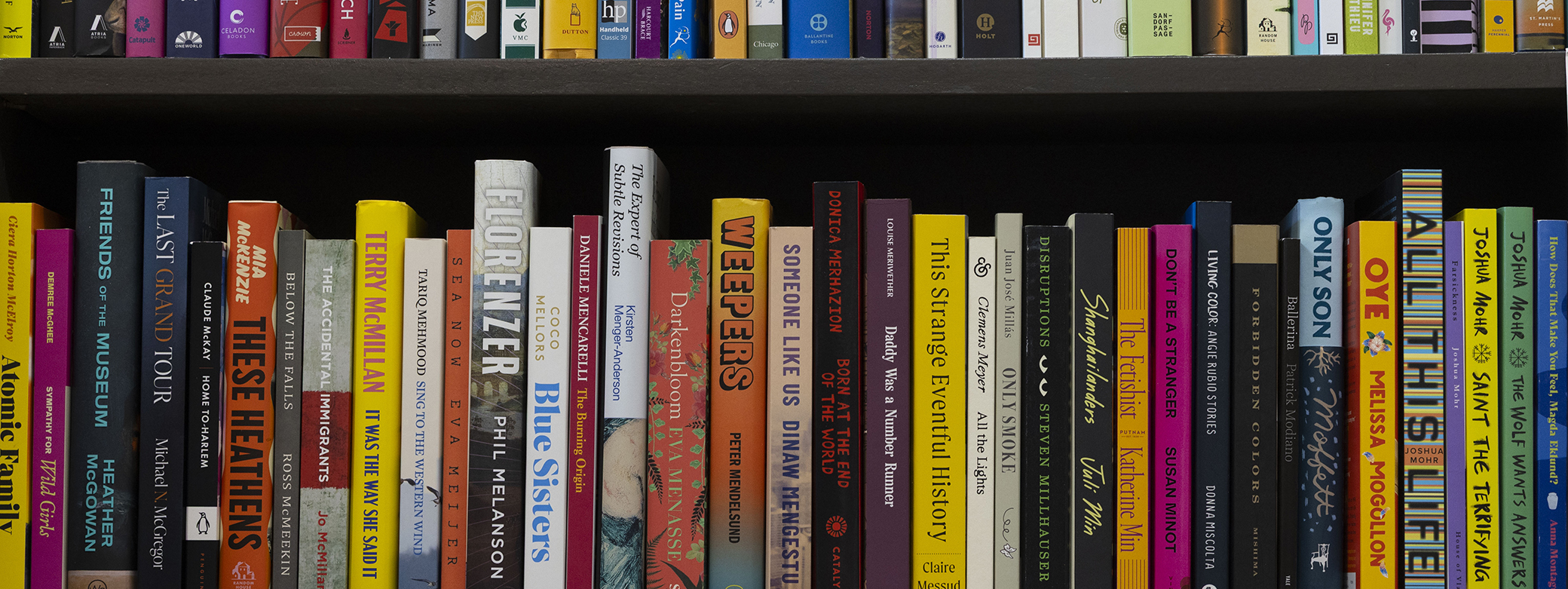
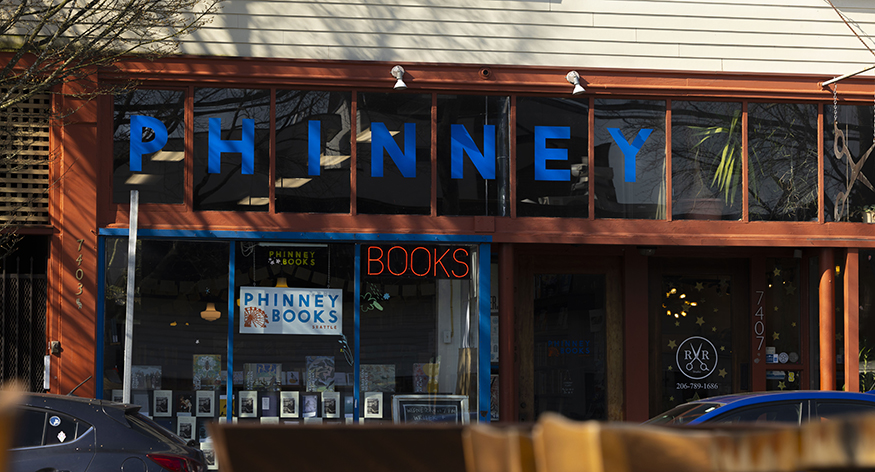
Nissley opened Phinney Books (previously Santoro’s Books) in 2014. He describes it as a general bookstore for the neighborhoods of Phinney Ridge and Greenwood, but that doesn’t fully capture the magic that happens there. Being a neighborhood store, Nissley and his staff know their customers and their specific literary interests, to the point that they often order books from publishers with specific customers in mind.
“I love that interaction with customers,” Nissley says. “I’ve been in the neighborhood since the late 90s, but before I didn’t know anybody except through my kids’ school. Now I cannot walk down the street without a hello from someone I know. Books have been a way of connecting to people.”
Nissley adds that most independent booksellers are thriving right now, which might surprise people given the pummeling they suffered when large bookstore chains, and then online retailers, entered the market. He hopes neighborhood bookstores will always play an important role in the book ecosystem.
“When the Kindle was introduced, everybody at Amazon thought there would be no physical books in five years,” Nissley says. “But people kept deciding that they not only like physical books, but they also like neighborhood bookstores. They realized they love these places. So, fortunately for independent bookstores like mine, people continue to come in and buy our books.”
More Stories
Finding Love at the UW
They met and fell in love as UW students. Here, 10 alumni couples share how they met, their favorite spots on campus, and what the UW still means to them.
AI in the Classroom? For Faculty, It's Complicated
Three College of Arts & Sciences professors discuss the impact of AI on their teaching and on student learning. The consensus? It’s complicated.
A Love of Classics and Ballroom
Michael Seguin studied Classics at the UW and now owns Baltimore's Mobtown Ballroom. The two interests, he says, are more connected than they might seem.