
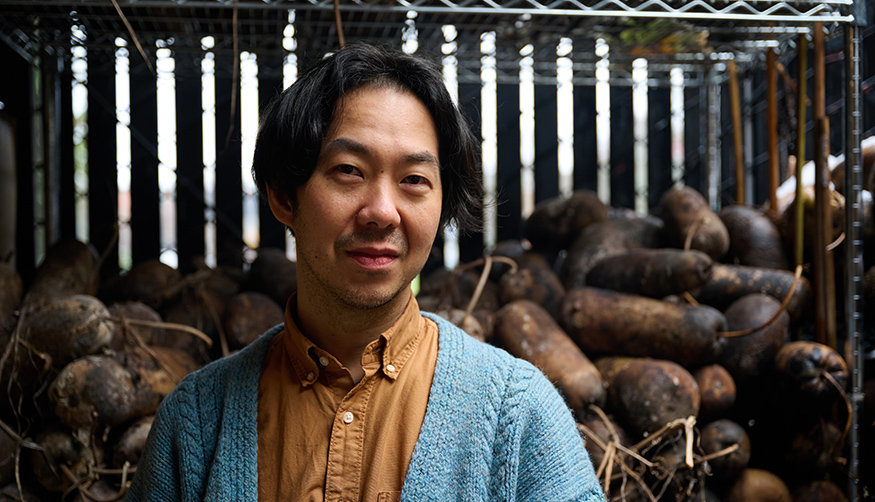
Yankowitz Selected as Moore Foundation Experimental Physics Investigator
Matthew Yankowitz, associate professor of physics and of materials science and engineering at the University of Washington, is among 21 scientists selected for the 2026 cohort of Experimental Physics Investigators, a distinguished group of mid-career researchers pushing the boundaries of experimental physics.

The Experimental Physics Investigators Initiative was established by the Gordon and Betty Moore Foundation to support creative individuals who have recently received tenure (or its equivalent) and to cultivate collaborative research environments. Investigators are encouraged to tackle interesting new research problems, pivot when necessary, and bring on students and postdoctoral researchers to accelerate their progress. Each Experimental Physics Investigator receives $1.35 million over five years.
In his UW research, Yankowitz studies what happens when sheets of atomically thin materials, such as graphene, are stacked in precise arrangements. He explains that, under the right conditions, the electrons in these materials stop behaving independently and instead act collectively, producing exotic forms of superconductivity, magnetism, and topological states within the same material.
The Yankowitz Lab builds devices in which these quantum states can be switched on and off with applied voltages, allowing a superconductor to sit directly beside a magnet or correlated insulator within a single device, with the boundary between them defined electrically. By studying what happens when these distinct quantum states meet, the lab aims to discover new forms of collective behavior and, ultimately, to develop electronics in which quantum states are programmed by voltage rather than fixed during fabrication.
As a member of the fifth cohort of Experimental Physics Investigators, Yankowitz will have opportunities to connect with other scientists from the current and past cohorts. To help investigators learn from one another, the Initiative brings cohorts together each year in an informal setting built around trading ideas and imagining new experiments, rather than the usual conference format. The Initiative also asks investigators to lead well-mentored, high-performing research groups that develop the next generation of scientific talent and supports professional development for Investigators toward that goal.
“It is a tremendous honor to be part of this program,” says Yankowitz. “The support gives us unusual freedom to take scientific risks, pursue unexpected results, and follow our curiosity wherever it leads. I am equally excited to join such an impressive community of mid-career scientists. I expect that the ideas and interactions that emerge from this group over the coming years will push our research in new directions we cannot yet anticipate.”
Rocha Beardall Receives William T. Grant Scholars Award
Theresa Rocha Beardall, associate professor of sociology, was named a William T. Grant Scholar, one of seven researchers nationwide selected for the program this year. The award supports promising early-career researchers as they expand their expertise into new disciplines, methods, or content areas. Each William T. Grant Scholar receives $425,000 over five years.

Rocha Beardall’s research bridges the areas of race, law, inequality, policing, family policing, indigeneity, and tribal sovereignty. Her scholarship is motivated by a commitment to better understand how law, legal institutions, and legal actors marginalize select racial groups, with the goal of helping to reduce and reverse these systemic inequalities.
With the Grant Scholars award, Rocha Beardall will reconstruct the histories of Native children affected by federal Indian boarding schools in Washington State by locating, digitizing, and linking records scattered across archives, with UW student researchers helping retrieve and catalog those materials. She will work under the direction of the Puyallup Tribal Historic Preservation Department, supporting tribally governed research and curriculum development while developing new expertise in Indigenous data sovereignty and supervised machine learning.
“This award comes at an especially meaningful moment in my career because it lets me extend a question that has shaped my research for years in entirely new methodological directions,” says Rocha Beardall. “Across my work, I have examined how Native nations exercise political authority within institutions that may recognize Native people while still constraining tribal authority, including through the systems that determine what information is collected, how it is classified, and how it shapes decisions. What excites me most is the question of what becomes actionable when Native nations govern the production and use of knowledge concerning their own citizens, histories, and governing institutions.”
Recognizing that early-career researchers are rarely given incentives or support to take measured risks in their work, this award includes a mentoring component as well as a supportive academic community. The William T. Grant Foundation holds an annual retreat during the summer to support Scholars’ career development, where they discuss works-in-progress and receive constructive feedback on the challenges they face in conducting their projects. Scholars are also invited to attend other Foundation-sponsored workshops on topics relevant to their work.
“The Scholars program gives me the rare opportunity to become a student again and develop new methods while expanding what I can bring to research governed by the Tribe, from the questions we ask to how it is used,” says Rocha Beardall.
Barnard Receives NSF CAREER Award
Arthur Barnard, UW assistant professor of physics and of materials science and engineering, received a 2026 National Science Foundation CAREER Award of more than $600,000 from the NSF Division of Materials Research. The CAREER Award is the agency’s most prestigious honor for early-career faculty, recognizing those with the potential to become academic leaders in both research and education.

With the award, Barnard and his team will study how interactions between electrons give rise to unusual forms of electronic order in two-dimensional quantum materials, including superconducting states and electronic crystals. The researchers will use a new measurement technique developed in Barnard’s Classical and Quantum Nano-Systems Lab that allows them to deliberately change how electrons interact while simultaneously measuring how the material responds. Understanding how these interactions produce behaviors such as superconductivity could help researchers learn how to more precisely control the electronic properties of materials, foundational knowledge for the development of future electronic and quantum technologies.
Barnard’s lab has spent the past several years developing what he described as a “one-of-a-kind tool” to help researchers better understand how superconductivity and other phenomena emerge in atomically thin materials. “Now, with NSF CAREER funding, we are beginning to put this tool to work and looking forward to what we will discover,” he says.
The project will also provide research training opportunities for undergraduate and graduate students and support the development of open-source hardware and STEM modules that offer hands-on experience with van der Waals material assembly and electronic measurements.
More Stories
A Breakthrough Prize, Husky 100, and Other Awards
Recent awards celebrate Arts & Sciences faculty, staff, and students for their research, leadership, and more.
2026 Awards of Excellence
Arts & Science faculty, students, and alumni were among the recipients of 2026 UW Awards of Excellence for their teaching, volunteerism, and innovation.
2026 Dean's Medalists, Exploring Big Questions
Meet the four new graduates honored as College of Arts & Sciences Dean's Medalists for 2026.