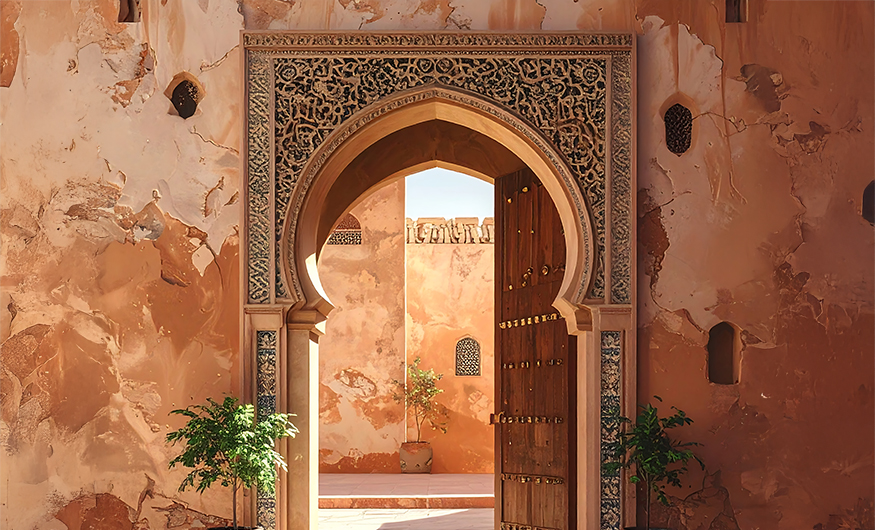
The Middle East is the birth place of major languages, religions, and philosophical movements. It is a region of layered histories and diverse cultures. The Department of Middle Eastern Languages and Cultures (MELC) is devoted to the study of the languages and cultures of the Middle East, Central Eurasia, North Africa, and the Horn of Africa. MELC explores the contemporary cultural diversity of the region, its ancient and medieval roots, and its relevance to modern societies.
VISIT DEPARTMENT WEBSITE1
Rhodes Scholar
EDUCATION
Established in 1969 by Professor Farhat Ziadeh, the Department of Middle Eastern Languages and Cultures offers BA and MA degree programs that investigate major literary and cultural traditions of the Near and Middle East, Central Eurasia, North Africa, and the Horn of Africa. The Department provides excellent training in languages and cultivates an appreciation and understanding of various communities in the region. Undergraduates can select from degree options concentrating in Comparative Cultures; Hebrew Bible and Ancient Near Eastern Studies; and Languages and Literatures. A MELC minor is available and language minors are available in Arabic, Modern Hebrew, Persian, Turkic, and Turkish. A Masters of Arts in Middle Eastern Languages and Cultures is offered for post-baccalaureate students. Near and Middle East Studies offers a PhD program, focused on the modern Middle East.
The modern languages we regularly teach include Arabic, Persian, Amharic, Tajik, Turkish (Modern and Ottoman), Central Eurasian Turkic languages (Uzbek, Kazak, Kyrgyz, and Uygur), modern Hebrew, Ladino, and Aramaic. A rich and vast heritage of the ancient Near Eastern is explored through the study of languages and literatures including Biblical Hebrew, Egyptian (Hieroglyphic and Coptic), Akkadian, Hurrian, Ugaritic, Phoenician, Syriac and Ge’ez (Classical Ethiopic).
MELC serves a broad spectrum of undergraduates, including those with plans to acquire specific linguistic and cultural proficiencies and those simply interested in the histories and cultures of the regions covered by the department. Graduates of this degree program have pursued further study in the humanities or social sciences, professional degree programs in law or medicine, employment with governmental or non-governmental organizations, and other careers.
The department participates actively in exchange programs, sending UW students for language and cultural study and research to a variety of locations—from North Africa and the Horn of Africa to the Middle East, and across Central Eurasia—and training many students from institutions overseas.
Students
Autumn 2023
- 12 Undergraduate majors
- 10 Undergraduate minors
- 3 Master of Arts students
Degrees Awarded
Sept 2022- Aug 2023
- 3 Bachelor of Arts degrees
- 14 Minor degrees
- 2 Master of Arts degrees
Major Student Awards
Since 2015
- UW President’s Medalist
- UW Medalist for High Scholarship
- UW Arts & Sciences Dean's Medalist
- Irene Dickson McFarlane Tuition Scholarship
- Schwartz Fellows for Study Abroad
- Roshan Institute Fellows for Excellence in Persian Studies
- Naficy Scholars in Persian Studies
- Turkish and Ottoman Literature Endowed Fellows
- Hooshang Afrassiabi Essay Award
- Foreign Language and Area Studies Fellows
- Easa Bateh Fellows
OUTREACH
MELC greatly values our close relation with the greater community of students, alumni, faculty and the greater Seattle community. MELC faculty participate in the annual World Languages Day at the UW, an event that introduces high school students to language study at the University. We have a quarterly Meet and Greet, jointly with the Middle East Center, to allow students and faculty to better get to know each other outside of the classroom.
Annual events include the Farhat J. Ziadeh Distinguished Lectureship in Arab and Islamic Studies, the Hooshang Afrassiabi Distinguished Lectureship in Persian and Iranian Studies, and the Walter G. Andrews Memorial Lecture Series. Additional lectures and cultural presentations are supported by the Turkish Studies Endowment, the Hebrew Bible and Ancient Near East Fund, the Ravani Endowment, and the Friends of Persian Studies Fund.
MELC values its close communication with the Middle East Student Commission, the Persian Circle, Arabic Club, Amharic Club, and other student interest groups through programs and cultural activities that are presented throughout the year. Within the Seattle community, we are proud of our continued work with multiple film festivals in the Seattle area, including the Seattle International Film Festival, the Turkish Film Festival, the Iranian Film Festival, and the Jewish Film Festival.
FACULTY
Autumn 2025
- 3 Professors
- 1 Teaching Professor
- 4 Associate Professors
- 2 Associate Teaching Professors
- 1 Assistant Professor
- 4 Assistant Teaching Professors
- 12 Adjunct Faculty
- 3 Affiliate Faculty
- 3 Emeritus Faculty
Faculty awards and leadership roles, past and present, include:
- Undergraduate Research Mentor Award
- Katz Fellow in Advanced Judaic Studies
- Royalty Research Fund Scholar Award
- Honorary Ph.D. in Letters from the University of Wisconsin, Milwaukee
- National Jewish Book Award
- Advisory Board Member, Peyvand NPO
- Chair, SIFF-Iranian Film Initiative
- Advisory Board Member, IACA-Iranian-American Community Alliance
- Associate Editor, Review of Middle East Studies
- Editorial Board Member, Modern Language Quarterly
- Editorial Board Member, Prooftexts
- Deputy Editor, Iranian Studies
- Co-organizer, The Pacific Northwest Adab Society
- Fulbright Scholars
- National Endowment for the Humanities grants
- Fellows, American Research Center in Egypt
- Senior Fellow, American Center for Oriental Research
- Presidents, Middle East Studies Association
- President, Society for Iranian Studies
- President, Middle East Medievalists
- President, Pacific NW American Research Center in Egypt
- President, Pacific NW American Academy of Religion/Society of Biblical Literature
- Director, American Research Center in Egypt
- Director, Center for Arabic Study Abroad
- Samuel and Althea Stroum Chair
- Mentor Award, Middle East Studies Association
- Service Award, Middle East Studies Association
- Foreign Language and Area Studies (FLAS) Fellowships
- Visiting Fellowship at Oxford University, All Souls College
- Fellow, UW Simpson Center Society of Fellows
SCHOLARSHIP
MELC faculty are engaged in a wide variety of individual research endeavors with emphases including post-colonial theory, intercultural exchange, literature as performance, archeology and culture of archaeology, gender theory, political literature and politics of literature, literary dynamics in exilic or diaspora communities, children’s literatures, linguistics, legal theory, and comparative religion. Departmental research on Jewish, Christian, and Islamic literatures and cultures is characterized by the study of these not as isolated entities, but rather as integral to wider Near and Middle Eastern cultural developments.
Faculty in MELC have been leaders in numerous national and international team research projects including:
- The Ottoman Text Archive Project, an international effort to make a vast collection of documents crucial to understanding the history and cultural heritage of the Ottoman Empire accessible in a central web-based text archive; for which a pilot project, The Baki Divan Project: Digital Approaches to Ottoman, was awarded $40,000 from the Royalty Research Fund (RRF) to archive and analyze the Divan (Collected Works) of the Ottoman poet Mahmud Abdulbaki, or Baki (1520-1600).
- The Newbook Project that establishes a digital archive and a publishing platform for manuscripts related to the Near and Middle East Studies.
- Turkey in Seattle: Oral History Project, a project to archive the immigration stories of people who came to the Pacific Northwest from Turkey.
- Federally-funded grants for innovative Arabic distance learning programs.
- National grant initiatives to develop more effective and advanced pedagogies for proficiency in Arabic and Persian.
- Organizing and hosting international conferences including Writing the Iranian Revolution: Memory, Testimony, Time (2017); The Many Poems of Baki (2017) ; Symposium on China’s Turkic Muslims (2019); and Workshop on Contemporary China’s Turkic Frontier Zone (2021).
Areas of Scholarship
- Linguistics and Middle Eastern Studies
- History of the Middle East
- Modern Hebrew, Arabic, Ladino, Persian, Ottoman, Amharic, Turkish and Turkic Languages, Literatures and Cultures
- Ancient Near Eastern Languages and Cultures
- Hebrew Bible
- Islamic Institutions, Philosophy, Religion, History
- Comparative Religion
- Middle Eastern Archaeology
Scholarships & Fellowships
- Hooshang Afrassiabi Student Prize in Persian Studies
- Naficy Family Fellowship in Persian Studies
- Friends of Persian Studies Student Fellowship
- Roshan Cultural Heritage Institute Fellowship
- Graduate Fellowship in Persian Studies
- Maurice and Lois Schwartz Fellowship for Study Abroad
- Michael A. Williams Scholarship for Excellence in Near Eastern Studies
- Turkish and Ottoman Literary Fellowship Award
CONTACT
Department of Middle Eastern Languages & Cultures
Box 353120
University of Washington
Seattle, WA 98195
(206) 543-6033
melc.washington.edu
last update: December 2025