
Discovering Soil Science
Cox marvels at how his career has unfolded. Growing up in Murray, Utah, a suburb of Salt Lake City, he had little knowledge of or interest in the agriculture industry. He majored in chemistry and German at the University of Utah before coming to the Department of Chemistry in the UW College of Arts & Sciences for graduate studies in analytical chemistry, a field that “comes down to how you measure things and involves developing tools to better measure things.” Next came a postdoc in mass spectrometry — “a totally different field but still measuring things” — at Pacific Northwest National Laboratory.

After his postdoc, Cox wanted to work in private industry but wasn’t sure where. The answer came through his wife, Elisha (Allred) Cox, whom he met at the UW. Elisha (BA, Mathematics, Spanish, 2010) came from a farming family in Eastern Washington, which introduced Jonathan to the agriculture industry.
“I discovered that there’s this whole branch of soil science and industry of commercial testing labs measuring nutrients in soils to help with agriculture,” Cox says. Soil testing has huge implications for an agricultural operation’s bottom line, since amending the soil with the wrong nutrients, or with the correct nutrients in the wrong quantity, can lead to unnecessary fertilizer expense and a less successful harvest.
Cox joined a soil testing lab in Eastern Washington, and then bought a different lab, Kuo Testing Labs, when the owner was looking to sell. In five years, he grew the lab from 13 to almost 30 full-time employees. But in 2020, he was ready for a change. “Owning a business, you’re tied down to it, and I had other things I wanted to do,” he says.
Cox sold the lab and joined Double Diamond Fruit, a company in the tree fruit industry, while also helping to create The Soil Center, which turns agricultural waste from orchards, dairies, and other operations into organic soil amendments. When asked to be CEO of The Soil Center, he accepted with the caveat that he would serve in that role for just one year, so he could explore other opportunities that might arise.
Then the Kyrgyzstan project came along.
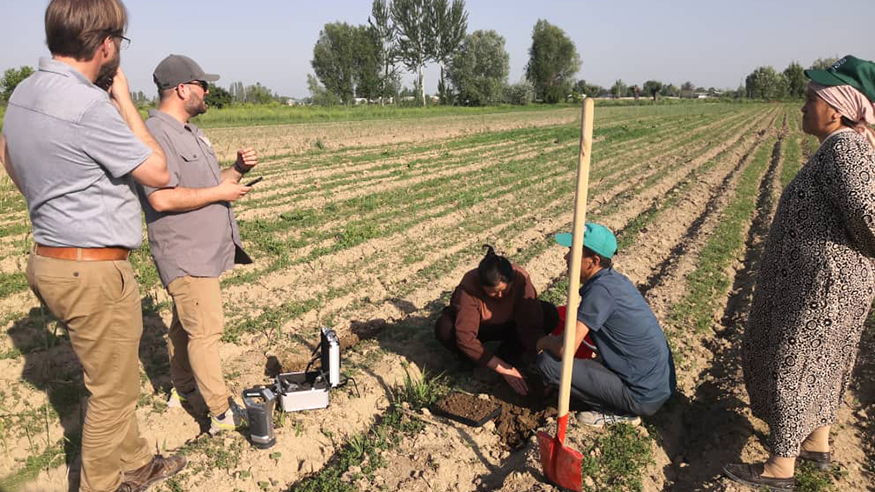

Another benefit: The mobile lab enabled more direct interaction with farmers on their land. Cox traveled with a Kyrgyz translator who was being trained to take over the project. “The goal was to build something sustainable that would outlive my time there,” Cox says. “That’s been the goal from day one, enabling locals to do that.”
Cox quickly learned that many farmers had overfertilized their land for years, depleting the soil. With the mobile testing lab, he was able to suggest fertilizer blends tailored to a farm’s specific soil conditions and crops. Cox thought the farmers might chafe at taking advice from an American, but instead they were eager for it.

Conversations with farmers led to another discovery: While compost is readily available to American farmers, it doesn’t exist in Kyrgyzstan, where animal manure — especially chicken manure — is discarded as a waste product.
“That’s black gold,” Cox says. “We can turn that into something incredibly useful.” Thanks to his Soil Center expertise, planning has begun for a compost operation in Kyrgyzstan.
In December 2025, Cox and his family returned to their home in Royal City, Washington, but he will continue as remote consultant for the projects he started in Kyrgyzstan, with occasional return visits likely. In January, he is traveling to India to assess whether similar projects might be replicated there, and he may take another exploratory trip to Africa this spring.
“When I got a doctorate in chemistry, I never thought I’d be working on soils in Kyrgyzstan,” Cox says. “But the guidance from faculty in the Chemistry Department provided a really good foundation to lead me on these paths. Analytical chemistry is how you measure things, and it’s been interesting to see how that concept has led me all the way around the world.”
More Stories
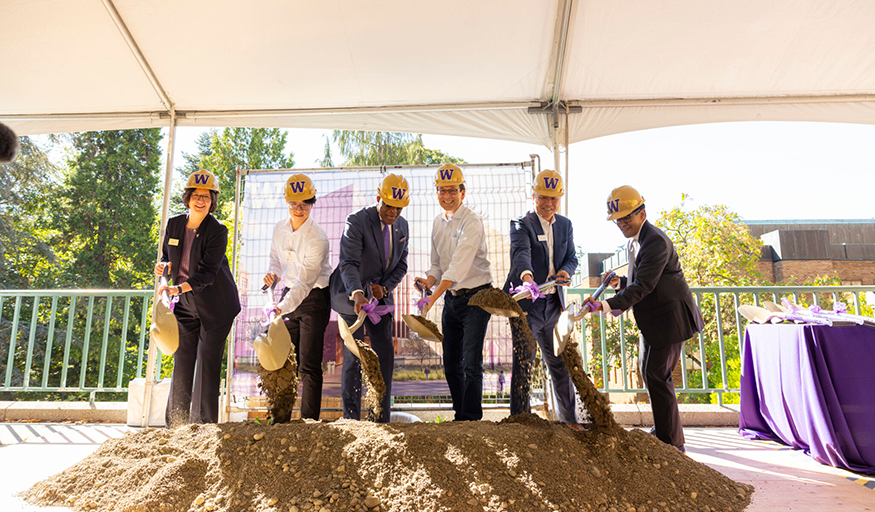
Chemical Sciences Building Reflects Future of Chemistry at the UW
The new Chemical Sciences Building, which broke ground on September 30, has been designed to enhance chemistry research and teaching excellence at the UW.
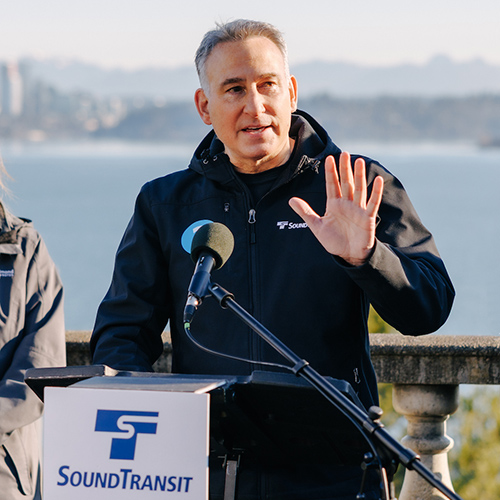
A Career Spent Shaping the Puget Sound
UW Regent Dow Constantine, who has three UW degrees, was Washington's longest-serving King County Executive and now leads Sound Transit as CEO.
Meet Our 2026 Graduate Medalists
Meet the four graduating students selected by the College of Arts & Sciences as 2026 Graduate Medalists for their accomplishments.