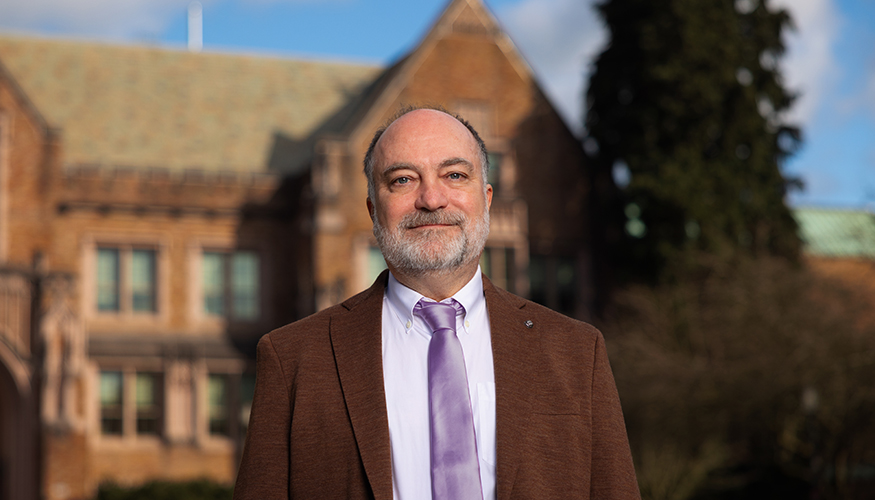
Richard Wright, professor and longtime chair of the UW Department of Linguistics, has been appointed to serve as the interim Divisional Dean of Humanities for the UW College of Arts & Sciences. His term of service will begin July 1, 2026, following the completion of Brian Reed’s term as the current Divisional Dean. With College of Arts & Sciences Dean Dianne Harris retiring in June 2026, Wright will lead the Humanities Division until the College’s new dean identifies a permanent replacement.
An accomplished scholar, administrator and leader, Wright cares deeply about the humanities and about students, faculty and staff. He is a linguist specializing in phonetics, language documentation, spoken-language technology, and hearing sciences. His research and teaching engage in a transdisciplinary approach where the Humanities intersect with the Social Sciences, Natural Sciences, Engineering and Medicine. He has published one book as editor and more than 70 articles and book chapters in areas ranging from computer science and electrical engineering to philology, linguistic theory, and neuroscience and human cognition. In the past five years, his research has covered 66 languages from 10 language families.
Wright has held grants from agencies and industrial partners, including IBM, NIH, NSF and SSHRC. Since joining the UW in 1998, he has directed the Linguistic Phonetics Laboratory, chaired 17 PhD committees and served as a reader on 44 PhD committees. He is a highly sought-after speaker, delivering numerous keynote addresses and invited talks at universities and conferences across North America, Europe, and Asia.
Wright received his BA with honors in French and African studies from Michigan State University in 1986. While there, he was a National Merit Scholar and received Title VI and Fulbright-Hays fellowships. Following that, he was a Peace Corps Volunteer in secondary education in Kenya from 1986 to 1988. He received his MA (1993) and PhD (1996) in Linguistics, with a specialization in Phonetics, from UCLA. While there, he held a Jacob K. Javits Fellowship in the Humanities and was awarded an NSF DDRIG grant and a UCLA Dissertation Fellowship. Before joining the Linguistics Department at the UW, he was an NIH postdoc in cognitive science at Indiana University.
Wright is a Fellow of the Acoustical Society of America and has editorial positions at several linguistics journals. He is deeply committed to the Humanities, and his preparation for the deanship includes an 11-year term as Linguistics Department Chair.
The College's current Divisional Dean of Humanities, Brian Reed, will complete his 8-year term on June 30, 2026.
"Brian has been an extraordinary leader whose many contributions will create a lasting legacy of strength and innovation for the humanities at the UW," says Dean Dianne Harris. "He has led the division with steadiness, kindness, compassion, skill, creativity and brilliance. His leadership supported the creation of innovative undergraduate programs such as Humanities First, Global Literary Studies, and Technical and Professional Communication. He has played a critical role in attracting and retaining outstanding faculty and in advancing interdisciplinary humanities research and scholarship in areas such as Humanities Data Science and Translation Studies. The College is grateful for his leadership and for his many efforts to serve students, faculty and staff throughout the College and beyond."