
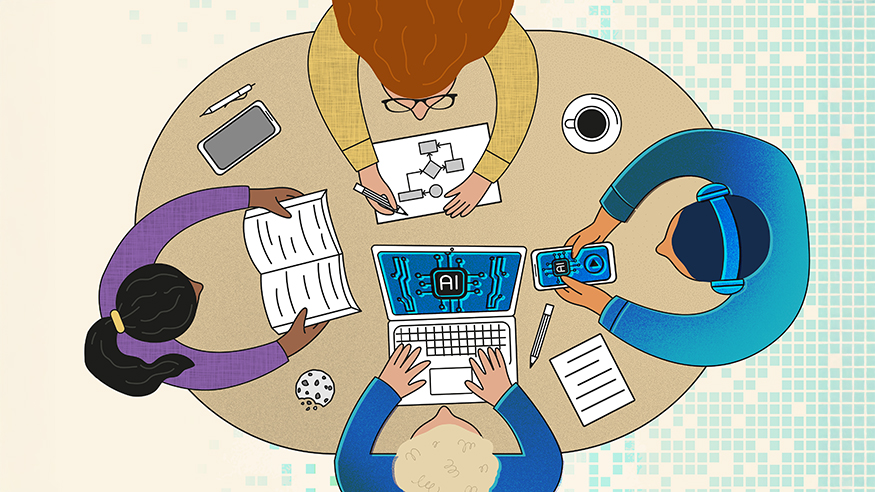
Talking with Faculty about AI
When Arts & Sciences faculty came to ASACS meetings to share how their departments were handling AI in their courses, their varied experiences highlighted the challenges of addressing AI in the College.

“We asked them directly what guidance they’ve received on AI,” said Nowicki. “Some have received guidance, others haven’t heard anything. It's not consistent. This year, we’re hoping to bring together individuals at a higher department level who may be able to help with a top-down communication plan that gives clarity to different departments and facilitates a larger message about AI.”
Nowicki and Khaira agree that a campus-wide AI policy is not realistic because each department is so different. But they say that zero-tolerance policies also hurt students.
“AI is relevant, it’s going to stay, and it can be used in helpful, good ways,” says Nowicki. “For those faculty members with zero-tolerance policies, I wish they would have a more thoughtful approach to how AI could be used. Be open to the conversation. Honestly, I think this would actually stop inappropriate use of AI in the classroom.”
Khaira agrees. “Right now, AI is kind of the elephant in the room. It needs to be addressed and integrated in a way where students are still learning.”
Students’ Varied Approaches to AI
ASACS members also wanted to learn more about their fellow students’ feelings about AI. Nowicki designed an anonymous survey that was sent to a cross-section of undergraduate and graduate students. The 82 respondents included representatives from every division within Arts & Sciences as well as students studying engineering, education, health sciences, and the environment.
When asked how often they used AI tools (including ChatGPT, Grammarly, and similar services) on a weekly basis, 45% reported never using them. When asked how often they used AI tools that were explicitly banned by the instructor, 78% reported never using them.
Students were offered the opportunity to elaborate on their responses, and more than one-third of respondents added more thoughts. “They were passionate enough about disliking AI or using AI that they had more to say. This is why students need to be included in the dialogue about AI, especially if and when policies are created,” says Nowicki.

Many of the survey respondents were concerned about AI’s impact on critical thinking skills. “AI is different from other tools in that it solves the entire problem for you or writes the entire essay. It is a direct discouragement of your own critical thinking skills,” wrote one respondent. Another agreed, writing simply: “Using AI is cheating yourself out of the opportunity to learn and think critically.”
Concerns also included the impact of AI on the environment, ethical and copyright infringement implications, and safety concerns. “It worries me when students use AI in civil engineering classes,” wrote one student. “What we do directly puts people in harm’s way if something is calculated wrong or not up to code.”
Some students, however, pointed out that AI is here to stay and can be used as a tool, not a solution.
“I use AI mainly to help elaborate on ideas or concepts I don’t understand, generate study questions, or to help get started on writing assignments. I don’t usually use it when it is not allowed, and I don’t use it to do entire assignments for me,” wrote one student.
Another noted that “AI can help you learn without mentoring, but relying on AI to directly solve problems will only hurt your critical thinking skills.” Some students mentioned services like Grammarly, which could be used to check for spelling and syntax errors— small tweaks that improve the overall readiness of an essay without offloading critical thinking skills. These students were aligned in their belief that, because AI is ubiquitous, students must know how to use it ethically to prepare themselves for the workforce.
“I feel that AI is like any other technology. It’s neutral,” wrote one student. “I use it to generate study questions, and I put my essays into it and have it grade my work. That said, I don’t use it to generate my work. I think it’s a great study tool and assistant and should be limited to that.”
More Stories
Humanity was Here
UW English major Piper Sorensen ('27) shares why the humanities matter, particularly in our polarized society, and how studying the humanities has shaped her world view.
2026 Awards of Excellence
Arts & Science faculty, students, and alumni were among the recipients of 2026 UW Awards of Excellence for their teaching, volunteerism, and innovation.
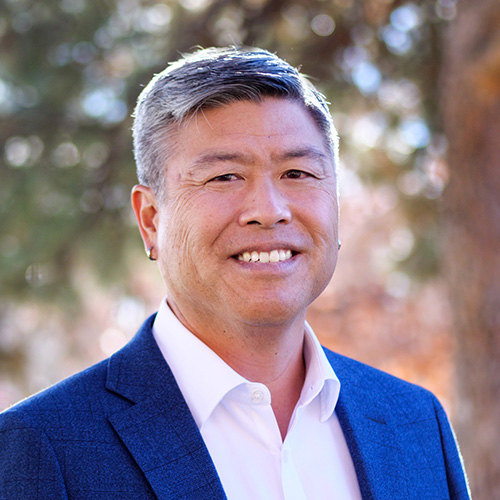
A New Dean for Arts & Sciences
Daryl Maeda brings his extensive leadership expertise to the UW College of Arts & Sciences in July, as he becomes the next Katherine and John Simpson Endowed Dean.