The future of chemistry research is percolating in the heart of the University of Washington campus. “We are on the cusp of a new era,” says Alshakim Nelson, chair of the Department of Chemistry and holder of the Job and Gertrud Tamaki Endowed Professorship. “Science will become more competitive as researchers around the world move faster.”
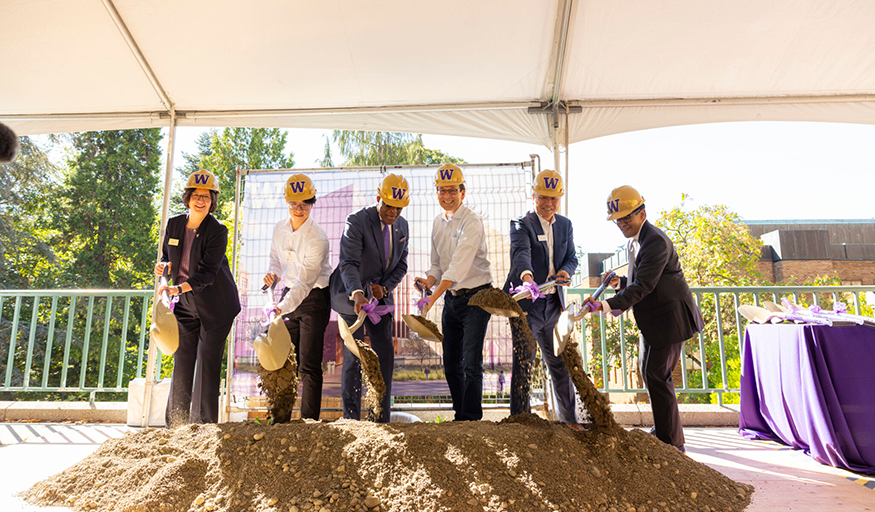
The new Chemical Sciences Building, which broke ground on September 30, has been designed to give UW Chemistry that competitive edge. Situated where the Chemistry Library once sat, the new building will feature flexible, state-of-the-art labs and equipment. New research and collaboration spaces will be equipped with modern instruments, stable temperature and vibration controls will be outfitted in each lab, and lab spaces will spread across different buildings and floors for maximum collaboration. These improvements will allow the department to remain competitive with national peers when recruiting faculty, researchers, and students.
Located in the UW's cluster of science buildings, the Chemical Sciences Building will feature 104,500 gross sq. ft. of labs, meeting rooms, common collaboration spaces and offices. With more than 6,500 UW students taking courses in the Department of Chemistry each academic year, the building will also provide training grounds for future leaders in a variety of industries—from healthcare, to education, to climate science.
“What [our students] learn in UW Chemistry opens a wide range of possibilities,” says Nelson. “Our graduates work in pharmaceutical and chemical companies, from startups to corporations such as Dow and Pfizer. They work at Boeing and at national laboratories. Others pursue medicine or law, or become journalists, writers, and editors.”
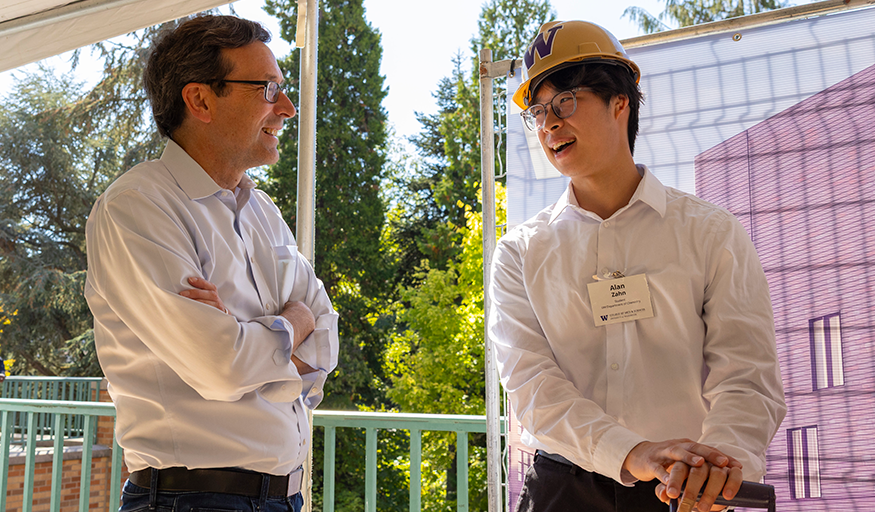
Alan Zhan, a junior chemistry major who joined the groundbreaking festivities for the Chemical Sciences Building, plans to pursue a PhD after graduating. “I'll leave the UW with almost four years of research experience and technical skills. I'm so grateful for the opportunities and mentorship I've received.”
Zhan shared the podium with Governor Bob Ferguson, who spoke on the importance of this next generation of science leaders to the State of Washington.
“Washington’s economy is built on innovation,” Gov. Bob Ferguson said. “Maintaining our leadership requires a reliable pipeline of skilled, highly educated workers. We’re proud to be an investor in this state-of-the-art new building. It’s an investment in our students, and Washington’s economic vitality.”
An Interdisciplinary Incubator
The Chemical Sciences Building will house Department of Chemistry faculty and students, but its impact transcends one department or school. The new building will support a wide array of interdisciplinary research at the intersections of chemistry, biology, physics, engineering, and medicine. Investing in this kind of collaborative excellence is a priority for Daryl Joji Maeda, the Katherine and John Simpson Endowed Dean of the College of Arts & Sciences.
“The Chemical Sciences Building will be a catalyst for both chemistry and the College’s collaborative work that addresses some of the most pressing and complex challenges of our time.”
“I like to think of the College of Arts & Sciences as an interdisciplinary incubator, where faculty and students collaborate across traditional boundaries to generate new knowledge and spark discovery,” says Maeda. “The Chemical Sciences Building will be a catalyst for both chemistry and the College’s collaborative work that addresses some of the most pressing and complex challenges of our time.”
Important interdisciplinary work is already happening within and beyond the Department of Chemistry, says Nelson—research with major implications for medical breakthroughs and disease detection, sustainable materials that support a healthier planet, and myriad solutions that will make life better for countless people.
Take Zhan, the chemistry major who is also a part of the Ginger Research Group. His research explores the intersection between materials science and renewable energy at a microscopic scale.
“I spend most of my time on campus working across our lab's various spaces,” says Zhan. “I'm excited to see the state-of-the-art facilities our brilliant scientists will soon be able to use.”
Zhan’s research group is studying thin-film semiconductors, which could have applications in fields as varied as solar energy, the space economy, and quantum technology.
“Undergraduate research has been the highlight of my college career. I get to do real research with genuine implications for next-generation solar technologies. I have that opportunity because I'm a student at the UW working alongside incredible graduate students and faculty.”
The Chemical Sciences Building will only grow this atmosphere of collaboration and impact for research groups such as Zhan’s.
“An open and modular [building] design will allow research groups to grow and evolve as their needs change,” says Nelson. “There will be fewer walls and divisions, allowing for more fluidity between groups, more crosstalk, and more opportunities for collaboration to evolve naturally. In a literal and scientific sense, we are removing barriers to discovery through this new building.”
Slated for completion in 2029, the Chemical Sciences Building is supported by a landmark investment from the State of Washington, an endorsement from the University of Washington Board of Regents, funding from the University and College of Arts & Sciences, and an ongoing philanthropic campaign.
More Stories
A Second Life for Plastics
Chemistry professor Matthew Golder and his research team are exploring ways to alter the chemical structure of plastics to keep them out of landfills.

Through Soil Science, an Adventure in Kyrgyzstan
Chemistry PhD alum Jonathan Cox spent most of 2025 in Kyrgyzstan, helping farmers improve their soil—and their crops—through soil testing.
Through Chemistry and 3D Printing, New Materials Emerge
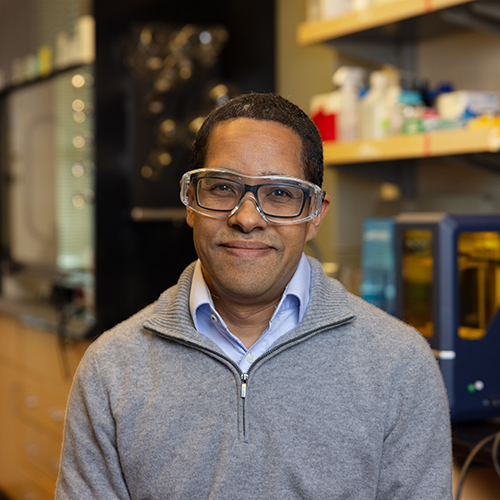
Chemistry professor Alshakim Nelson and his research team use 3D-printing technology to develop new materials with potential real-world applications in medicine, engineering, and sustainability.