stock photo of audio engineering equipment

Bringing Music to Life Through Audio Engineering

Back to All Perspectives Stories
Nancy Joseph 12/30/2025 December 2025 Perspectives
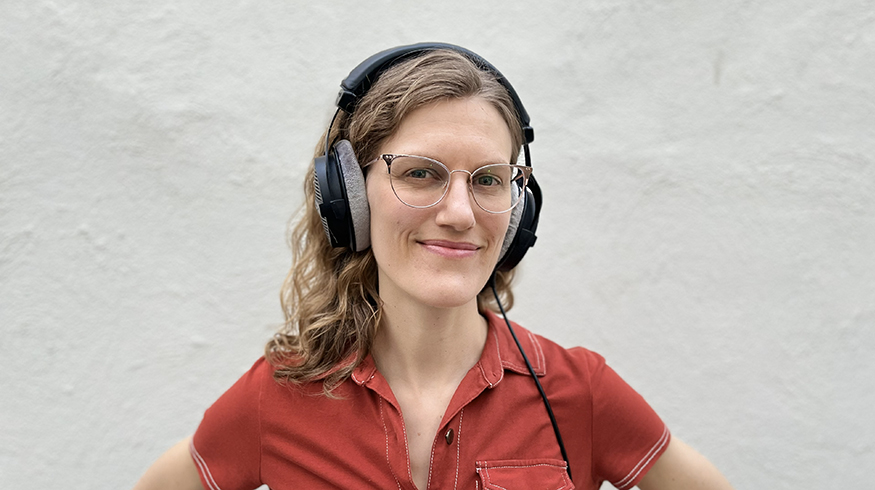
Andrea Roberts wearing headphones
“There are so many paths you can take as an audio engineer,” says UW alum Andrea Roberts. “It never gets old because there’s always something else to learn or expand upon.”

When Beyoncé’s “Cowboy Carter” album won Album of the Year at the 2025 Grammy Awards in Los Angeles, UW School of Music alum Andrea Roberts was in the audience cheering the win. As part of the audio engineering team for the album, it was a win for Roberts as well.

“It’s amazing to be involved in something at that level,” says Roberts, who previously worked on Beyoncé’s “Renaissance” album and film. 

Beyoncé’s projects are as high-profile as it gets, but Roberts has worked with recording artists in a wide range of genres, from hip hop to classical, as well as on film projects. “There are so many paths you can take as an audio engineer,” she says. “It never gets old because there’s always something else to learn or expand upon.”

The Intersection of Art and Technology

Roberts earned a bachelor of music in jazz studies in 2010, after studying piano for 15 years. When she started piano lessons as a six-year-old, she could barely tolerate 30 minutes of practice. 

“I had a timer and as soon as it went off, I was gone,” she laughs. “But I stuck with it, and around the time I was 13 or 14, it shifted. My parents would have to tell me to stop practicing.”

Roberts recording keyboards for a music project.
Roberts has played piano since age six and majored in jazz studies at the UW. 

At the UW, Roberts immersed herself in jazz studies and performed with various jazz ensembles and also played keyboards for the Undergraduate Theater Society’s musical productions of Hair and the Rocky Horror Show. After graduating, she spent several years performing in Argentina, in bands ranging from tango to rock. Seeking a wider range of career opportunities, in 2012 she enrolled at Argentina’s Cetear Escuela Internacional de Sonido for a certificate in audio engineering. She’d considered majoring in physics at the UW before music won out, so the idea of working at the intersection of art and technology appealed to her.
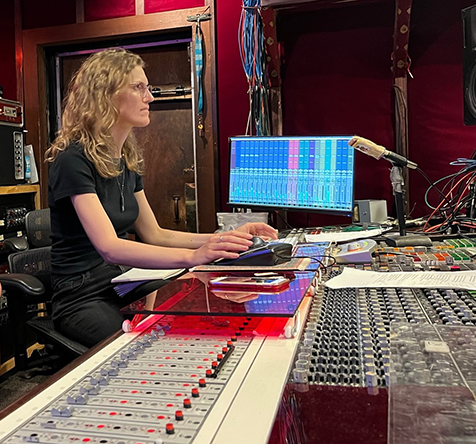
Andrea Roberts working at the console in a recording studio.
Roberts at the console in a recording studio. 

Roberts’ first audio engineering job was at NRG Recording, a commercial recording studio in Los Angeles, where she worked her way up from intern to runner (running errands) to assistant engineer, which involves understanding and setting up all the recording equipment based on the needs of a project.

“A lot of clients will bring in their own engineers, but the studio’s assistant engineer is the one who understands the room and all the gear the studio has,” Roberts explains. “The engineer depends on you because you’re the one who understands how everything in that studio works.”

When Covid hit, the recording studio closed for an extended period, so Roberts pivoted to freelance work.  Fortunately, past NRG clients — including members of Beyoncé’s team — remembered Roberts’ skill as an assistant engineer and invited her to work on upcoming projects. Given the paltry representation of women (about 3%)  in technical roles on top-charting hits, this was no small feat.

“It was a right place, right time situation,” Roberts says. “Show up and be interested and try to do your best, and people notice that.”  Roberts also credits organizations like We Are Moving the Needle and Women’s Audio Mission, which are working to increase opportunities for women and nonbinary audio engineering professionals.
Adding a New Spin to Songs

There is no one job title for Roberts’ work. On some projects, she’s credited as assistant recording engineer; on others she’s mixer or recording engineer or Pro Tools engineer.  She’s also worked on film projects as a score mix assistant, technical score engineer, and music editor, all of which involve working with the film score. The variety of job titles hints at the many steps in the audio engineering process, from capturing sound, to blending and editing it, to providing a final polish before a project is shared with the world. 

With production and mixing, I can come in and elevate an idea and put a new spin on it, which is really fun for me.

Andrea Roberts BM, Jazz Studies, 2010

Roberts enjoys all those roles, but her favorites are producing and mixing — the blending and editing of sounds. “When I was playing in bands, I never came up with the idea for a new song, but I would get really excited about helping bandmates flesh out their song ideas,” she says. “If you have a little idea, a little gem of an idea for a melody or rhythm or whatever, then I love taking that and turning it into something. With production and mixing, I can come in and elevate an idea and put a new spin on it, which is really fun for me.”

That’s how a project with UW alum Rocky Duval (BM, Music Ed., 2009) came about. The two Huskies met in high school in Colorado and then, by chance, both studied in the UW School of Music. Duval recently took a deep dive into the music of Saint Hildegard von Bingen, a 12th century abbess and one of only four female doctors of the church. She asked Roberts to collaborate on an album of von Bingen’s compositions, which are among the earliest Western compositions by a woman that exist in written form.

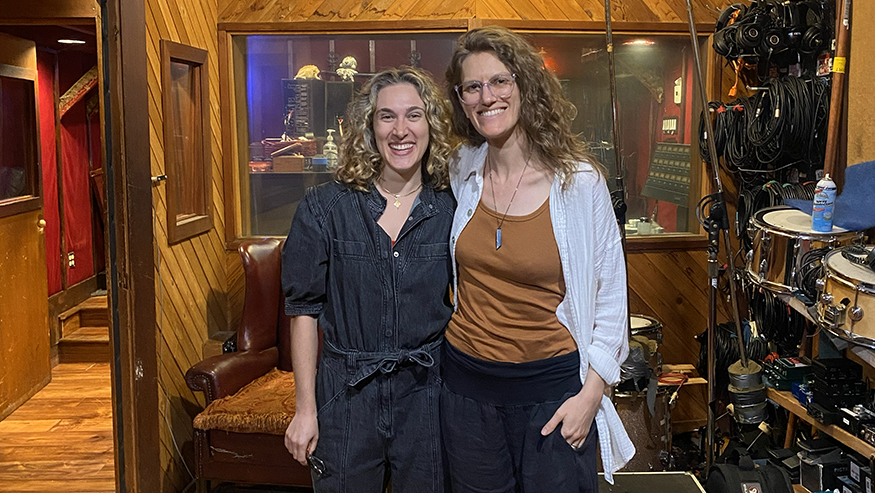
Andrea Roberts and Rocky Duval stand side-by-side in a recording studio, smiling at the camera.
Roberts (right) and UW alum Rocky Duval are collaborating on an album that takes listeners on a journey from very old to very new sounds. 

Roberts and Duval collaborated closely to bring Hildegard’s music and Duval’s compositions to life, taking the listener on a journey from very old to very new sounds. The project was an opportunity for Roberts to use her engineering, keyboard, and production skills.

“It’s something I was missing,” she says of the creative artistic collaboration of the album. “That was so much of what I did for so many years, and then as I got more into the engineering, I felt I had to just focus on that to level up career-wise. Now I want to create music with all these tools I have.”

The album, titled MELZITA, will be available February 2026 on select streaming platforms. It may not garner as many Grammy nominations as Beyoncé’s projects, but Roberts is fine with that — though being in Beyoncé’s orbit has definitely been exciting.

“Even more than the Grammys, it’s meaningful to be part of something that is heard by so many people,” she says of Beyoncé’s projects. “It still blows my mind sometimes to think about the reach and scope of something that I had a small piece in creating.”

More Stories

Vi Hilbert in a woven cape, with her hands raised.

A Healing Heart Returns

In February, the UW Symphony will perform a symphony that Coast Salish elder Vi Hilbert commissioned years ago to heal the world after the heartbreak of 9/11. The symphony was first performed by the Seattle Symphony in 2006.

Person watching a movie at home, with a popcorn container on the table and stockinged feet resting on the edge of the table.

Need a break from holiday movies? Try these

For those wanting a break from holiday movies, Cinema & Media Studies faculty and grad students offer suggestions. 

UW student Edwin Bai on University Way in Seattle

The Public Impact of Private Cities

Geography major Edwin Bai has researched private cities, developed by individuals and corporations, that  "take the libertarian idea of low government regulation to the maximum."