A ballroom filled with couples dancing in casual clothes

A Love of Classics and Ballroom

Back to All Perspectives Stories
Nancy Joseph 12/30/2025 January 2026 Perspectives
Michael Seguin behind the bar at Mobtown Ballroom.
“It’s a complicated, many-headed beast,” Michael Seguin says of running Mobtown Ballroom in Baltimore. He has been a co-owner of the business for 14 years. Photo courtesy of Michael Seguin.

On any given day, Michael Seguin might teach a Lindy Hop dance class, plan a cocktail menu, and deal with city permits.  And then, to relax, he might read “The Iliad” in ancient Greek. (Really.)

As co-owner of Mobtown Ballroom, an event venue in Baltimore, Maryland, Seguin is a jack-of-all-trades, addressing problems as they arise. As a classicist with a bachelor’s degree from the University of Washington Department of Classics (BA, Classics, 2008) and a master’s from the University of Maryland (2011), he continues to enjoy Greek and Roman literature.

Seguin says the two interests are more connected than they might seem.

“The humanities give me a richer understanding of myself and other people,” he says. “I may not be saving puppies or curing cancer, but on a day-to-day basis, I often think about the people I’m dealing with in terms of what’s right and wrong and what would benefit the community. I’m certain that I would be stumbling through that without the humanities.”

Pursuing Classics, Teaching Dance

As an undergraduate, Seguin intended to study English and philosophy. But as he took courses in those fields, he found that they were indebted to ancient Greek and Roman works, so he decided to take a few courses in Classics as well.

“I felt like I couldn’t take any literary pursuit seriously without some kind of background in the classics,” he says. “And then I found Classics courses very cool. The ancient Mediterranean was a multiracial, multilingual, wild society. Its inheritance goes forward, but it is also something of a closed system where you can study the arc of how things develop and then splinter and fragment. It goes in every direction you could want to study.”

...On a day-to-day basis, I often think about the people I’m dealing with in terms of what’s right and wrong and what would benefit the community. I’m certain that I would be stumbling through that without the humanities.

Michael Seguin BA, Classics, 2008

While Seguin was immersing himself in Homer and Lucretius in the UW College of Arts & Sciences, he taught dance classes — mostly swing dance and Lindy Hop — at Seattle’s Century Ballroom to make ends meet. He began teaching there in high school, after discovering dance at age 15. The job was very part time during his UW years, but it paid well and he liked that it used a different part of his brain.

“It was a way to sort of shake off the books for a minute, have a very different experience, and make a little tuition money,” he says.

Moving to Baltimore after college, Seguin continued to juggle Classics and dance. While he pursued a master’s degree in Classics, he and a partner ran small weekly dance classes and events. At first, they rented space around the city, but eventually it made sense to lease a space of their own, which became Mobtown Ballroom. After Seguin completed his master’s degree, he devoted all his energies to his new business.

A Community Hub

Seguin’s old haunt, Seattle’s Century Ballroom, was his model for the new space. He named it Mobtown Ballroom as a nod to Baltimore’s history.

“Mobtown is a really old name for Baltimore,” Seguin explains. “Over the years, Baltimore has been a hotbed of every kind of chaos and madness and people running through the streets, back well into the 1700s.”

Mobtown Ballroom offers dance and music events, from square dance to honky-tonk to monthly open mics and more. The space has a sprung wood floor for dancing, a bar that serves food, and a dedicated clientele. Seguin views it as a community hub, where people can break away from their computer and TV screens and be social in a participatory way.  

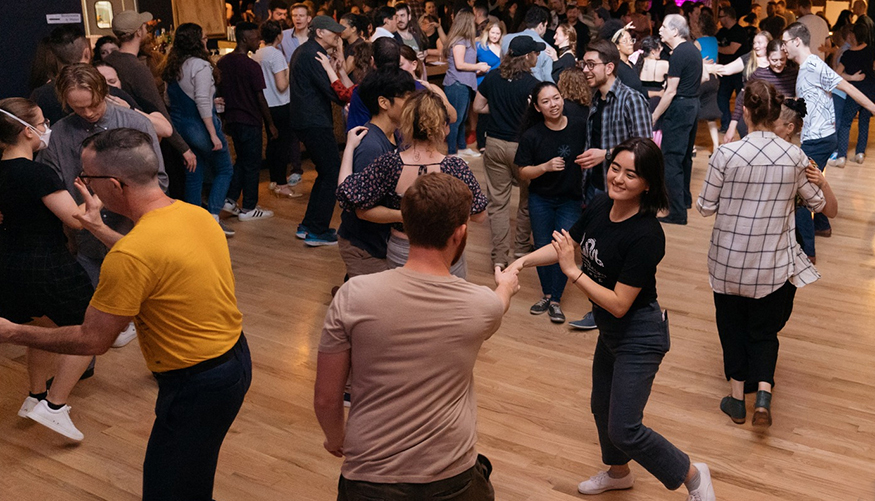
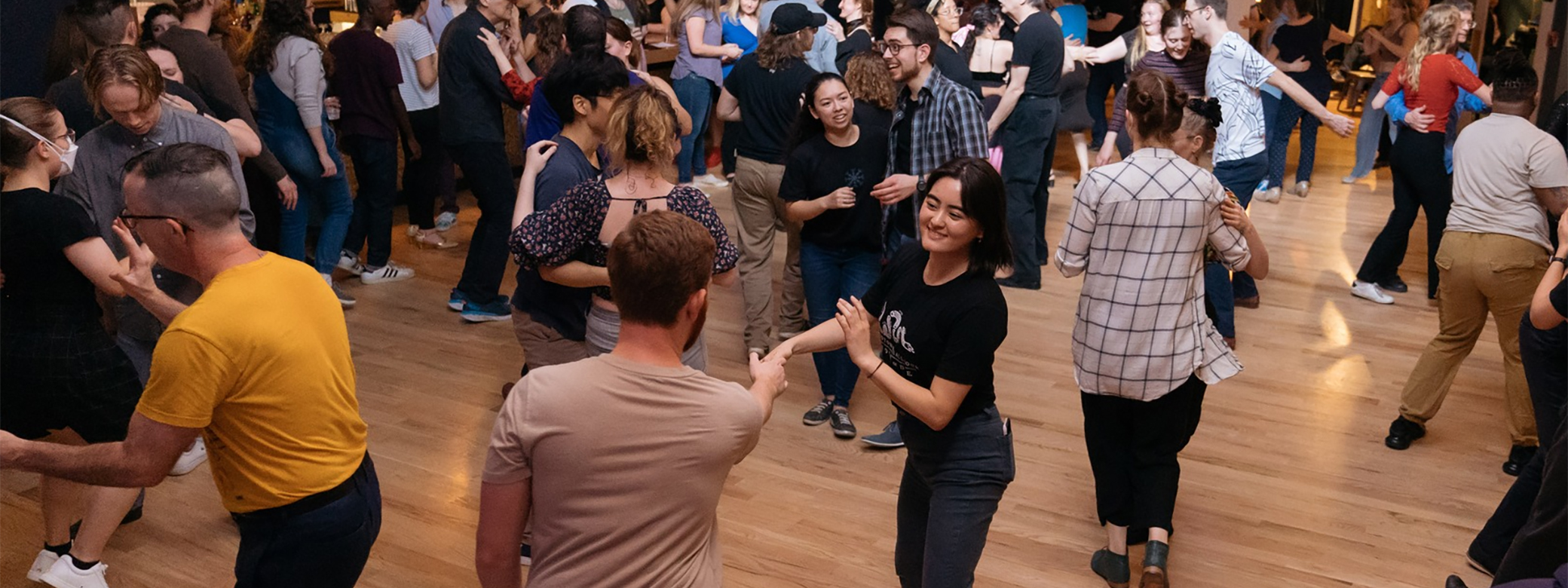
Couples in casual clothes fill the dance floor at Mobtown Ballroom.
 “I look out and there’s maybe a couple hundred people all having a wonderful time," Seguin says of Mobtown Ballroom. "I feel like I’m hosting something that is communal and, on some level, meaningful." Photo by Jerry Almonte.

“We’re committed to the idea that people need to go out and mix it up with each other,” he says. “Social dancing is a lovely, structured way for people to interact, particularly with strangers. You come out, you take a little lesson, everybody dances with everybody. The same with our live music events. Most of the things that happen in our spot, you’re coming to participate.”

Creating that welcoming space is not easy. Consider the tasks that Seguin must oversee: event scheduling, addressing the needs of musicians, purchasing inventory for the bar, facility maintenance, permitting, building security, event marketing, hiring, and anything else that comes up as a small business.

“It’s a complicated, many-headed beast,” he says.

Being Comfortable with Risk

Mobtown Ballroom has been going strong for 14 years, surviving the Covid pandemic and a 2023 move to a new building and neighborhood. That doesn’t mean Seguin can sit back and relax. He’s ever vigilant, just as he was when he started Mobtown. Fortunately, he’s also comfortable with a high level of risk.

“When we opened, I had zero money,” Seguin says. “I was just pretending. Even when we’re doing really great and I’m making a whole bunch of money, one stupid thing can derail it. If you need to close because the air conditioning goes out, you start hemorrhaging money immediately. It can clean you out. Which means you can’t just be comfortable with risk, you have to enjoy it. We try a lot of things and some of them work and some of them don’t, but you have to be able to go home and pet your cat and have dinner and not just sweat bullets.”

The lease on the current Mobtown Ballroom space is up for renewal in April, and Seguin is now eyeing a larger space in the current building. At the same time, he’s weighing another scenario: moving on to pursue something else. But given the thriving community he has created, it would be hard to say goodbye.

“We have something going on most every night,” Seguin says. “I look out and there’s maybe a couple hundred people all having a wonderful time. I feel like I’m hosting something that is communal and, on some level, meaningful. I’ve been around long enough now that people who met at Mobtown Ballroom have gotten married and had kids. You start to see the ways that the threads of people’s lives weave together, and that’s just really cool to witness.”
More Stories

Person watching a movie at home, with a popcorn container on the table and stockinged feet resting on the edge of the table.

Need a break from holiday movies? Try these

For those wanting a break from holiday movies, Cinema & Media Studies faculty and grad students offer suggestions. 

UW student Edwin Bai on University Way in Seattle

The Public Impact of Private Cities

Geography major Edwin Bai has researched private cities, developed by individuals and corporations, that  "take the libertarian idea of low government regulation to the maximum." 

Zev Handel photographed on the UW campus

The Curious Journey of Chinese Characters

Several Asian countries adapted the Chinese writing system—the oldest writing system still in use—for their own languages. In a new book, Professor Zev Handel shares how that happened.

Explore Stories Across Arts & Sciences Departments