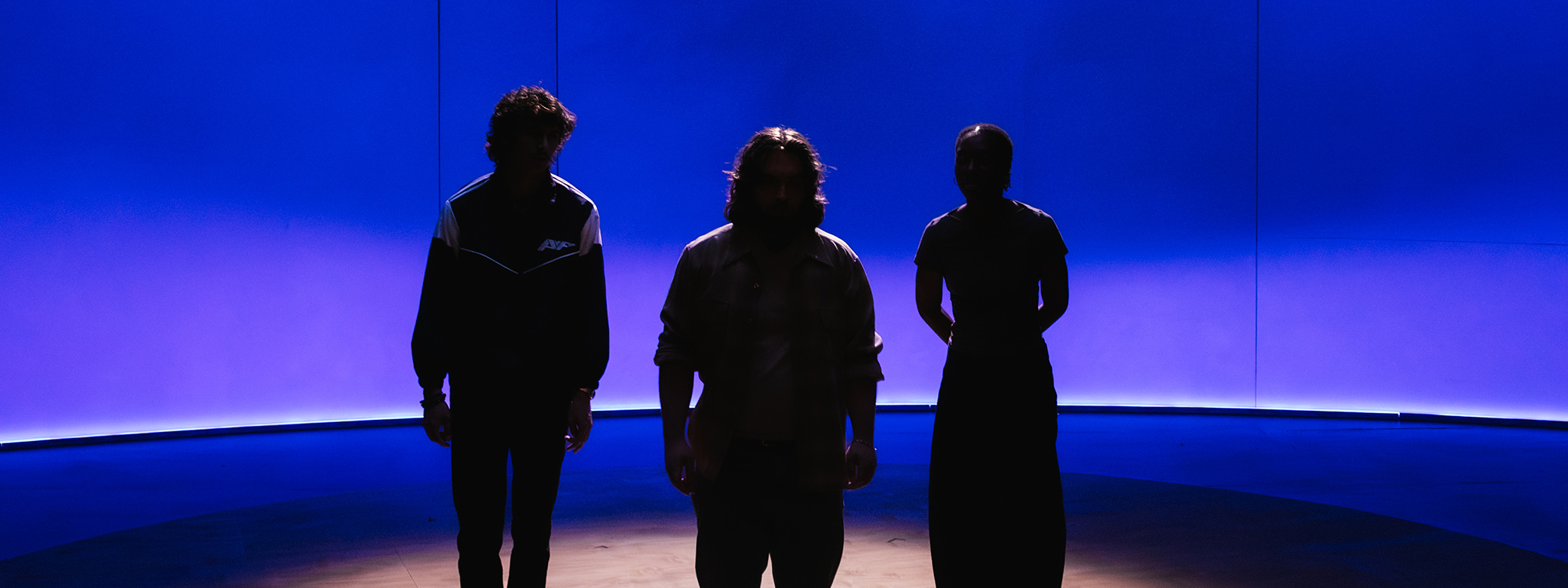
Sihouettes of three figures on stage, lit from behind with a blue light.

Death, Humor, and a Bingo Wheel

Back to All Perspectives Stories
Nancy Joseph 07/20/2026 August 2026 Perspectives
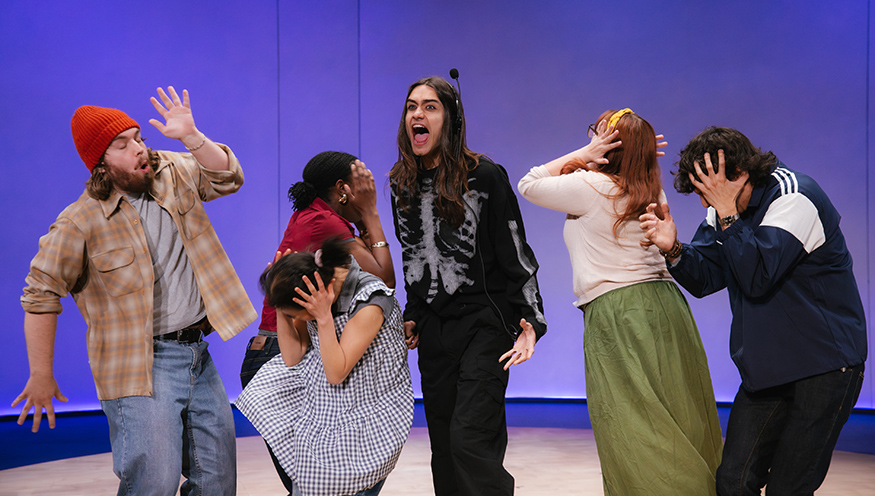
In the play "Everybody," an actor wearing a skeleton suit shouts while other characters cover their ears with their hands.
Characters in the play "Everybody" react as Death shouts at them. Photo by Sunny Martini.

Ten minutes into the play “Everybody,” presented by the UW School of Drama in May, five actors were handed balls from a spinning bingo wheel. Each ball represented a specific character in the play — the role they would perform that night.

The challenge of receiving those random assignments in front of an audience was more energizing than terrifying for the actors.

Two actors on stage spin a bingo wheel with colored balls inside.
Colorful balls in a bingo wheel were used to assign roles to actors each night. Photo by Sunny Martini.

“It trains you as an actor to be able to handle uncertainty and the unpredictable,” says UW drama and biology major Julie Chen. “And being able to act with others who are also randomized in their roles, we have different dynamics with each other based on who is playing what role. Being in tune with the other person and trusting that they are there with you was a great experience.”

The nightly swapping of roles is just one unusual aspect of Everybody, a contemporary play by Branden Jacobs-Jenkins based on a medieval play that explores the transition from life to death. The “Everybody” character, not wanting to face death alone, tries to convince others to join the journey.

UW drama professor Chi-wang Yang directed the UW production, working with an undergraduate cast and crew.  “This play came to mind because it balances a deep attempt at talking about something that is quite serious, death, but it does it with humor in a very contemporary language,” says Yang. “I was fascinated by the play but also by what it would mean to do this for, and with, this undergraduate community.”
Actors Eager for the Challenge

Before students auditioned for Everybody, Yang thought of ways he could limit the randomization of roles if the actors were not skilled or mature enough to take on the challenges of the play. He quickly discovered that his concerns were unwarranted.

“What I came to find is that not only did we have the talent in our community, but once the undergraduates heard that the challenge for these roles was this extreme, more people came out to audition and they wanted it more,” Yang says. In choosing actors for the production, he considered their technical skills but also their bravery.

The students demonstrated that bravery from the beginning. A few times during rehearsals, Yang considered giving them advance notice of their role for the next rehearsal so they’d have more time to prepare. The students vetoed that idea. “Mostly what they were saying was ‘No, let’s randomize more. I want to really feel what that challenge is,’” Yang recalls.

I was fascinated by the play but also by what it would mean to do this for, and with, this undergraduate community.

Chi-wang Yang Assistant Professor, UW School of Drama
portrait of Chi-wang Yang

The result of all that randomization was that each of the ten performances presented in the Floyd and Delores Jones Playhouse felt very different, with the actors bringing a unique interpretation to their assigned role that day. While most audiences experienced a single performance, the cast and crew loved witnessing the variations over multiple performances.

“We would always watch each other in the wings,” Chen recalls. “We were crowded there, trying to sneak a peek, because it was really fun to watch everyone do something different every day. We all brought bits of ourselves to the characters.”

Grappling with Mortality — and Metaphor

Before rehearsals began, an undergraduate dramaturgy team led by School of Drama doctoral student Rachael Herren prepared a thick packet of information about the play for the cast and crew. The dramaturgs researched and analyzed the play’s text and historical and cultural influences to understand it in a broader context.

“Everybody” is an adaptation of the medieval morality play “Everyman,” which in turn was based on earlier Christian stories and a Buddhist narrative, adapted to address the medieval anxiety about death stemming from the Black Plague. In the printed program for the UW production, the dramaturgy team shares that at its core, the play “asks us how we grapple with the inevitability of mortality and just what it is that matters when we come to the end.”

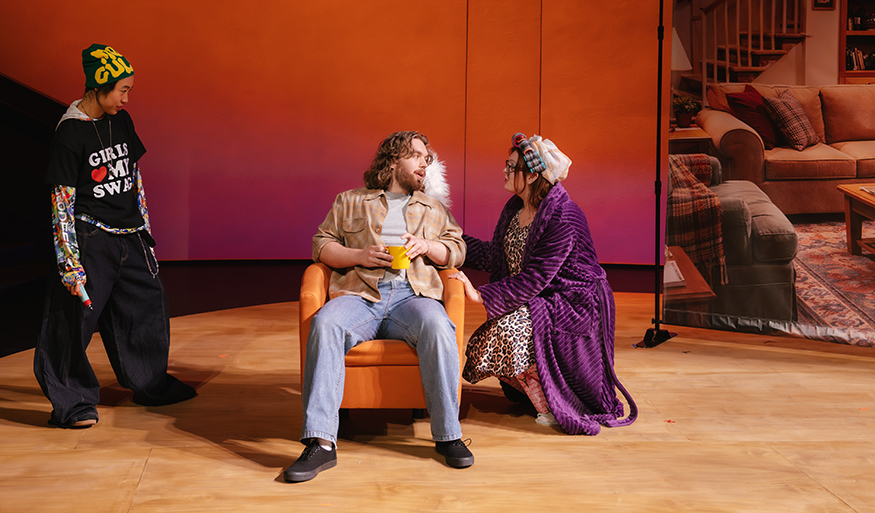
Three actors in contemporary clothes are on stage, with one seated in an upholstered chair.
In one scene, the Everybody character (seated) tries to convince family members to join him on his journey to death. Photo by Sunny Martini.

Herren, a palliative care volunteer, was particularly interested in those end-of-life questions. She invited Nicole Loving, a palliative care nurse practitioner and teaching associate in UW Medicine, to speak with the cast and crew about the different ways that people face death.

“Having guided people through the process of dying, Nicole gave us so much perspective on the issues and themes of this play, which directly influenced our artistic choices,” says Yang.

Those choices included many design decisions. Throughout the play, traditionally staged scenes were interspersed with shorter, more dream-like scenes in near darkness. The staging and lighting of those scenes was an intriguing challenge for Yang and the designers.

“Because the show is somewhat abstract and metaphorical and hops between different spaces, it’s a real challenge to figure out how to build a world for it,” says Yang. “Even in a show that takes place nowhere in nothingness, you still need to anchor it somehow.”

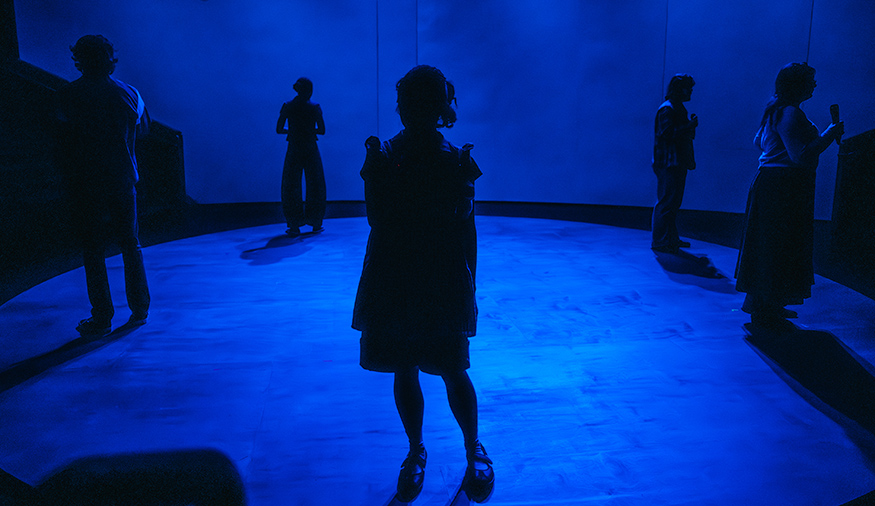
Sihouettes of actors on stage, lit from behind with a blue light.
The designers for "Everybody" built a special light box to provide a subtle and ambiguous quality to the dream-like scenes. Photo by Sunny Martini.

The designers were eager to think outside the box. Yang and undergraduate lighting designer Aiden Bonheyo built a special light box to provide a subtle and ambiguous quality to the dream-like scenes. Sound designer Alex Parr, a recent alumnus, designed metallic resonators from scrap metal to create other-worldly sound effects. The costume co-designers, Allison Macip-Palacios and Laurence Wulfe, created a suit that resembled a human-size Labubu doll, which added levity but also meaning to a scene about the “stuff” we hold on to.

Though the UW production of Everybody has ended, Yang and the students are certain they will remember being part of this unusual play for a long time. 

“Everyone who worked on this really poured their hearts into it,” says Chen. “It was a challenging play, but we were all so supportive of each other that it felt fun and safe. As a team, we had the freedom to express this piece of very abstract art in a way that was personal to all of us. The experience was really special.”

More Stories

Close up of a blooming cherry tree on the UW quad

Meet Our 2026 Graduate Medalists

Meet the four graduating students selected by the College of Arts & Sciences as 2026 Graduate Medalists for their accomplishments. 

A soccer player kicking a ball.

Need More Soccer? Watch These FIlms

Has the World Cup left you wanting more soccer? The UW Department of Cinema & Media Studies suggests some films to keep you going. 
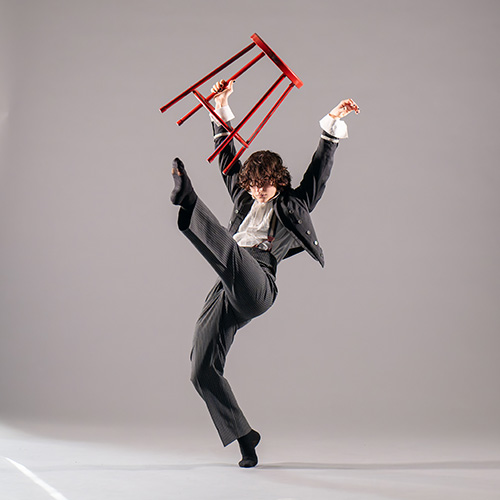
Eddie McClary does a high kick while lifting a red stool overhead during a dance performance.

Finding Joy in Dance and STEM

“I feel like my experience at the UW has been incredibly well-rounded," says Eddie McClary, who graduates in June 2026 with bachelor's degrees in dance and biochemistry. 

Explore Stories Across Arts & Sciences Departments