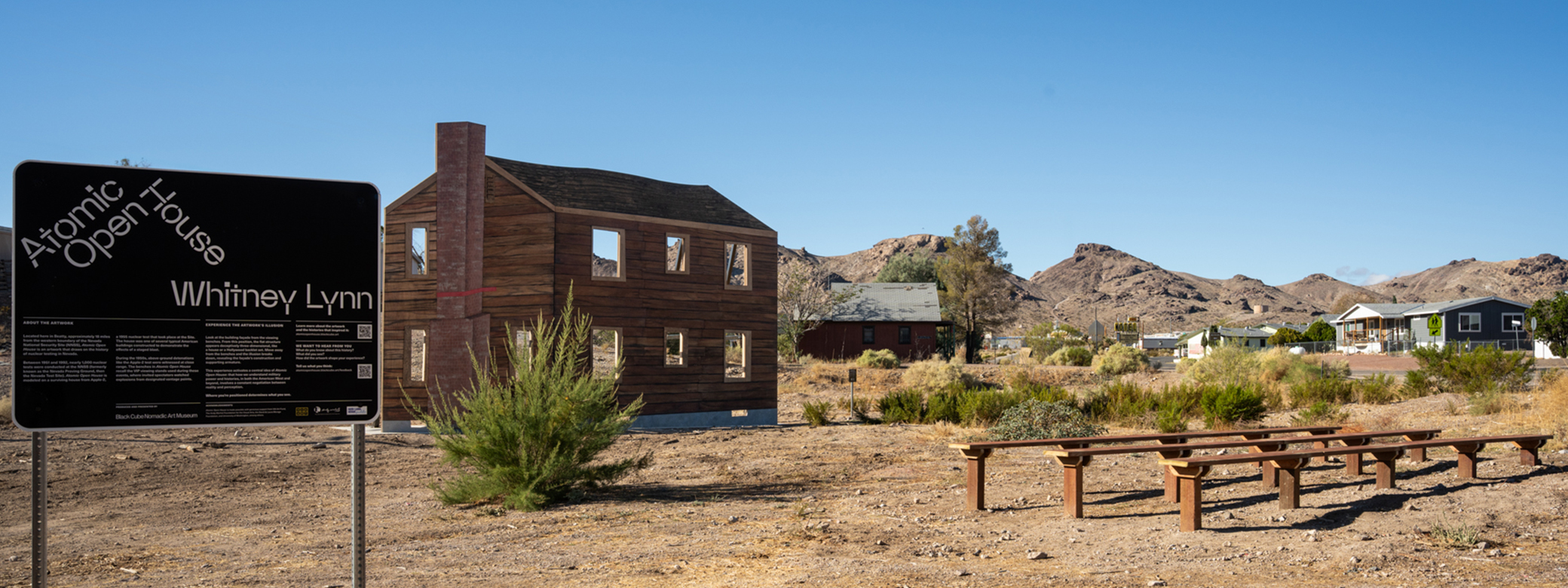
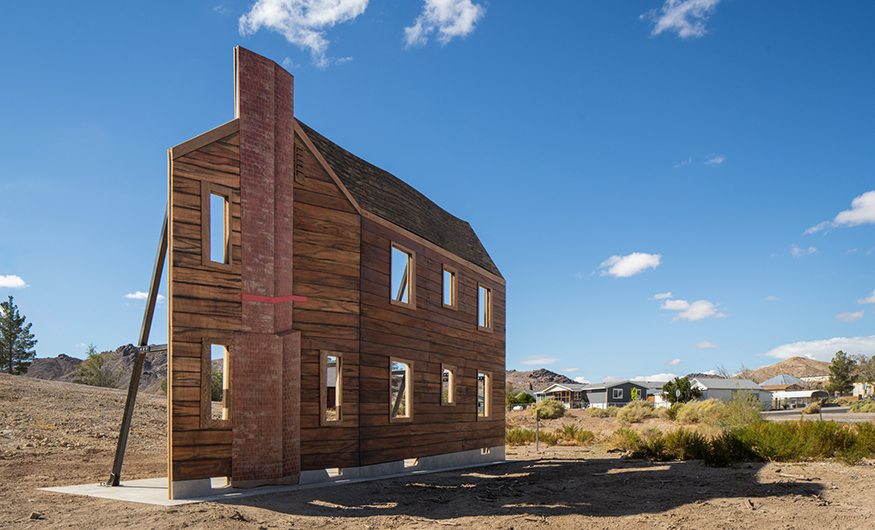
How did this project come about?

I was invited to be an Artist Fellow with Black Cube, a non-profit museum that produces site-specific art in the public realm. I began thinking about creating an artwork that could also function as a roadside attraction. When I started looking for potential sites, I noticed that the highly restricted Nevada National Security Site (formerly the Nevada Test Site) directly abuts US-95 in the corridor between Las Vegas and Death Valley, and that set the gears in motion.
Atomic Open House references 1950s nuclear testing in Nevada. What led to your interest in that topic?
I grew up in a military family and was born on an Air Force Base in Arizona. Partly because of that background, I’ve long been interested in how the boundaries of the military extend far beyond official perimeters, often in ways that are not immediately visible.
During a visit to the Atomic Museum in Las Vegas, I simultaneously learned about the Nevada Test Site and the phenomenon of Atomic Tourism. I was astonished to learn that nearly a thousand nuclear tests, both above and below ground, had taken place just 65 miles away over the course of four decades. While the Atomic Energy Commission systematically downplayed the risks, Las Vegas capitalized on the spectacle, with casinos and other businesses advertising mushroom clouds as tourist attractions.
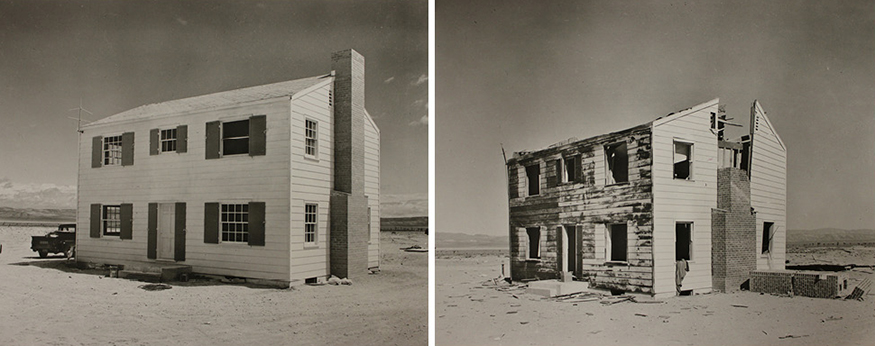
One of the central threads of my research was the relationship between nuclear testing and the mythology of the American West. I became interested in how the desert has been represented as empty, barren, or expendable, and how nuclear testing reinforced those ideas. In reality, the region has a rich ecology, a long history of human habitation, and deep cultural significance to Western Shohone and Southern Paiute communities.
Another surprising area of research was the extent to which nuclear testing was intertwined with Hollywood and popular culture. There was even a classified Hollywood production facility, Lookout Mountain Laboratory, that produced films and photographs for the Department of Defense and Atomic Energy Commission.

Why are viewing benches part of your artwork?
The benches are based on archival photographs of "VIP bleachers" constructed at the Nevada Test Site. During atmospheric tests, invited observers gathered at the benches to watch the detonations from relatively close range. For Atomic Open House, the benches serve two purposes. They reference a history of organized spectatorship, and they establish a vantage point from which the house façade appears three-dimensional. The benches make the viewer’s position, and the act of looking, explicit. Where you are positioned determines what you see.
What are the specific challenges and opportunities presented by site-specific artwork like this?
There are certainly practical challenges. For this project, working in the desert means accounting for extreme weather conditions. We had to engineer the structure to withstand high winds and consider how the materials would weather over time, since the surface is essentially being sandblasted by the environment. Maintenance, liability, land leases, and fundraising also become significant considerations.

Despite these challenges, the greatest opportunity is that the location is inseparable from the work. Atomic Open House wouldn’t have the same meaning anywhere else. It’s less than 20 miles away from the entrance to the Nevada National Security Site, in a community that continues to be affected by the legacy of nuclear testing.
Speaking of the community, how have neighbors responded to this artwork?
During the final days of installation, many community members stopped by to see what was happening. Despite the town’s long and complicated history with nuclear testing, the response to the installation was overwhelmingly positive. There was a lot of curiosity about the project, questions about the role of public art, and candid conversations about local concerns, particularly around data centers, mining, and water.
How was this art project funded?
The project started with seed funding from Black Cube, and we worked together to raise additional funds (including from the Andy Warhol Foundation for the Visual Arts, the David & Laura Merage Foundation, and the WC & EJ Thornton Foundation). I also received a significant grant from the VIA Art Fund and support from the University of Washington through a Kreilsheimer and Jones Large Grant and the Wycoff Milliman Endowed Fund. Despite this generous support, we are still working to close a funding gap to cover the lease for the land, allow for maintenance of the artwork, create a museum-quality exhibition catalog, and allow for seasonal programming.
More Stories
How to Persuade People: A Philosopher's Perspective
In our increasingly polarized world, philosophy professor Colin Marshall's new book about successful — and ethical — persuasion offers an encouraging perspective.
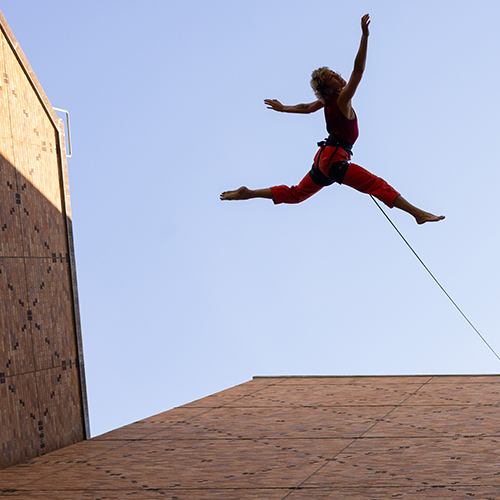
A Dance Film That Soars
In their new dance film, professors Rachael Lincoln and Juliet McMains highlight dancers (including Lincoln) leaping along an exterior wall of Meany Hall, 30 feet in the air.
Where Philanthropy Meets Racial Justice
Political science professor Megan Ming Francis studies how philanthropy impacts social justice movements, sometimes with unintended consequences.