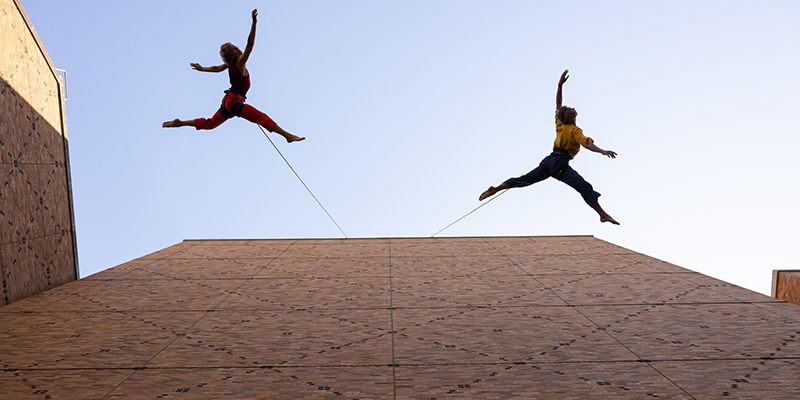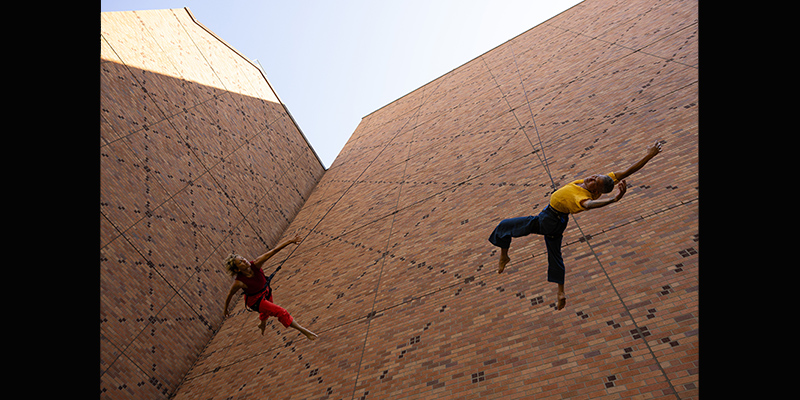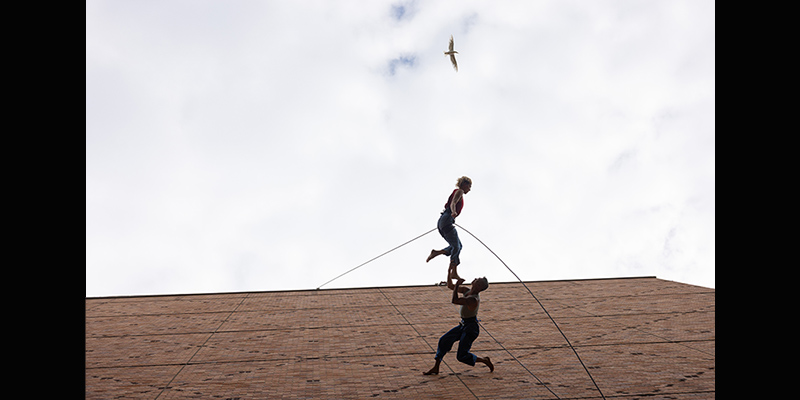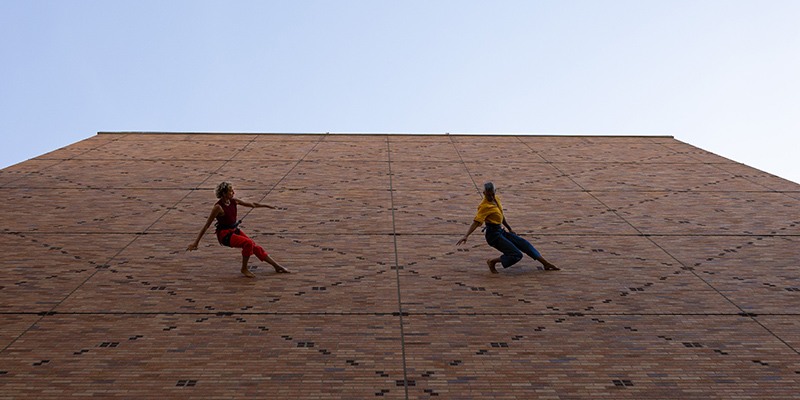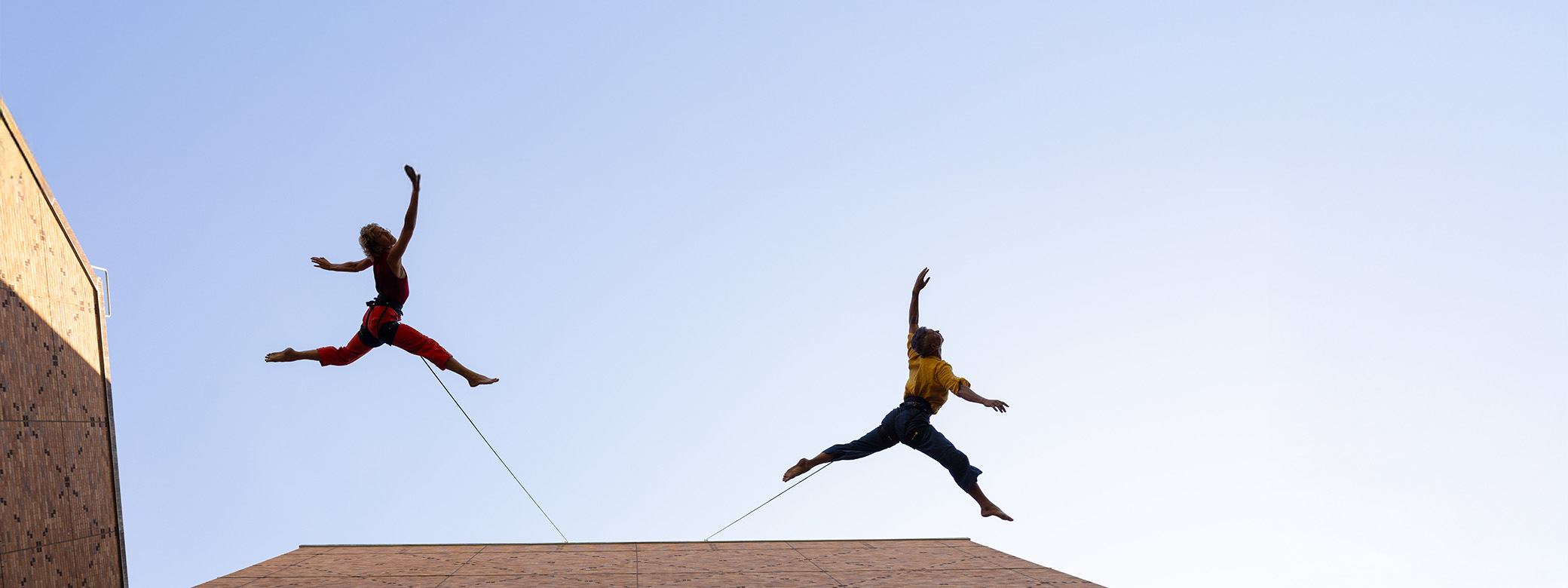
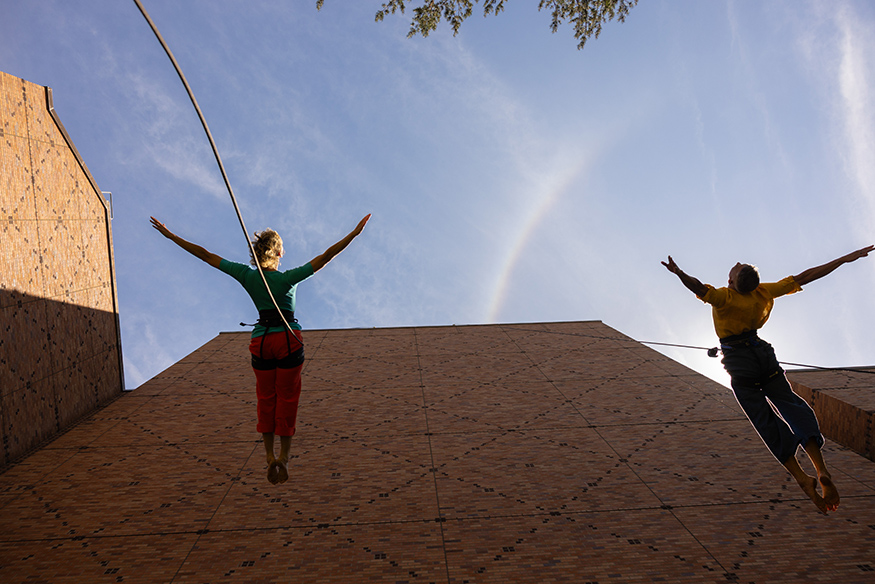
On a sunny morning in August, dancers Rachael Lincoln and Wailana Simcock danced in unison 30 feet above the ground along the west façade of the University of Washington’s Meany Hall. Secured with ropes and harnesses, they leapt into open air, backs arched, then returned to the wall with cat-like grace. Below them, videographers Juliet McMains and Theo Angell filmed their movements from various angles.
The stunning display was a rehearsal for a dance film conceived by Lincoln and McMains, both professors in the UW Department of Dance. Through rehearsals, they explored various movements and camera angles that might fit their vision for the film. The completed film will feature the dancers in three UW locations: Meany Hall’s west wall, Meany’s front facade, and Kane Hall’s concrete exterior.
Both McMains and Lincoln have worked on dance films before, but each says this project, incorporating “vertical dance” high up on a massive wall, is their most ambitious yet.
“Filming somebody in the air is totally different than anything I’ve done before,” says McMains. “It was an opportunity to grow and experiment in a really new way.”
Dance Film as Art Form
McMains has been interested in dance films for years. She worked briefly as a video editor after college, and during a 2012 visit to Argentina, she met Margarita Bali, a founder of video dance in Argentina, who became a mentor. McMains began making small dance films, often taking on all the roles — dancer, videographer, and editor. On a recent sabbatical in Argentina, she pursued a larger project, creating video portraits of a dozen Argentinian tango dancers.
“Dance films are different than documentation of a live performance,” McMains says. “It’s a dance that only exists in the medium of film, that comes into being through the filming techniques and editing.”
Lincoln has worked on dance films as well, particularly while in graduate school. “As a dance maker, I’m always thinking about the audience and what they are seeing,” she says. “You’re imagining where the eye will go on stage and how you’re commanding attention. But with the camera, you have so much more control over that. And that gets really exciting and daunting.”
Dance films also allow for the manipulation of time and space. You can slow things down or speed them up. You can superimpose images or feature locations that would be unrealistic for a live performance with an audience. You can make the impossible appear possible. Then again, Lincoln already does the seemingly impossible in her performances.
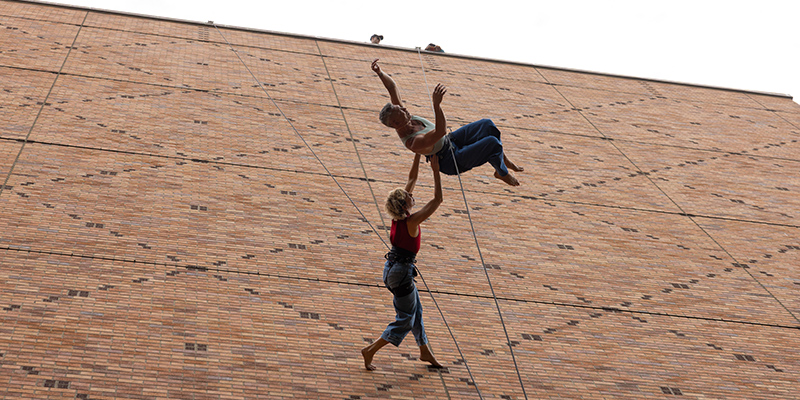
This slideshow features moments from a dance rehearsal on the side of Meany Hall. The dancers, Rachael Lincoln and Wailana Simcock, are secured with ropes and harnesses. Photos by Juan Rodriguez.
Lincoln has been performing “vertical dance” for years as a member of the dance company Bandaloop. For the current project, she is performing with Bandaloop dancer Wailana Simcock (though the film is not a Bandaloop project). While Lincoln and Simcock’s graceful leaps and spins may look effortless, dancing at great heights with ropes and harnesses for safety is very physically demanding.
“A lot of the training is to make it look easy,” Lincoln says. “But vertical dance is like nothing else. I do get the feeling of arcing through space and the sky. There’s something viscerally delicious about it even though it’s taxing.”
A Team Effort, Thanks to Grant Support
Translating the wonder of vertical dance to film is not easy. The spectacular nature of dancing at great heights, the scale of it, is more easily understood when viewed in person. “That’s been the biggest challenge,” says Lincoln. “How do we make this at least as cool on film as it is live? That’s been a big puzzle to us.”
Rehearsals helped solve the puzzle. The project team had four days of rehearsal, trying different choreography and camera angles before shooting final footage for the film. Team members included dancers Lincoln and Simcock, videographers McMains and Theo Angell, UW student assistant Samantha Stratman, and — critical for vertical dance — experienced rigger Ryan Daudistel and assistant Trevor Gilbert, who set up rock-climbing ropes from the Meany Hall roof that assured the dancers’ safety. Costumer Doris Black and composer Paul Matthew Moore round out the project team.
Support for creative research is so critical. Personally, it’s an important reason I’m at the UW. To me, the outcome of this funding is more about growth and experience with how to shoot something like this than about the final product.
A Kreielsheimer and Jones Large Grant from the UW College of Arts & Sciences’ Arts Division has been critical for this project. “The collaboration has been amazing, and this funding enables that collaboration because we can pay everybody,” says McMains. “Suddenly we have a whole team.”
Lincoln appreciates that the grant values the creative process as much as the resulting film. “Support for creative research is so critical,” she says. “Personally, it’s an important reason I’m at the UW. To me, the outcome of this funding is more about growth and experience with how to shoot something like this than about the final product.”
Still, there will be a final product. Whether that film includes much of the vertical dance footage is still, er, up in the air. The plan is to begin with footage from the other locations, where the camera can come close to the dancers and connect the audience with their characters, and later move to the vertical dance, where the characters ascend to the sky.
McMains and Lincoln hope to complete the film by the end of 2026 and submit it to dance film festivals worldwide. They also plan to screen the film locally — including at the UW Dance Presents concert to be presented by the Department of Dance in January 2027 — and share clips on social media in the coming year, widening its audience.
“What’s interesting is how many more people you can reach with a film than with live dance,” says McMains. “You can reach audiences who might not come to a performance. And it’s been such a treat to work with Rachael, a stunning dancer and choreographic mind. I’m looking forward to sharing our collaboration with the world.”
More Stories
Massive Galaxies & Mentorship
Astronomy professor Arianna Long studies some of the most massive and extreme early galaxies and mentors future generations of scientists.
Death, Humor, and a Bingo Wheel
In a recent School of Drama production about the transition from life to death, actors swapped roles nightly, creating a different experience with each performance.
Need More Soccer? Watch These FIlms
Has the World Cup left you wanting more soccer? The UW Department of Cinema & Media Studies suggests some films to keep you going.