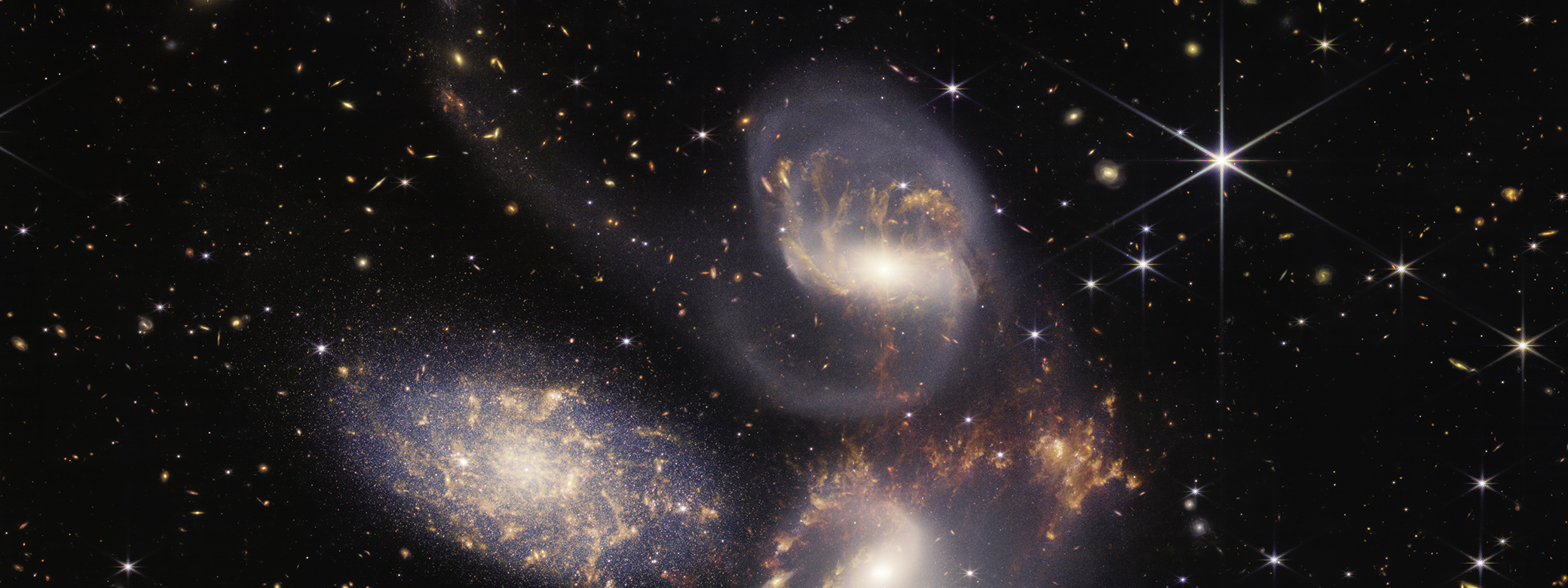
NASA photo of Stephan's Quintet, a group of galaxies

Massive Galaxies & Mentorship

Back to All Perspectives Stories
Nancy Joseph 09/01/2026 September 2026 Perspectives
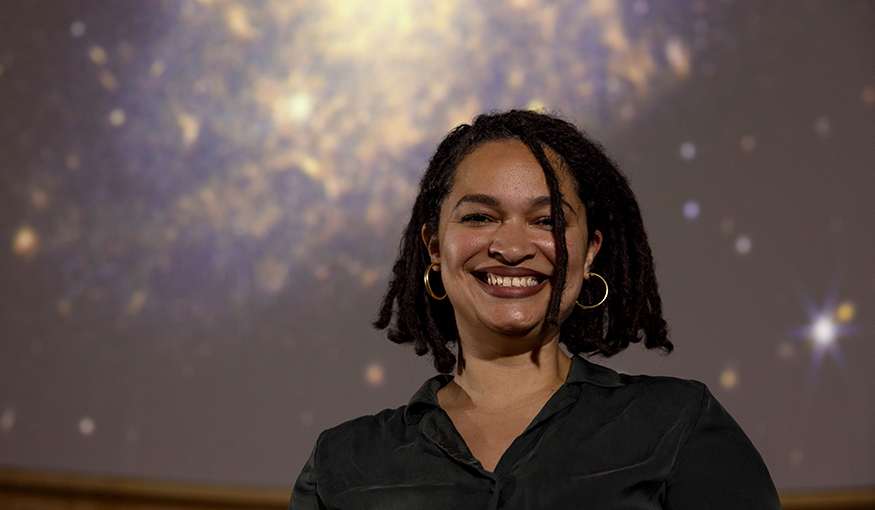
Arianna Long in the UW Planetarium, with galaxies projected on the screen overhead.
“To me, this job is way bigger than just doing science," Arianna Long (above) says of her role as an astronomy professor. "It is about continually making change in the field [of astronomy] and building a space for people like me while also getting to do science." Photo by Juan Rodriguez.

Beyond the riot of stars visible on a clear night, beyond more distant galaxies studied over the past half century, are some of the earliest galaxies, created during the early formation of the Universe. Thanks to powerful 21st-century telescopes, astronomers can now study these distant galaxies dating back 12-13 billion years.

Arianna Long, UW assistant professor of astronomy, is particularly interested in massive and extreme early galaxies, which are 10 to 100 times larger than the Milky Way but often cramped into spaces 10 times smaller. She believes these early galaxies may provide clues to how the Universe evolved.

Big Questions about Massive Galaxies

Massive early galaxies are different than other galaxies. Nearer spiral galaxies like our Milky Way continually form stars at a slow and steady pace. Their centers are yellow, indicating the presence of old stars, and their outer spirals are beautiful blues, indicating young stars forming. But the massive galaxies that Long studies have no blues and purples, suggesting they stopped forming stars long ago.  (An extreme, but useful, oversimplification.)

“When we finally got the instrumentation to calculate how long they’ve been aging, we learned that they’ve been aging for most of the Universe’s lifetime,” Long says. “So, for about 10 to 12 billion years out of the Universe’s 14 billion years, they have aged quietly, no longer forming any stars despite the fact that there is plenty of “fuel” left to build them.”

How did these early massive galaxies evolve and why did they stop forming new stars?  Thanks to telescopes that can now collect very faint light from the far reaches of the Universe, Long has been able to explore these questions — but there are challenges.

As we go earlier and earlier, most of our simulations literally don’t have enough time with the physics at hand to build enough stars for one of these massive galaxies, let alone the many we are finding.

Arianna Long Assistant Professor, Astronomy

Computer simulations, so central to astronomy research, are difficult for these early galaxies. “As we go earlier and earlier, most of our simulations literally don’t have enough time with the physics at hand to build enough stars for one of these massive galaxies, let alone the many we are finding,” says Long. “The star formation was so violent with so many supernovas exploding, oftentimes the simulated galaxies shred themselves apart because it’s so extreme. On top of that, there’s the challenge of then stopping the galaxy from forming stars in the simulation.”

Another challenge: The very faint light from the earliest galaxies has changed by the time it is captured by telescopes. This matters because astronomers learn about galaxies by capturing and studying their light. Each telescope captures a specific type of wave (ultraviolet, visible, microwave, radio wave, X-ray) that reveals specific information about the galaxy’s makeup and ongoing activities. But starlight from the earliest galaxies travels such huge distances before reaching a telescope, through a cosmos that is expanding and stretching over time, that the light itself expands and stretches. By the time the light is captured, its waves have changed from ultraviolet — typical of young, hot stars — to infrared, a cooler wavelength of light.

“To study the first galaxies, we needed an infrared telescope that could capture all that stretched light,” says Long. “That’s where JWST [the James Webb Space Telescope, operational since 2022] comes in. It is able to detect those wavelengths when looking for early galaxies.”

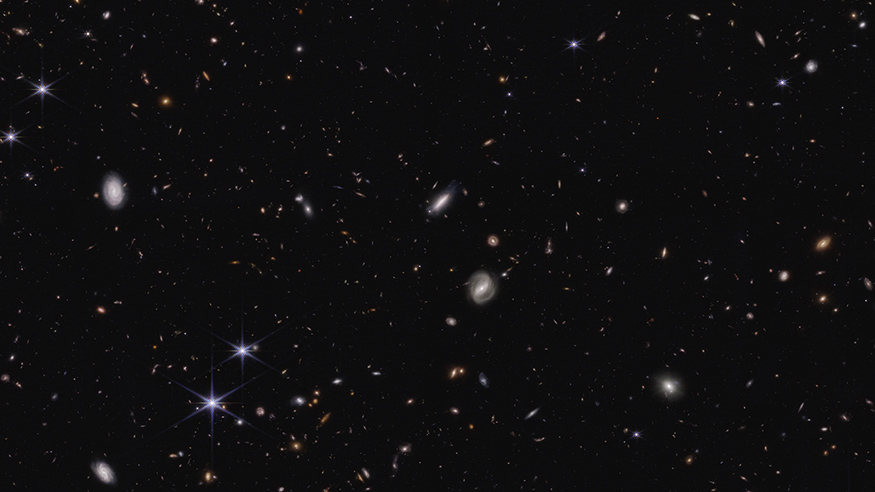
Distant galaxies appear as white dots of varying sizes in a sea of black.
This image of distant galaxies shows a small portion of the field observed by NASA’s James Webb Space Telescope’s NIRCam (Near-Infrared Camera). Light from some of the galaxies has traveled for more than 13 billion years to reach the telescope. Image: NASA, ESA, CSA, Steve Finkelstein (UT Austin).  

Long also uses ALMA, an array of 66 radio telescopes in northern Chile, to learn more about star formation in early galaxies. ALMA measures the cold gas and dust in distant galaxies — important since a gas cloud that becomes very cold will collapse from the force of its own gravity, leading to nuclear fusion and star formation.

“To make stars, you need cold gas,” says Long. “So, to understand galaxy formation, and when they stop forming stars, you need to understand what happens to its cold gas. Is it all consumed? Is it heated up? Is it blown out of the galaxy from really extreme processes or not even entering the galaxy in the first place?  This is where ALMA comes in and this is why it’s important to pair JWST and ALMA. You can’t really understand where a galaxy came from and where it is going if you don’t have a perspective on the fuel for that motion.”

Pairing Science and Mentorship

To explore these questions, Long has built a research team that includes graduate and undergraduate students, a postdoc, and a post-baccalaureate student. She is fiercely committed to mentorship of her team and received a 2026 Outstanding Undergraduate Research Mentor Award based on nominations from team members.  

Arianna Long with six students on her research team.
Arianna Long (back row, second from left) with members of her research team.

Long did not have the same mentorship when she was in college. After she told a professor she was passionate about astronomy, he told her there were no careers in astronomy and suggested she pursue something else. Following that advice, Long majored in math and minored in computer science. That led to a data analyst role in the corporate world, which she hated. Her husband encouraged her to pursue what she loved instead, so she returned to school for a PhD in astronomy.

In graduate school, Long began volunteering with VanguardSTEM, a volunteer-run nonprofit devoted to encouraging conversations between emerging and established women, girls, and non-binary people of color in STEM. She is now a co-director of the national nonprofit. And since joining the UW Department of Astronomy in 2024, Long has been working to invite colloquium speakers from non-traditional backgrounds so that UW students underrepresented in the field can see themselves reflected in successful astronomers.
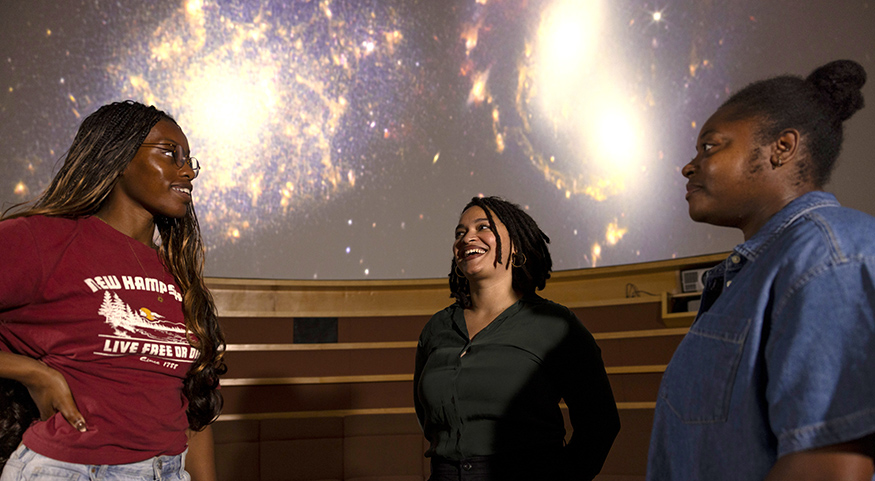
Arianna Long talking with two astronomy students in the UW Planetarium, with galaxies projected on the screen overhead.

“There are only about 30 Black women with astronomy PhDs on record, and I believe UW Astronomy has graduated the most of any university,” Long says. “I feel very lucky to be at the UW, in a department that has been enthusiastic about all my mentoring work.”

Reflecting on her role as an astronomy professor at the UW, Arianna says, “To me, this job is way bigger than just doing science. It is about continually making change in the field and building a space for people like me while also getting to do science. It’s constant and it’s exhausting, but there’s no point in me being in this position if I don’t use it to try to better this space.”

More Stories

UW Quad in autumn with students walking across the quad.

2026 Dean's Medalists, Exploring Big Questions

Meet the four new graduates honored as College of Arts & Sciences Dean's Medalists for 2026. 
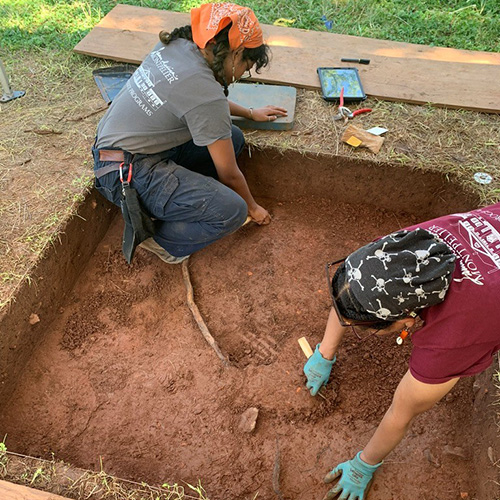
Two people excavating a shallow section at an archaeological site.

Unearthing Clues to Past Lives

Through summer excavations at a former plantation and an anthropology honors thesis, Raquel Matthews is advancing our understanding of the lives of enslaved people who lived there. 
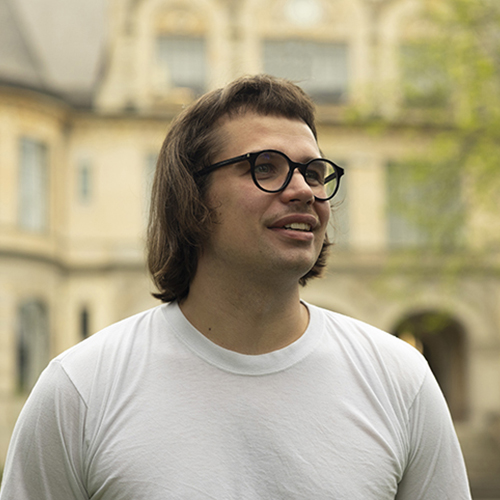
Greg Rahuoja on the UW campus, with Denny Hall in the background.

Supporting a Threatened Language

For his UW master's in Scandinavian Studies, Estonian student Greg Rahuoja addressed political and practical challenges for Khanty, an Indigenous language spoken in parts of Siberia.