
abstract pattern in blues and greens

How to Persuade People: A Philosopher's Perspective

Back to All Perspectives Stories
Nancy Joseph 10/26/2026 November 2026 Perspectives
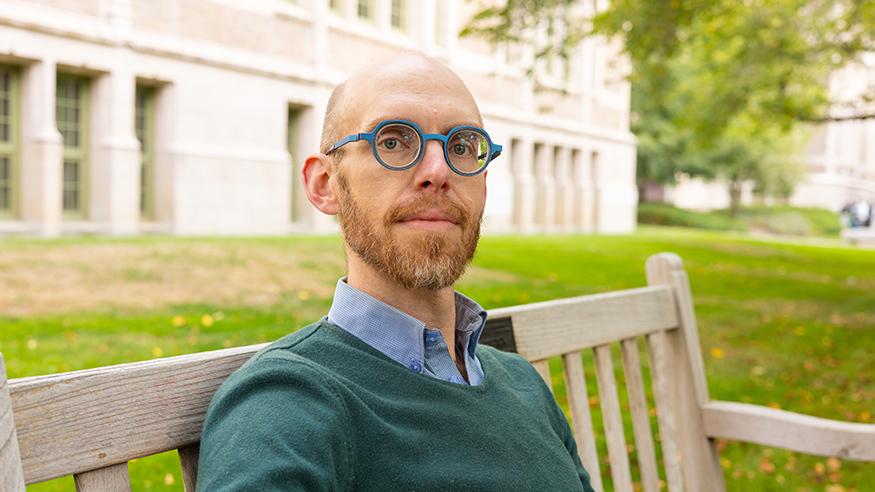
Colin Marshall sitting on a wooden bench on the UW campus.
Philosophy professor Colin Marshall incorporates philosophy and social psychology research on persuasion in his new book, "Just Hear Me Out," written for a general audience. Photo by Juan Rodriguez. 

At a family gathering, a cousin launches into a tirade about vaccinations or immigration or some other hot button issue. You vehemently disagree with his views. Should you push back and risk a shouting match, or excuse yourself and walk away?

Colin Marshall believes there’s another option: civil persuasion. In his new book, “Just Hear Me Out: How to Change Minds Without Lies, Bullshit, or Moral Compromise,” Marshall outlines this approach, with compelling real-life examples that demonstrate how civil persuasion is good for both our conscience and our communities.

“This is not a book for people who are looking for a list of tricks to persuade people,” says Marshall, UW professor of philosophy. “It’s a book for people who wouldn’t normally buy a persuasion book because they don't want to manipulate anyone."

Persuasion Without Trickery

Bright red cover of Colin Marshall's book, "Just Hear Me Out."
Colin Marshall's book, "Just Hear Me Out," published by the University of Chicago Press. 

Marshall chose to research effective persuasion after witnessing increased polarization in the US and recognizing that the usual ways of developing arguments were not changing people’s minds. With support from a Gerler Faculty Fellowship from the Department of Philosophy, Marshall enlisted UW social psychology PhD student Terrènce Pope to help him dive into existing persuasion research. Marshall learned that using tricks to change people’s minds often yields short-term results at best and can seriously backfire.

Consider a smear campaign that employs emotional triggers to disparage an opposing candidate. “You might sway a few people, but it’s not going to do much,” Marshall says. “And if people realize they’re being tricked, there’s the sense of, ‘I know what you’re trying to do and I don’t like it.’ The blowback can be nasty.”

Marshall believes that civil persuasion is a more successful and ethical approach. He describes civil persuasion as taking another person seriously and engaging with them sincerely, recognizing that they may have things to teach you as well.

Of course, that can be easier said than done, particularly if you clash on issues of great importance to you. So Marshall gets more specific about possible approaches, offering real-life examples.

Leading with Respect and Compassion

Inspired by the work of German philosophers Immanuel Kant and Arthur Schopenhauer, who have very different views on human nature, Marshall identifies two parts of civil persuasion: respect and compassion.

“Respect” relates to Kant’s belief that ethics are grounded in human reason rather than emotions. “A lot of us care about being seen as rational beings,” says Marshall. “It really stings if someone dismisses us as hopelessly irrational. So respect is the part of civility where you’re taking someone seriously as a person you can reason with. That doesn’t mean they’re perfect, or right, or even reasoning well. It just means they’ve got the capacity to reason with you, to recognize mistakes, and to potentially teach you something even if they’re wrong about a lot.”

Illustration of two heads facing each other in profile, with text bubbles above their heads.

In his book, Marshall offers the powerful example of Daryl Davis, a Black musician who convinced dozens of Ku Klux Klan members to leave the Klan. “Part of what’s striking is that Daryl Davis is constantly learning about the Klan,” says Marshall. “He knows a lot about the system because he seriously engages with people. He’s not open to being persuaded that he’s subhuman, which some of them think he is, but he’s still interested in learning something from them, and I think that’s part of why he’s effective. They can tell he’s actually listening and learning, which is really powerful.”

That ability to interact with respect in a situation that is emotionally charged is unusual. Not everyone can manage that approach, and not all situations warrant it. Sometimes, compassion takes the lead instead. For inspiration in addressing compassion, Marshall looked to Schopenhauer.

...if you just get someone to register an idea, then months or even years later might be when it actually clicks and they change their mind.

Colin Marshall Professor, UW Department of Philosophy

“While we want to be seen as rational, Schopenhauer points out that’s not the core of who we are,” says Marshall. “We’re these often emotionally insecure beings that are intensely embodied, with more going on in terms of emotional baggage than we want to let on. So, if you’re just treating people like rational beings and expect a rational conversation, some people might not feel fully seen. I found examples where it was very clear that compassion had to come first.”

Consider the approach of Life After Hate, a nonprofit that helps people leave extremist hate groups. Rather than engaging with individuals about their hate group’s extremist beliefs, Life After Hate leads with compassion, expressing concern for an individual’s well-being if they seem to be struggling. In such situations, persuasion will take time, but compassion may lead to those reasoned conversations later, when an individual is ready.

Providing Food for Thought

And if you cannot muster respect or compassion no matter how hard you try? Marshall admits that sometimes it’s best to disengage and step away.  “Even if you want to change someone’s mind, you also have to look out for yourself,” he says. “There are times when that takes priority.”

Professors Colin Marshall and Jose Jorge Mendoza in front of bookshelves in a bookstore.
Marshall (left) in conversation with UW philosophy professor José Jorge Mendoza at an event to launch Marshall's book. Photo by Juan Rodriguez.

But, he adds, there may be a middle ground. If a political disagreement arises at the Thanksgiving table, for example, there is the option to acknowledge it and suggest a future conversation rather than continuing to butt heads.

“You don’t need to avoid the disagreement entirely, but don’t try to persuade someone right then and there, where there’s an audience and performative pressure and lots of distractions,” says Marshall. “Instead, it can be an opportunity to say, ‘Hey, would you want to hash this out over a beer sometime?’ That is an expression of respect and interest in having the conversation.”

Marshall notes that even in the best of circumstances, it’s unrealistic to expect one conversation to change people’s minds on deep-seated beliefs. Truly effective persuasion is a long process. For Daryl Davis and Life After Hate, success often requires multiple conversations over long periods of time.

Still, Marshall believes a single conversation using civil persuasion can provide a seed that might germinate later.

“The most liberating insight I got from social psychology on this was that sometimes, if you just get someone to register an idea, then months or even years later might be when it actually clicks and they change their mind,” he says. “I think this makes civil persuasion a little less stressful. Maybe, in the moment, you just give each other food for thought.”

More Stories

Arianna Long in the UW Planetarium, with galaxies projected on the screen overhead.

Massive Galaxies & Mentorship

Astronomy professor Arianna Long studies some of the most massive and extreme early galaxies and mentors future generations of scientists. 

Portrait of Matthew Golder in his chemistry lab.

A Second Life for Plastics

Chemistry professor Matthew Golder and his research team are exploring ways to alter the chemical structure of plastics to keep them out of landfills.

Professor Nicole McNichols sitting on a bench on the UW campus.

Nicole McNichols Wants to Improve Your Love Life

In her new book, "You Could Be Having Better Sex," psychology professor Nicole McNichols shares frank information based on academic research. 

Explore Stories Across Arts & Sciences Departments