Matthew Yankowitz, associate professor of physics and of materials science and engineering at the University of Washington, is among 21 scientists selected for the 2026 cohort of Experimental Physics Investigators, a distinguished group of mid-career researchers pushing the boundaries of experimental physics.

The Experimental Physics Investigators Initiative was established by the Gordon and Betty Moore Foundation to support creative individuals who have recently received tenure (or its equivalent) and to cultivate collaborative research environments. Investigators are encouraged to tackle interesting new research problems, pivot when necessary, and bring on students and postdoctoral researchers to accelerate their progress. Each Experimental Physics Investigator receives $1.35 million over five years.
In his UW research, Yankowitz studies what happens when sheets of atomically thin materials, such as graphene, are stacked in precise arrangements. He explains that, under the right conditions, the electrons in these materials stop behaving independently and instead act collectively, producing exotic forms of superconductivity, magnetism, and topological states within the same material.
The Yankowitz Lab builds devices in which these quantum states can be switched on and off with applied voltages, allowing a superconductor to sit directly beside a magnet or correlated insulator within a single device, with the boundary between them defined electrically. By studying what happens when these distinct quantum states meet, the lab aims to discover new forms of collective behavior and, ultimately, to develop electronics in which quantum states are programmed by voltage rather than fixed during fabrication.
More Stories
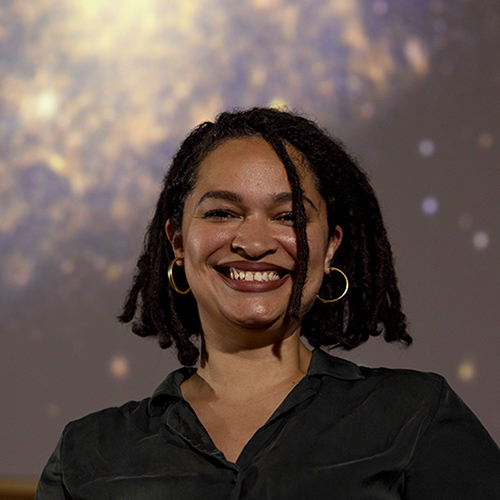
Massive Galaxies & Mentorship
Astronomy professor Arianna Long studies some of the most massive and extreme early galaxies and mentors future generations of scientists.
A Breakthrough Prize, Husky 100, and Other Awards
Recent awards celebrate Arts & Sciences faculty, staff, and students for their research, leadership, and more.
2026 Awards of Excellence
Arts & Science faculty, students, and alumni were among the recipients of 2026 UW Awards of Excellence for their teaching, volunteerism, and innovation.