-
Opinion: What grief taught me about emotional regulation
"On Dec. 30, 2024, my mother, Brenda Louise Baker, died. I have known grief most of my life. I was 9 when my uncle died. By high school, death no longer felt shocking. It felt familiar. I decided I wanted to become a pathologist, as if understanding the science of death might quiet the ache it caused," writes KD Hall, affiliate instructor of communication leadership at the UW. -
UW MFA students build literary community with Castalia
“[Castalia is] a wonderful space for us to celebrate the hard work that we're all doing,” Em Beckert, a second-year MFA student, said. “On the first level, it was really hard to get into this program, and on the second level, it's really hard to be here and to keep writing and to move your life, in some cases across the country, and to find your voice and just to celebrate all of that.”
-
10 new art shows in India we’re excited about this April
Associate Professor Sangram Majumdar was recently featured on Vogue India for his solo exhibition Bad Actors at Galerie Mirchandani + Steinruecke in Mumbai, India.
-
Digital sphinx raises questions about connectome models
A neural network based on a nematode worms connectome can puppeteer a digital fruit flys body, a new preprint shows. The work comes just two weeks after Eon Systems, a neurotechnology company based in San Francisco, announced that it had uploaded a fly brain and released a video of that brain controlling a biomechanical fly model in a virtual world. Bing Wen Brunton, professor of biology at the UW, and John Tuthill, professor of neurobiology and biophysics at the UW, are quoted. -
Sharing Shakespeare
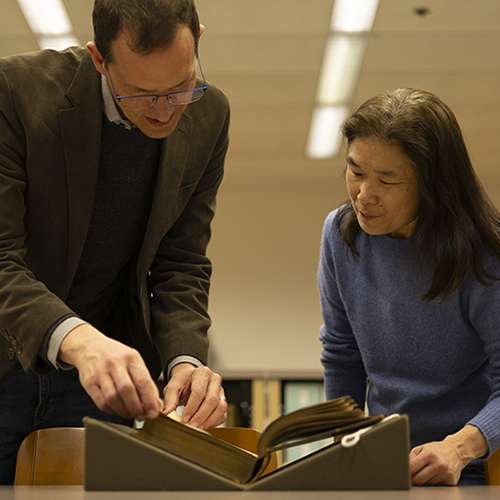
Thanks to a School of Drama connection, an 19th-century illustrated Shakespeare edition with an interesting backstory is now part of UW Libraries Special Collections.
-
Early data from Rubin Observatory reveals over 11,000 new asteroids
Using preliminary data from the Simonyi Survey Telescope at the NSFDOE Vera C. Rubin Observatory, scientists have discovered over 11,000 new asteroids in our solar system. The findings include hundreds of distant worlds beyond Neptune as well as 33 previously unknown near-Earth objects.
-
These birds suck literally
New research reports that sunbirds use suction from their tongue to sip nectar. The find is the first example of any vertebrate drinking through suction generated by the tongue alone, rather than by changing the shape of its mouth. A UW research project is mentioned. -
Mosquito research in Washington could help improve future repellents
New research at the University of Washington could help scientists develop better mosquito repellents as mosquito season grows longer in parts of the Northwest. Jeff Riffell, professor of biology at the UW, is quoted. This story was republished in numerous outlets.
-
These "living fossils" have roamed the oceans for 500 million years
A University of Washington-led team discovered that modern Nautilus and Allonautilus species inhabit deeper waters than their extinct ancestors did over 500 million years ago, with juveniles living at twice the depth of mature adults. -
Woven Wonders: Coast Salish weaving, past and present, on view at the Burke Museum
On display now at the University of Washingtons Burke Museum of Natural History and Culture, Woven in Wool: Resilience in Coast Salish Weaving examines the traditional art form and its importance to Coast Salish communities. Kathryn Bunn-Marcuse, associate professor of art history at the UW and curator of Northwest Native American Art at the Burke Museum, is quoted.