The Birth of Curiosity Clinics
As one but not the only outcome of our work together (a report on the outcomes of the broader Futurist experiment is forthcoming), the Futurists designed an experimental instructional model, the Curiosity Clinic, to be nested within gesture. So named by Professor Ellwood Wiggins (German Studies, participant in the Futurist group AY 23-25), the Curiosity Clinics combine transformational experience with the “growth mindset” and story-as-learning skills that are the focus of the gesture Lab. We recruited gesture students into the first round of clinics as opportunities to more deeply explore how people become curious, develop wonder, and learn to become active novices across domains. We also sought to produce courses that could be rapidly launched with relatively little associated burden, that would be experimental in their transdisciplinarity and pedagogical approach including the possible integration of AI technologies and place-based learning, and that would be energizing for all involved.
We have now offered several 1-2 credit Curiosity Clinics, each one designed to be a light lift for students, faculty and staff. To date, the Clinics have included a course taught by Professor Tony Gill (Political Science) in a local grocery store using its setting and contents as a place-based teaching resource, and another focused on Games and Learning taught by Professors Ian Schnee (Philosophy) and Stephanie Kerschbaum (English). A group of the Futurists also offered a cluster of curiosity clinics during our summer College Edge program for entering students under the title “Foundations in Curiosity.” These included courses such as “Geocache Your Story” (Anis Bawarshi), “How to be a Person” (Stephen Groening), “How to be Wonderful” (Tony Gill), “Mini-Podcasts” (Michelle Habell-Pallan), and “Space, Time and Modern Architecture” (Vikram Prakash).
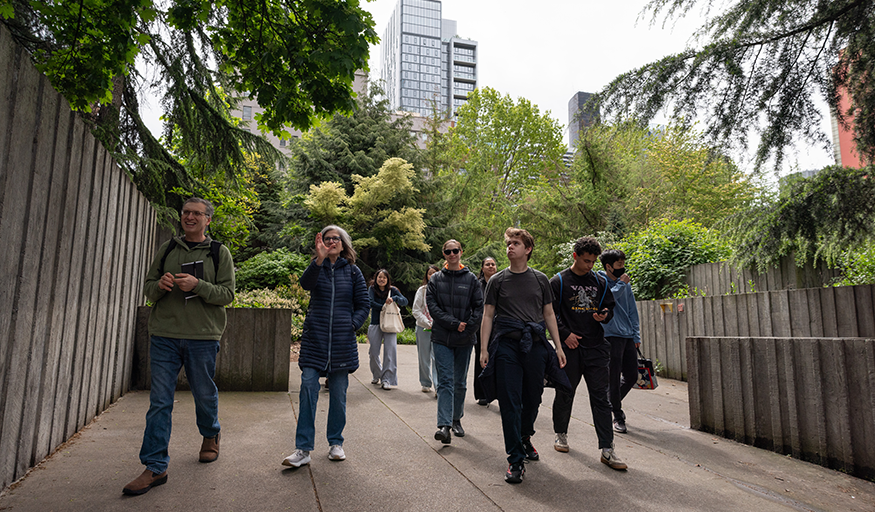
Last spring, we (Dianne and Anis) led a Curiosity Clinic that focused on the topic of Stories, Places, and Civic Engagement. We took a group of students on a Saturday field trip to visit two urban spaces located in downtown Seattle: The Freeway Park which spans I-5 connecting the First Hill neighborhood to downtown, and the newly constructed Waterfront Park built after the demolition of the Alaskan Way Viaduct that had separated the city from its waterfront.

Though one was designed and constructed in the mid-1960s through the 1970s, and the other is only recently completed, both resulted in different ways from the damage created by highways that severed parts of the city; both parks ultimately resulted from the leadership and deep commitment of visionary, charismatic and dedicated civic leaders: the late Jim Ellis (Freeway Park) and UW Regent Maggie Walker (Waterfront Park). The goal was to help the students understand how big, civic projects can have lasting impacts; require long vision, collaboration, determination, organizing and civic acumen, and a commitment to the good of the whole over the interests of the personal; and shape how we make connections between, experience, and tell stories about places.
For the clinic, we took the students on the light rail to downtown first to visit the Freeway Park and then we walked to the Waterfront, ate lunch together, and then met with Regent Maggie Walker to hear about the civic history of the project. While each stop was deliberately chosen, it was also the journey and transitions in-between that proved just as important.
Before becoming a historian of the built environment and later a Dean, Dianne studied landscape architecture and worked in the early 1980s for the firm that designed connections from Freeway Park to the Washington State Convention and Trade Center, so from that experience we had knowledge of that site’s history and of Jim Ellis’s important civic leadership that helped make it possible. Because both Freeway Park and the Waterfront were dramatic attempts at creating re-connections, and given Anis’ scholarly expertise in rhetoric, the Clinic also focused on questions of spatial experience and what it means to pay attention to, connect, move between, and narrate urban spaces.
Together, we decided to structure the clinic around a set of questions:
- How do great civic spaces come into being? What is required of the civic leaders who spend decades or more organizing communities, building coalitions, fundraising, reaching stakeholders/constituent groups, mediating difficult conversations, navigating city regulations/policies and codes, working with design teams, and realizing a vision?
- What does it mean to spend more than fifteen years of your life working towards something that is not for you or about you, and that will at some point have no visible connection to you? What do we owe back to the world(s) we inhabit?
- How do we inhabit transitions and experience moving in slow time between urban places/spaces--a poetics of moving through space? What does it mean to stay in-between something without needing to make it to the next thing? What is the experience of moving in slow time between places and dwelling in sites of articulation?
Ahead of the trip, we asked students to take time during their daily routines to attend to the in-betweens/transitional spaces: what they are attuned to and inclined to ignore; how junctures stitch relationships between places; and what stories they tell themselves about how the places they move between are connected.
Lessons Learned
So what did we learn from teaching our first Curiosity Clinic and how was it different from other courses that follow the “high-impact practices” first identified by George Kuh that are now frequently implemented in colleges and universities and that are typically characterized by small class size, increased interaction with faculty, field trips, and engaged research experiences among other things? To be sure, the clinic shared some of those characteristics. But the Curiosity Clinic was also a different way to organize our work in the university and—importantly—to teach differently in a particularly difficult time and in ways that restored joy and wonder for faculty and students alike, all done during the span of about six hours.

During the clinic, the interstitial experience of dwelling in-between and connecting across places included the way we experienced disciplinary knowledges, which became subordinated in the service of curiosity as we moved through the city, discussed what we saw no matter what it was, and asked questions as we moved through space. We, along with Maggie, brought various disciplinary backgrounds and expertise to the clinic, but the questions we posed did not fit neatly into our fields of expertise though they overlapped with them.
We learned that our Curiosity Clinic required a leap of faith—for us and for our students. We didn’t know how it would go, we didn’t know exactly what we and they would see. We had to trust that we could make something hopefully transformative and memorable from an unconventional experience that did not require an elaborate website/LMS, or a many-page syllabus, or even a lot of pre-planning or pre-reading. We just did it. And we had fun.
Thanks to Maggie and the students and with support from our colleagues in the gesture Lab, we were able to realize a successful proof-of-concept for this experimental model of instruction. As we rode home together on the light rail, the students conveyed their excitement over what they had experienced during the day. One of the students, Miles Zaner, wrote afterwards that he found the clinic to be “...extremely enlightening in terms of understanding not only transitions in everyday life but the immense amount of effort that goes into these projects.”
What we have done so far with the Curiosity Clinics can be described as “little bets,” a concept popularized in Peter Simms’ book of the same title. They are opportunities to experiment, to take little bet, low-stakes risks that permit relatively rapid reiteration for further experimentation. They are not meant as a substitute for what we currently do as university faculty, but they can be used as a structure to rapidly test pedagogical experiments. By themselves they don’t shift a transactional mindset motivated by the need to declare a major and obtain a degree. On the surface, they may not seem particularly futuristic. But we see ways that our proof-of-concept with its emphasis on distinctively place-based learning, disciplinary elision, and its malleable “knowing with” structure could help us radically redesign the university through an emphasis on the transformational aspects that come from leading with curiosity.
Anis Bawarshi is the Thomas L. and Margo G. Wykcoff Endowed Professor of English at the University of Washington
Dianne Harris is the Katherine and John Simpson Endowed Dean of the College of Arts & Sciences and Professor of History at the University of Washington
More Stories
Awards for Research, Podcasts & More
Recent awards celebrate Arts & Sciences faculty for their research, outreach, lifetime achievements, and more.
What Students Really Think about AI
Arts & Sciences weigh in on their own use of AI and what they see as the benefits and drawbacks of AI use in undergraduate education more broadly.
10 Arts & Sciences Stories from 2025
As 2025 comes to a close, we're sharing some of the year's top Arts & Sciences stories.