stock photo of audio engineering equipment

Pairing Music & Technology

Back to All Perspectives Stories
Nancy Joseph 05/05/2026 May 2026 Perspectives
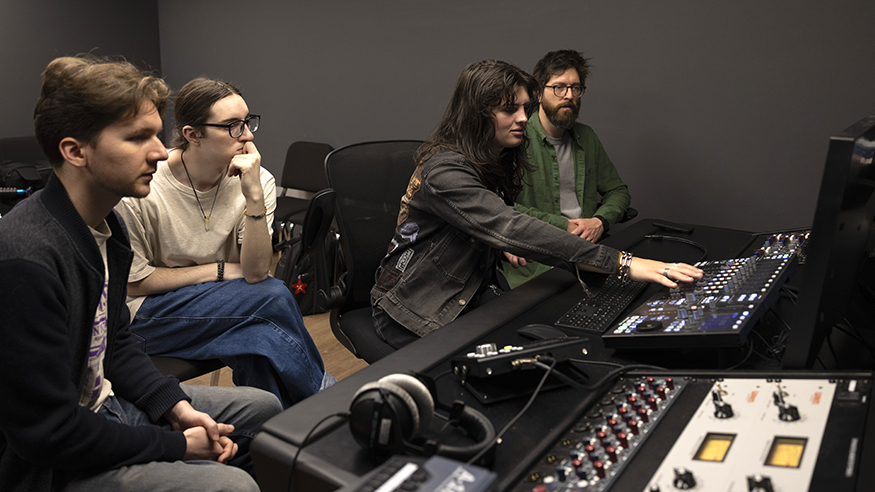
Four students work with recording equipment in the recording studio.
Students in "Recording Techniques," a UW School of Music course, work on a project in the Music Building's recording studio. Photo by Juan Rodriguez. 

While a jazz ensemble performs in a rehearsal space in the sub-basement of the University of Washington Music Building, students in an adjacent room — visible through a large window in the wall — work with recording equipment to capture the music’s complexity.

It’s just another class session for students in Studio Recording Techniques, a three-course sequence offered through the School of Music’s new Music and Technology program. Introduced in fall 2024, the Music and Technology program is designed to provide a foundation in music recording.

“Making recordings is such a core part of our musical experience these days,” says Andrew Munsey, assistant professor of music, who heads the program. “If folks want to have a creative practice and perhaps a professional practice, understanding the practicalities of being a recording artist is part of that.”

In addition to hands-on technique courses, the Music and Technology Program offers an introductory lecture course on the fundamentals of sound recording. A course on the history of music recording will be added to the curriculum in the coming year.

New Tech in an Old Building

Long before Munsey joined the UW faculty, School of Music professor Ted Poor had spent years advocating for a music technology program. He secured a UW Program Renewal Grant for renovation of spaces in the Music Building to create a recording studio and — with broad faculty support — spearheaded the hiring of an expert in music technology to lead the program. School of Music director Joël Durand has provided dedicated, ongoing support beyond the original grant. 

Munsey was a perfect fit to head the new program as a Grammy-nominated recording engineer, jazz musician (drums), composer, and music producer with a passion for music recording.

A [recording] studio is such a powerful thing, and being able to function and work in one lets you create so much.

Rory Somers Graduate Student, Jazz and Improvised Music, UW School of Music

“Most of the music I connected to growing up was recorded music,” Munsey says. “Of course I have a connection to live music as most musicians do, but I was always really fascinated with the inner workings of how the recording itself was made.”

Before Munsey could share his knowledge and enthusiasm with UW students, he had to contend with the realities of the studio space. The Music Building is more than 75 years old, and the small room identified for a recording studio had a single electrical outlet to accommodate all the recording equipment.

“Professional recording environments are usually purpose-built, from the material in the walls to the whole architecture of the place,” Munsey says. “That was never going to be a possibility here, since we had to use existing spaces. But though we don’t have the perfect hygienic laboratory for music exploration, we have been able to create an environment that invites collaboration in making music.”

A High Learning Curve

Collaboration is at the heart of Munsey’s recording techniques courses, with students functioning as a team after gaining basic knowledge of the studio during the first quarter of the three-course sequence.

“The studio itself has a high learning curve,” says Rory Somers, a trumpet player and graduate student in Jazz and Improvised Music, who is taking the year-long course. “It is a very large jump from working on a personal computer to using professional audio equipment and software.”

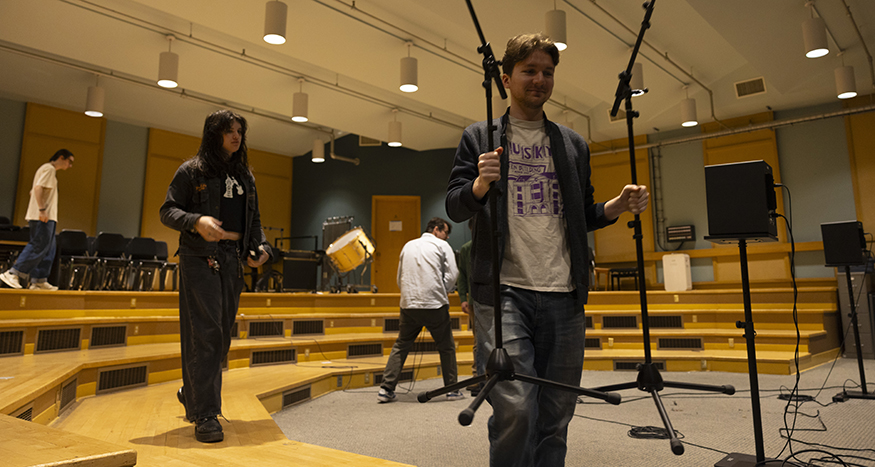
Students grad microphone stands in a performance space.
Students set up recording equipment in the performance space adjacent to the recording studio. Photo by Juan Rodriguez. 

The second quarter, the students put their newfound skills to the test. The class teams up with Ted Poor’s Jazz Lab course, which is designed to prepare students to work as studio session musicians. The pairing is a win/win: The Jazz Lab students experience actual recording sessions, and the recording techniques students have a jazz ensemble on which to hone their craft. A different student leads the recording team each week.

“Those recording sessions are a high stakes situation,” says Munsey. “If something goes wrong, you have to fix it in the moment. Telling the musicians to come back the next day is not an option.”

The final quarter is more relaxed but no less important. The focus is on the post-production process, during which recorded music can be manipulated to achieve a desired effect.

“This is the other aspect of making recordings, where you get to discover what’s there, to tease it out, to sculpt it, to edit and prepare it for the end listener,” says Munsey, who sees recorded music as an entirely different genre than live music, just as film is a different genre than live theater. “I don’t approach recording as documenting what’s happening when musicians perform live,” he says. “Instead, it’s an opportunity to explore and make the music something completely different in its recorded format versus when you hear somebody perform it.”

Making an Impact

Though students in Munsey’s courses train on professional recording and editing equipment, Munsey prioritizes the basic principles of music recording over specific software.

Andrew Munsey sits at the recording controls while three students observe,
“We want to impart the golden principles rather than the latest fads,” says Andrew Munsey, far left, of the recording techniques curriculum. Photo by Juan Rodriguez. 

“The technical side is changing so fast that we want to make sure we’re not just teaching tools that are going to expire in a few years,” he says. “We want to impart the golden principles rather than the latest fads.”

The recording studio is currently in high demand. Beyond class sessions, students in the recording techniques course seek studio time whenever the space is available, often at night and on weekends. School of Music faculty also use the studio for their own projects.

A second studio space, adjacent to the first, is currently in the works, which will increase access. Thinking long term, Munsey and Poor hope to create a degree program in music technology, which might combine courses in music, acoustics, digital arts and experimental media, electrical engineering, and other disciplines. While that may happen in the future, the Music and Technology program is already making an impact.

“Being able to work with people with all sorts of musical and production experience, under the guidance of an experienced industry professional, in a studio with high quality equipment, is a fantastic way to learn about making music,” says Somers. “I hope to use these skills to continue making my own music and helping others make theirs. A studio is such a powerful thing, and being able to function and work in one lets you create so much.”

More Stories
Maddy Brown in a t-shirt and baseball cap stands on a basketball court.

A Math Course Inspired by TikTok & Basketball

After creating popular social media content analyzing basketball statistics, UW Mathematics doctoral student Maddy Brown created a course to help students present data through storytelling. 

a group of studn

What Students Really Think about AI

Arts & Sciences weigh in on their own use of AI and what they see as the benefits and drawbacks of AI use in undergraduate education more broadly. 

Illustration of a student at a desk, with a computer monitor replacing his head.

AI in the Classroom? For Faculty, It's Complicated

Three College of Arts & Sciences professors discuss the impact of AI on their teaching and on student learning. The consensus? It’s complicated.