Close up of cherry blossoms on a branch, with the roof of a university building in the background.

Supporting a Threatened Language

Back to All Perspectives Stories
Nancy Joseph 05/29/2026 June 2026 Perspectives
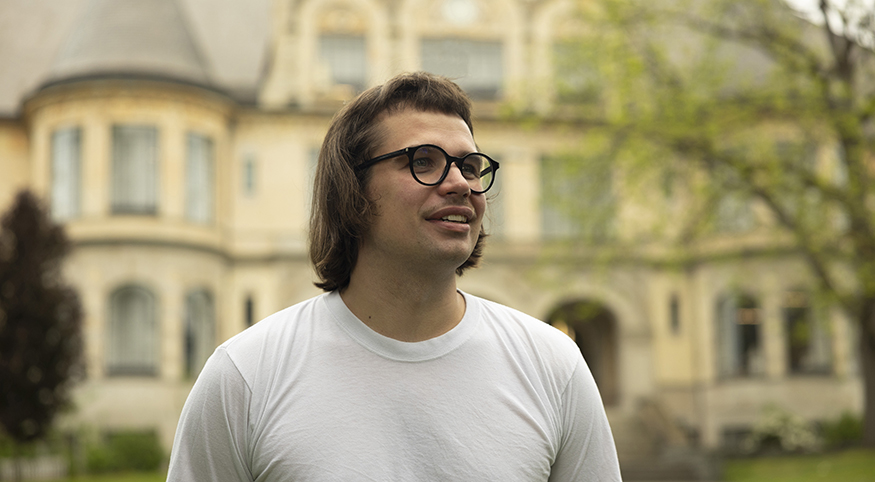
Greg Rahuoja on the UW campus, with Denny Hall in the background.
“Given the current political climate [in Russia], the Khanty have been stripped of political agency to do this work for their own language. That struck a chord in me," Greg Rahuoja says of his master's research focused on the Khanty language. Photo by Juan Rodriguez. 

Fred Gregor “Greg” Rahuoja is fascinated by language — particularly how geography and politics can impact, and sometimes endanger, languages. As a University of Washington graduate student in the Department of Scandinavian Studies, Rahuoja has focused on Khanty, an Indigenous language spoken in parts of Siberia.

With guidance from UW faculty across several disciplines, Rahuoja has explored political pressures that have impacted the Khanty language, while also addressing a challenge in machine translation of Khanty into other languages.

“Given the current political climate [in Russia], the Khanty have been stripped of political agency to do this work for their own language. That struck a chord in me,” says Rahuoja, an international student from Estonia who will earn his master’s degree in June. “And the slice of the digital documentation challenge of the Khanty language which I could solve in a master’s program seemed appropriate.”

An Early Start on Language Learning

Rahuoja has been immersed in multiple languages most of his life. By fifth grade, he had learned three languages in addition to his native tongue, Estonian.

“In Estonia, where only a million people speak your language, it’s a given that you have to speak other languages,” he says. “During general education, we were introduced to French in first grade, Russian in third grade, and English in fourth grade. I’m really glad that I was brought up in such a system, which takes language learning as opportunities.”

Languages ...have the great potential of broadening thinking. But languages need to be nurtured by their users. If there’s no attention to them, we lose worlds.

Greg Rahuoja MA, Scandinavian Studies, 2026

As an undergraduate at Estonia’s University of Tartu, Rahuoja majored in history but was drawn to linguistics and the philosophy of language. His bachelor’s thesis compared the Estonian language spoken in Estonia with the Estonian spoken by emigrants who moved to the US to avoid the Soviet invasion of Estonia in 1944. “It was like their Estonian had been in some sort of time capsule,” he says of the expats. Rahuoja also collaborated with faculty from the University of Tartu on a published paper analyzing a distinct type of slur in Estonian.

After graduating, Rahuoja taught at a high school in a Russian-speaking area of Estonia, then moved to the US when his wife was accepted to a graduate program in California. Over the next year, he taught himself computational methods for natural language processing, which would later figure into his UW research.

Supporting a Threatened Language

Arriving at the UW as a graduate student, Rahuoja reached out to faculty across several disciplines — Guntis Šmidchens in Scandinavian Studies, Shane Steinert-Threlkeld in Linguistics, and Russell Hugo, director of the Language Learning Center — to provide guidance as he embarked on his Khanty language research. He received support from the Department of Scandinavian Studies Endowed Scholarship Fund in Honor of the Nordic Museum as well as support (as an Estonian language teaching assistant) from the Napa Endowed Fund in Estonian Studies and the Baltic Studies Endowed Fund.

Greg Rahuoja sitting by his computer in a UW office.
Rahuoja sought guidance from UW faculty across the humanities as he pursued his master's research. Photo by Juan Rodriguez. 

Rahuoja’s research goal was twofold: a master’s thesis on the impact of Russia’s linguistic policies on Khanty, and a computer program to address a data processing gap in how computers translate Khanty into other languages. He explains that the Khanty people, an Indigenous group living in western Siberia, “are in a linguistically hostile environment” where they are pressured to speak Russian rather than their Indigenous language. As a result, the Khanty language is now classified as threatened.

“The situation is not looking good,” he says. “On the other hand, there is already so much to work with to help the Khanty language.”

Rahuoja points to the development of a digital form of Khanty and a machine translation program for Khanty and other Finno-Uralic languages (which include Estonian), created by researchers at University of Tartu, his undergraduate alma mater. But along with these promising developments for Khanty, there have been challenges.

The data set for the Khanty language is very small, while language models for machine learning programs prefer large amounts of language data. Also, the standardized system for writing Khanty has been revised three times since the 1990s due to linguistic policies imposed by the Russian government. Most of the variations are subtle — a hook, tail, or descender added to a character — but having all three versions in the language data confuses machine learning programs.
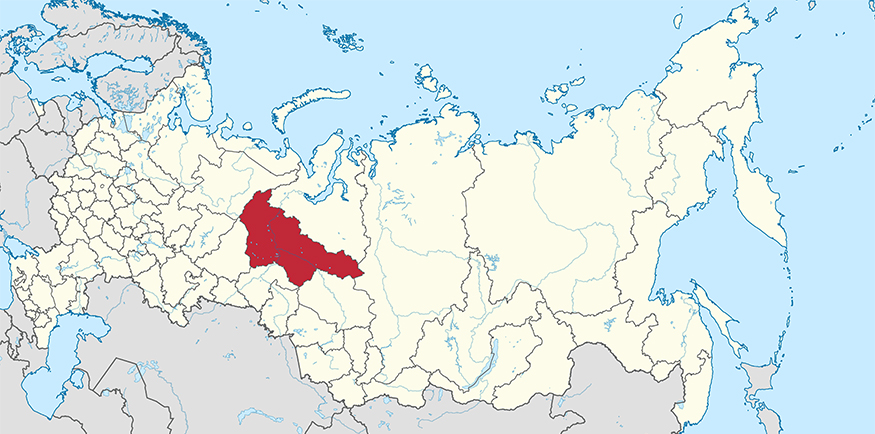
Map of Russia showing Khanty area in red.
Khanty is spoken in the Khanty-Mansia region of Western Siberia, shown here in red. Image from Wikimedia Commons. 

“The thing that is being expressed is the same, and all the people who read it can process this, but machines cannot,” says Rahuoja. “Even if the entire word is the same and used in the same context, you may get three different translations because of that very slight change in one of the characters.”

Rahuoja has written a piece of code that standardizes some of these confusing characters, translating the different versions into a single version that machine learning algorithms can process. “Users can still input the information in their preferred way, but behind the scenes, the system is able to accept those and process them in one consistent way,” he says.

Opening Worlds Through Language

Along with his computational work, Rahuoja has researched linguistic policy in Russia and its effect on languages like Khanty. One focus is Russia’s Foreign Agents Act of 2022, a revision of Russia’s foreign agent law, which seeks to prohibit any foreign influence in Russia and provide judicial basis to arrest journalists. As a result of this act, Rahuoja and other researchers must work with Khanty language data collected before the foreign agents act was updated, to avoid putting Khanty communities at risk.

“I by no means want to take the Khanty’s agency from them, and I do my best to understand the precarity of their situation,” says Rahuoja. “That’s a significant part of my research — to offer an argument for why it is okay to work with this data from a distance, because there aren’t opportunities to work on it there.”

Rahuoja will return to Estonia after graduation, with the goal of working in computational linguistics with a focus on endangered or low-resourced languages.

“Languages open worlds,” he says. “They expose you to patterns of thinking that you might not have experienced in the languages you were using before, so they have the great potential of broadening thinking. But languages need to be nurtured by their users. If there’s no attention to them, we lose worlds.”

More Stories

Hunter Jung in a research lab, with shelves of lab equipment on either side of her.

Before Med School, A Year in Paris

Graduating with bachelor's degrees in neuroscience and French, Hunter Jung is heading to France for a cognitive neuroscience program that reflects both interests.

Scott Magelssen and Julie Tanaka look at an illustrated Shakespeare book donated to UW Libraries.

Sharing Shakespeare

Thanks to a School of Drama connection, an 19th-century illustrated Shakespeare edition with an interesting backstory is now part of UW Libraries Special Collections. 

Illustration of a student at a desk, with a computer monitor replacing his head.

AI in the Classroom? For Faculty, It's Complicated

Three College of Arts & Sciences professors discuss the impact of AI on their teaching and on student learning. The consensus? It’s complicated.