A pink sunset in Paris, with the Seine in the foreground and the Eiffel Tower in the background.

Before Med School, A Year in Paris

Back to All Perspectives Stories
Nancy Joseph 06/01/2026 June 2026 Perspectives
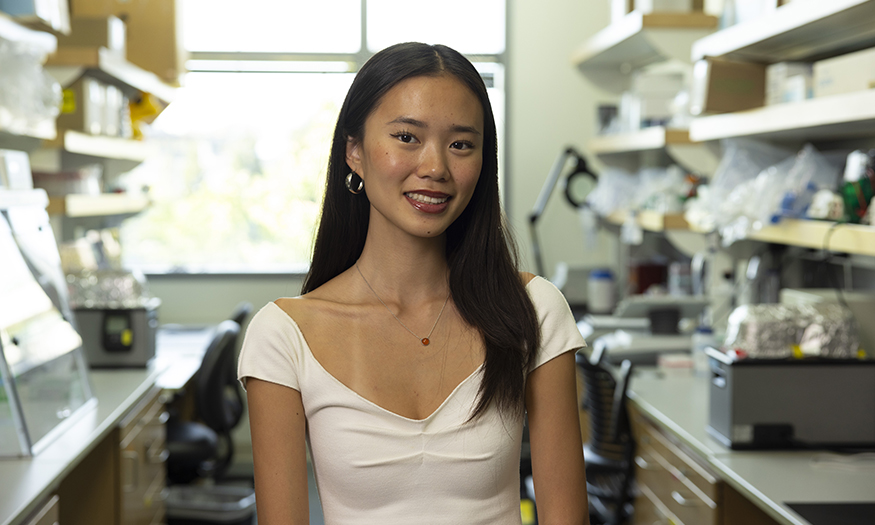
Hunter Jung in a research lab, with shelves of lab equipment on either side of her.
Hunter Jung (in the School of Medicine lab where she conducts research) was awarded a Lafayette Fellowship to study cognitive neuroscience in France. The fellowship is a perfect fit given Jung's two UW majors, neuroscience and French. Photo by Juan Rodriguez.

Hunter Jung’s grandfather always wanted a family member to pursue a medical career. When Hunter showed interest, he began calling her Dr. Jung.

She was in grade school at the time.

“My hal-abeoji (Korean for “paternal grandfather”) would only refer to me as Dr. Jung for a really long time,” recalls Jung, who graduates from the UW College of Arts & Sciences in June with a BS in neuroscience and a BA in French, and a minor in public health from the School of Public Health.

Jung does plan to become “Dr. Jung” someday. She is applying to medical schools for 2027. But first she will pursue a master’s degree in cognitive neuroscience. Her grandfather won’t see her earn a medical degree — he passed away from Parkinson’s disease in 2018 — but he still inspires her. It was his illness that led her to study neuroscience.

“Parkinson’s is a really common non-curable neurological disease,” she says. “I want to find a cure. That’s a major reason why I chose the neuroscience major at the UW and why I’m pursuing a master’s program in cognitive neuroscience before medical school.”

Neuroscience & Croissants

Jung will attend the Cog-SUP master’s program at Université Paris Cité and Sorbonne University in Paris as an inaugural fellow of the Lafayette Fellowship, funded by the French Embassy in the US and Villa Albertine. She could imagine no better way to weave together her UW studies in neuroscience and French.

“I never thought I’d apply to a fellowship at this level, but it just sounded so fitting for me that I figured I might as well go for it and see what happens,” she says.

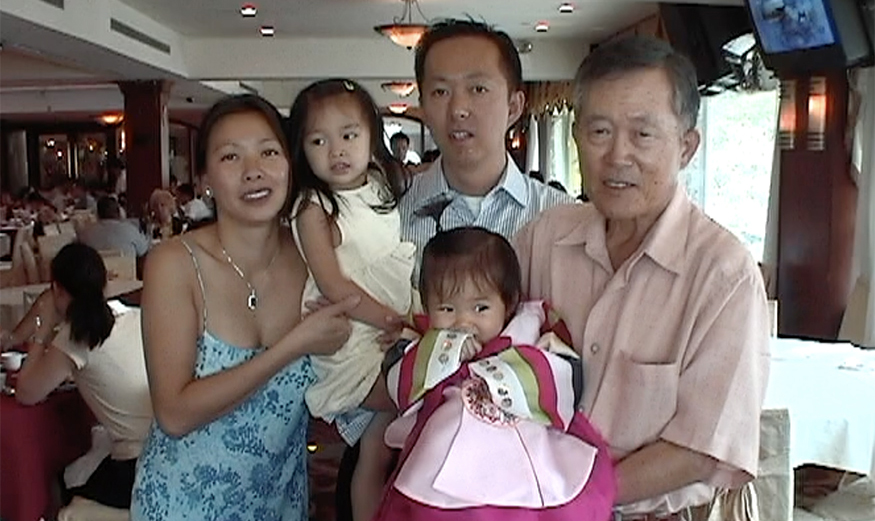
Hunter Jung as a baby, with her parents, grandfather, and sister.
Jung, in pink, is held by her grandfather in a family photo. Before long, he would begin calling her "Dr. Jung." Photo courtesy of Hunter Jung. 

After studying French for years, Jung is eager to speak the language in Paris. She’s visited France only briefly before, traveling with her family after high school. “I had to translate for them the whole time,” she laughs.

Jung had several reasons for studying French, including the desire to be multilingual and think beyond STEM. But there’s also the dream of one day volunteering as a physician with Médecins Sans Frontières  (Doctors without Borders), providing medical services in francophone regions such as Haiti and West Africa. She explains that Médecins Sans Frontières, a French NGO, prefers volunteers who speak French. “If you’re going to work in francophone areas, it’s really important to connect with those patients by speaking their language,” she says.

Yet majoring in French has been about more than mastery of the language. Jung studied francophone literature and cultural history, including the impact that colonization has had in France and other francophone regions. For an independent research project, she and Richard Watts, associate professor of French, researched how French colonial medical systems established racialized hierarchies, and how those hierarchies continue to shape inequities in modern global health systems in West Africa. “I’ve learned so much through my French professors,” Jung says. “They have been so encouraging and knowledgeable.”

Small Programs, Strong Connections

Jung is equally passionate about neuroscience. She chose the UW in large part because of its undergraduate neuroscience program, which focuses on the nervous system with the goal of understanding higher brain function and neurological disease at the cellular and molecular level. The program is interdisciplinary, with courses taught by both College of Arts & Sciences and School of Medicine faculty.

Like the French major, the undergraduate neuroscience program is small, which means faculty know their students well. “I have a close relationship with all my professors,” Jung says of the program. “It’s been an incredible experience overall.”

Outside of class, Jung has worked in research labs since her sophomore year. In the School of Medicine’s Beliveau and Schweppe labs, she is currently conducting fluorescence in-situ hybridization experiments to better understand how different modes of stress — heat stress, chemical stress, osmotic stress — impact the cellular stress response.

I think being able to spend time in a mindset that’s humanities-driven is really important, especially for students going into medicine, where everyone is so STEM focused.

Hunter Jung BA, French, BS, Neuroscience, 2026

That research experience will serve Jung well as a future doctor. So will her hands-on experience as an emergency medical technician (EMT). Jung completed EMT training in 2023, then worked with Northwest Ambulance, transporting patients between facilities such as hospitals and skilled nursing facilities. She is currently an EMT at Pioneer Health Services’ King County Diversion Center, where individuals experiencing chronic homelessness and intoxication can spend the night to get sober and sleep. As an EMT, Jung monitors the visitors’ vitals, since overdoses, cardiac arrest, and other crises can arise during the night.

Back on campus, Jung has found community with other future physicians through the Phi Delta Epsilon International Medical Fraternity, which she joined as a first-year student. The organization hosts MCAT workshops, networking events and more, including an annual anatomy fashion show -- everyone wears body paint to resemble different body systems — as a fundraiser for Seattle Children’s Hospital. This year, Jung is the medical fraternity’s Secretary & Risk Management Officer.

All of these activities are preparing Jung for a career in medicine, but they have brought other benefits as well. She has gained close friendships through the medical fraternity, community connections through her EMT work, and diverse ways of thinking through the study of both humanities and STEM disciplines. Jung wishes more students would pair their STEM studies with humanities courses.

“I think being able to spend time in a mindset that’s humanities-driven is really important, especially for students going into medicine, where everyone is so STEM focused,” she says. “Being open to different opinions and perspectives I wouldn’t hear about in STEM has impacted me in so many ways. I’m grateful for both of my degrees.” 

More Stories

Greg Rahuoja on the UW campus, with Denny Hall in the background.

Supporting a Threatened Language

For his UW master's in Scandinavian Studies, Estonian student Greg Rahuoja addressed political and practical challenges for Khanty, an Indigenous language spoken in parts of Siberia. 

Scott Magelssen and Julie Tanaka look at an illustrated Shakespeare book donated to UW Libraries.

Sharing Shakespeare

Thanks to a School of Drama connection, an 19th-century illustrated Shakespeare edition with an interesting backstory is now part of UW Libraries Special Collections. 

Maddy Brown in a t-shirt and baseball cap stands on a basketball court.

A Math Course Inspired by TikTok & Basketball

After creating popular social media content analyzing basketball statistics, UW Mathematics doctoral student Maddy Brown created a course to help students present data through storytelling.