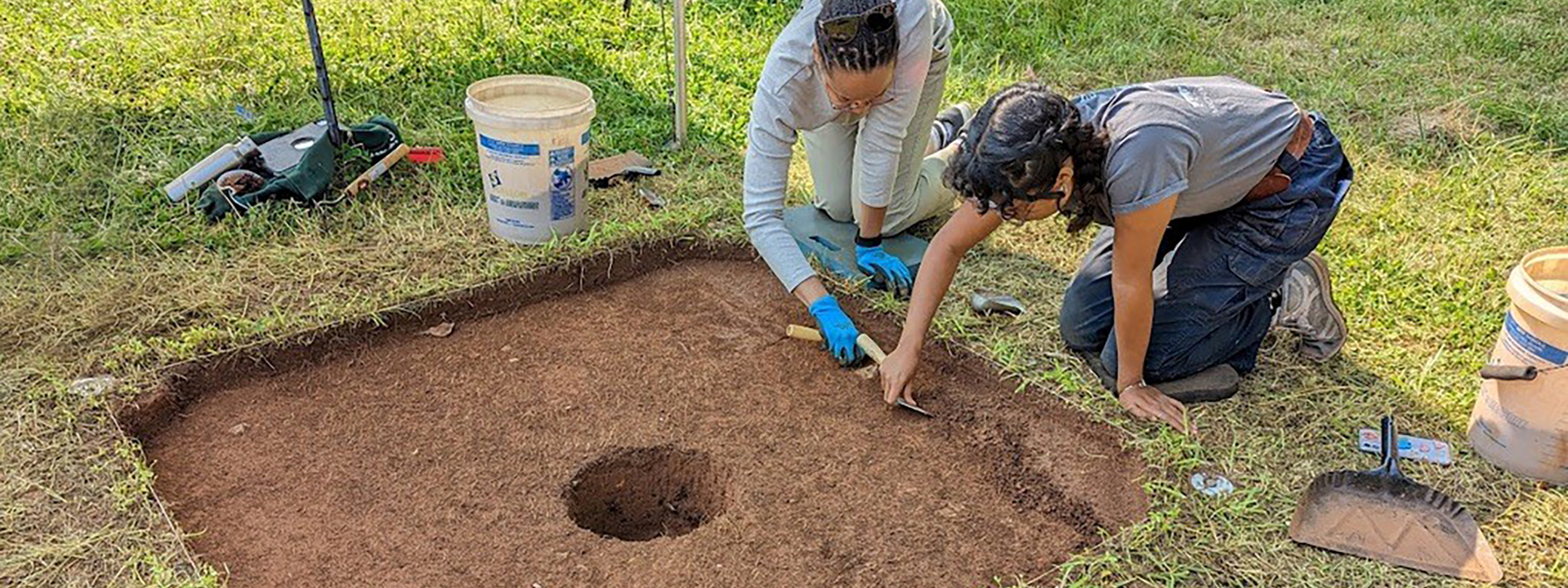
Two students excavating in a shallow excavation area at a former plantation.

Unearthing Clues to Past Lives

Back to All Perspectives Stories
Nancy Joseph 06/01/2026 June 2026 Perspectives
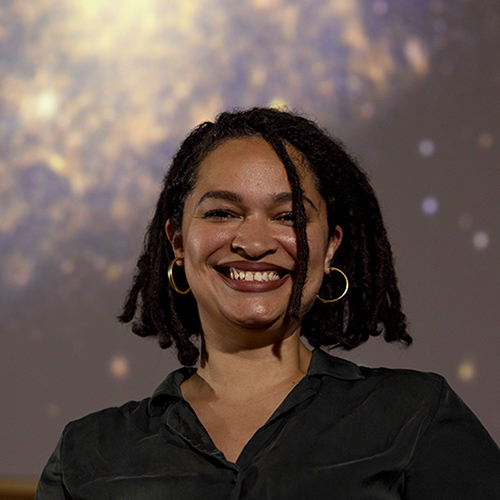
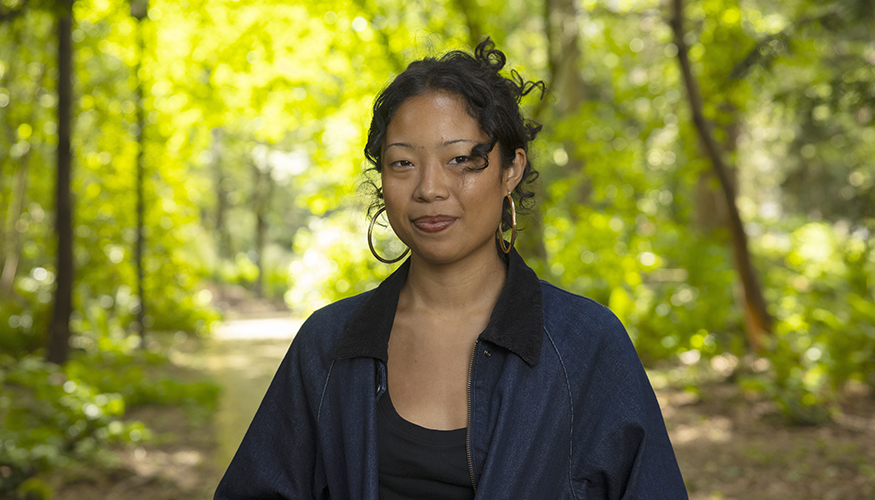
Raquel Matthews on the UW campus, with trees in the background.
“I find myself deeply moved, time and time again, when I am able to commune with past generations' stories — especially when those stories have been deliberately obscured,” says Raquel Matthews, who graduates with a BA in anthropology in June. Photo by Juan Rodriguez.

Raquel Matthews likes to dig for information, sometimes literally. For the past three summers, she has participated in excavations at a former plantation to learn more about the lives of the enslaved people who lived there.

The former plantation, Montpelier, is well known and often visited as the home of President James Madison. But there is still much to learn at the site several centuries later.

“I’ve always been interested in creative ways to approach history, beyond written documents and texts,” says Matthews, a University of Washington anthropology major who will graduate in June. “There’s a lot of value in written materials, but I think when paired with other kinds of sources, you just get a richer, more complicated and interesting picture.”

A Plantation Full of Stories

Matthews took her first archaeology course as a first-year student at Reed College and was immediately intrigued. Her professor told her about the Montpelier Museum’s summer archaeology field school, which offered a grant for African American students to participate. Matthews jumped at the chance.

She and other students excavated a site at the plantation that was likely an overseer’s dwelling. Most of what they unearthed were common objects, such as sherds from broken pots.  “The plantation had enslaved overseers and free overseers at different times, so there’s a very complex history there,” says Matthews. “That was really interesting to learn about.”

Raquel Matthews and another person excavate inside a small square (about 5 ft. x 5 ft.) dug into the ground.
Matthews and a colleague excavate a small area of the former Montpelier plantation. Photo courtesy of Raquel Matthews. 

Upon returning to Reed, Matthews realized she preferred a larger school, so she transferred to the UW. But she continued to spend her summers at Montpelier as an intern. The summer following her sophomore year, she worked on a team delineating the perimeter of an enslaved burial ground; the next summer she worked in the Montpelier Museum’s archaeology lab processing artifacts and helped excavate a blacksmith’s dwelling.

“There are a huge range of projects at Montpelier because presidential plantations, elite plantations, are massive,” says Matthews. “There were just so many people living there, spanning a good amount of time. There are so many different stories, entangled in each other.”

The burial ground project was particularly impactful for Matthews. That project was led by a committee made up of descendants from Montpelier’s enslaved community, who were designing a memorial for their ancestors. They wanted to ensure that the memorial would not be built on top of any graves.

Most of what the excavation team found were trash deposits from later occupations, once Montpelier was no longer a plantation. That was a relief , but also deeply saddening for Matthews.

“The space deserved and deserves a lot more respect than being treated as a dumping ground,” she says. “If I didn’t have a good idea of how important that project was to the descendent community, I suppose it might have felt tedious, but honestly, I was a little bit on edge the whole time, hoping we didn’t come across anything. Just in general, it’s very emotionally difficult to be working at a site like that, especially as a Black student. I was so grateful for my Black peers. We always came together during hard moments.”
Seeking Answers Through Data Science

Back on the UW campus, Matthews learned about conducting research with archaeological data through a course taught by Ben Marwick, professor of anthropology. The course, Archaeological Data Science, introduces key data science tools used in archaeological and cultural heritage work, including the Digital Archaeological Archive of Comparative Slavery (DAACS), managed by Monticello’s archaeology department.

Matthews would become very familiar with DAACS over the next year. The archive includes information about artifacts from plantations in North America and the West Indies, with new artifacts added all the time. For a class project, Matthews and two classmates used DAACS to look at toys catalogued from excavations of North American plantations.

There’s a lot of value in written materials, but I think when paired with other kinds of sources, you just get a richer, more complicated and interesting picture.

Raquel Matthews BA, Anthropology, 2026

“Our research questions in that class were pretty baseline, mostly about the materials and manufacturing techniques used in the toys,” says Matthews. “But it was a perfect opportunity to work with DAACS and figure out how to navigate an archaeological database.”

At Marwick’s encouragement, the team presented their research at the UW Undergraduate Research Symposium. The project then became a starting point for Matthews to ask more in-depth questions for her anthropology honors thesis. With support from a Mary Gates Research Scholarship, Matthews researched how children may have related through object play or toy play in an enslaved context.

“I wanted to explore whether free and enslaved children were interacting, and if so, how those interactions were mediated by these toys and this kind of play,” says Matthews. “Dr. Marwick helped me build the question in a way that would make sense and be feasible.”

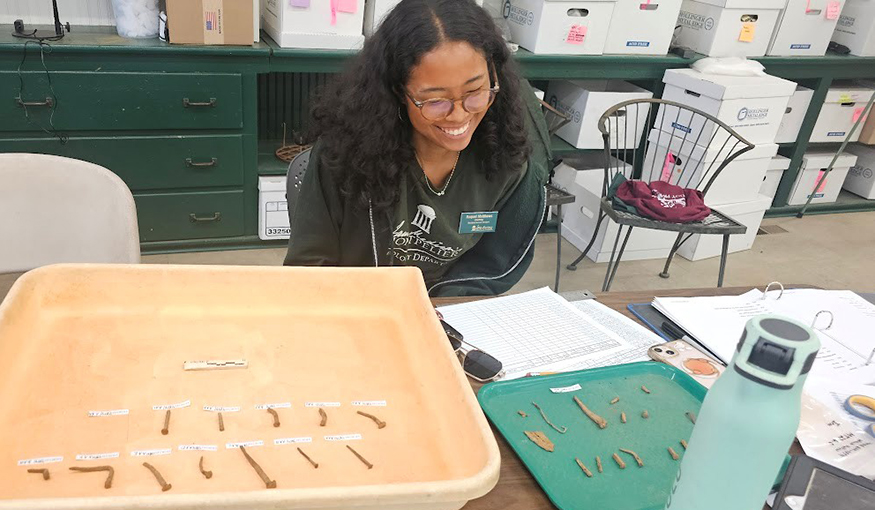
Raquel Matthews sitting behind a long table with small excavated items laid out in even rows. y lab at the Montpelier Museum.
As an intern at the Montpelier Museum in 2025, Matthews worked in the archaeology lab while also helping with an excavation. Photo courtesy of Raquel Matthews. 

As her research project progressed, Matthews decided to compare the use of toys in enslaved contexts in North America and the West Indies. The latter was a site of vastly fewer toys — at least ones that have survived — which raised additional questions to explore.

Matthews acknowledges that seeking insights into human relationships through found materials can be challenging. “It can be a contested terrain of analysis for archaeologists,” she says. “For anything historical, we’re making interpretations. We’re not saying that this is the ultimate truth. I don’t ever want to attempt to do that.”

After graduating this spring, Matthews hopes to continue working in the cultural heritage sector, either through archaeology or in some other way, to add to our understanding of people’s lived experiences.

“I find myself deeply moved, time and time again, when I am able to commune with past generations' stories — especially when those stories have been deliberately obscured,” she says. “Opportunities to find those little details of people’s lives and interactions feel very sacred to me.”

More Stories

Hunter Jung in a research lab, with shelves of lab equipment on either side of her.

Before Med School, A Year in Paris

Graduating with bachelor's degrees in neuroscience and French, Hunter Jung is heading to France for a cognitive neuroscience program that reflects both interests.

Greg Rahuoja on the UW campus, with Denny Hall in the background.

Supporting a Threatened Language

For his UW master's in Scandinavian Studies, Estonian student Greg Rahuoja addressed political and practical challenges for Khanty, an Indigenous language spoken in parts of Siberia. 

Maddy Brown in a t-shirt and baseball cap stands on a basketball court.

A Math Course Inspired by TikTok & Basketball

After creating popular social media content analyzing basketball statistics, UW Mathematics doctoral student Maddy Brown created a course to help students present data through storytelling.