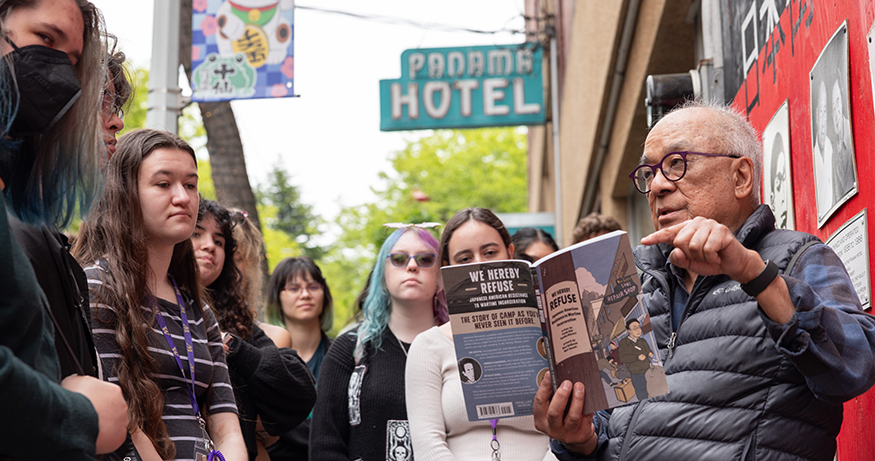
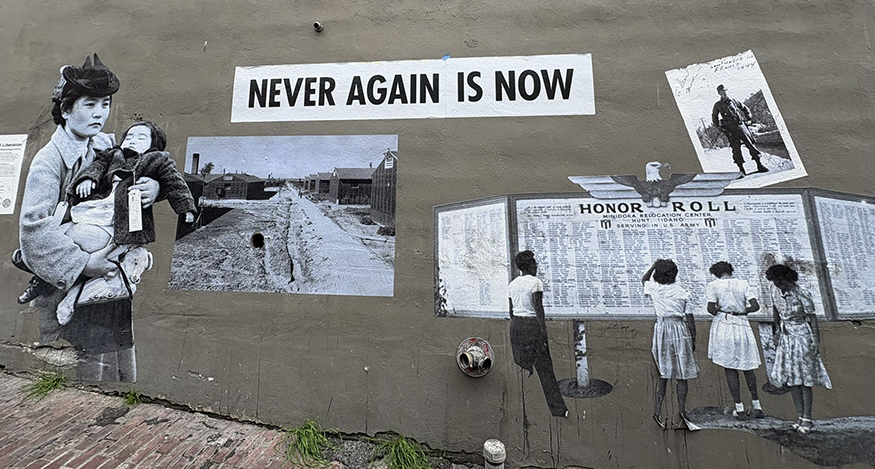
On a cloudy afternoon in April, a University of Washington humanities class boarded light rail for downtown Seattle, where they toured the Chinatown-International District (CID) with their professors, Sarah Stroup and Sam Hushagen. They were joined by Frank Abe, author of “We Hereby Refuse: Japanese American Resistance to Wartime Incarceration,” a book the class had read.
Visiting the CID and meeting Abe brought the experiences of Japanese Americans during and after World War II to life. It was one of many field trips for students in Humanities 103, the final course in a year-long Humanities First sequence offered by the College of Arts & Sciences. Ending the sequence with a field-trip-focused course was by design.
“Getting students out of the classroom and into space, if you can do it, is a far superior way of teaching and learning,” says Stroup, director of Humanities First, professor of classics, and chair of the Department of Spanish and Portuguese Studies. “You can describe something to students so they know it intellectually, but places show things. Spaces teach people, if they are there to learn.”
The Power of Place
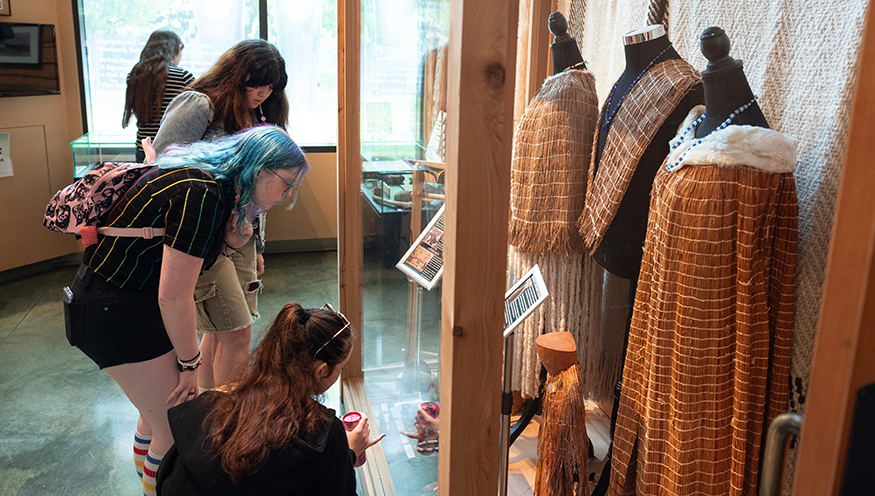
Humanities First is a program for first-year students, to introduce them to the methodological approaches specific to humanities disciplines. Each course builds on what came before. Humanities 101 is team-taught by faculty from across the humanities who explore shared topics through the lens of different disciplines. Humanities 102 focuses on Indigenous communities of the Pacific Northwest, with assigned readings by Indigenous authors and a visit to the UW’s Burke Museum. Humanities 103 is all about place-based learning, with numerous field trips highlighting Indigenous and Asian American experiences in the Puget Sound region.
“An important thing about the humanities as a methodology is that to do it well, we need to be able to think like people who are very different from ourselves,” says Stroup. “In our highly polarized world, people are often driven by uninformed binary thinking, with no nuance or subtlety. We teach our students how to develop a nuanced way of thinking about people who are different than them.”
You can describe something to students so they know it intellectually, but places show things. Spaces teach people, if they are there to learn.
Stroup offers the example of the CID field trip. Prior to the visit, students learned about Executive Order 9066, issued during World War II, which forced Japanese Americans out of their communities to be incarcerated in camps. In addition to Abe’s book, they read “No-No Boy,” a novel by Frank Okada that describes the aftermath of Japanese American incarceration from the perspective of a young Japanese American man raised in Seattle’s CID.
“On the field trip, we were able to visit some of the streets the fictional protagonist of No-No Boy would have wandered around 75 years ago,” says UW sophomore Spencer Grubbs, who enrolled in Humanities First last year. “And we stopped at the Panama Hotel building, which provided a visceral — and literal — glimpse into the not-so-distant past.”
Grubbs explains that the Panama Hotel stored the belongings of Japanese Americans who were forced to leave and abandon their possessions during World War II. A window installed in the hotel enables visitors to see where some of these items are still stored. He says that viewing the abandoned possessions was like seeing “the fears of an unknown future, being incarcerated by government for no other crime than being of Japanese ancestry, frozen in time.”
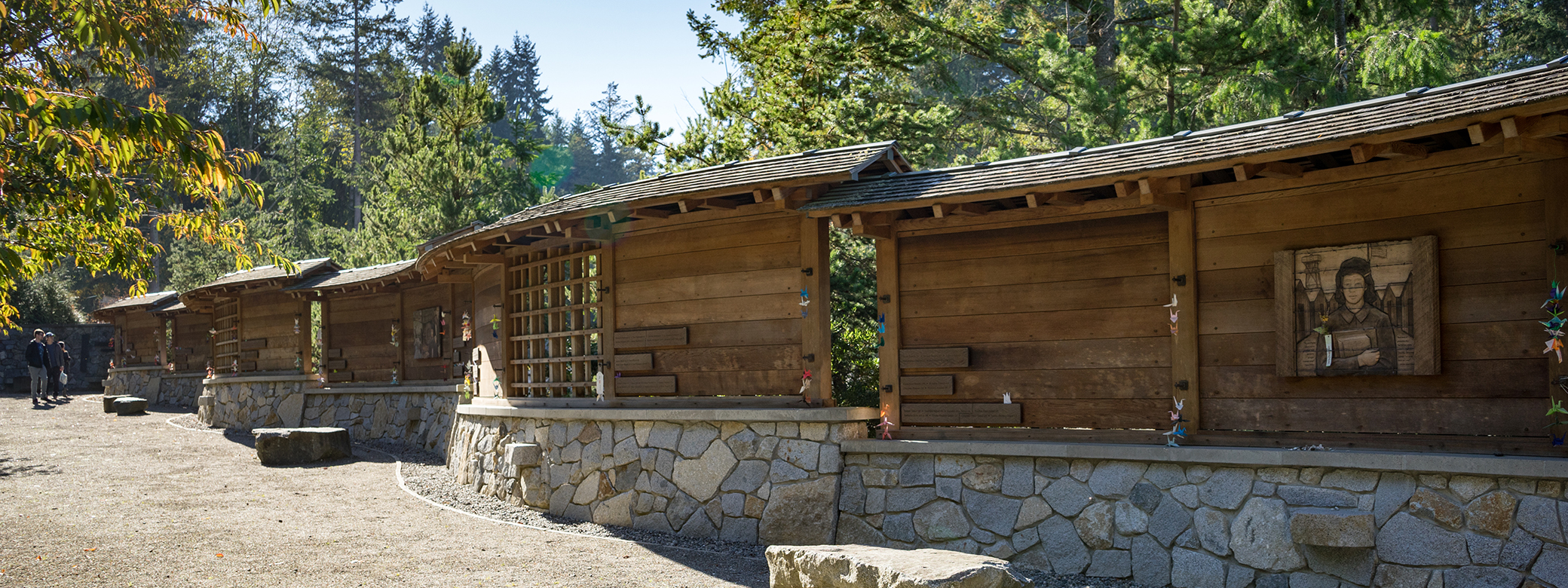
Other Humanities 103 field trips have included visits to the Seattle Asian Art Museum, Seattle’s historic Lakeview Cemetery, Kubota Garden and the Seattle Japanese Garden, the Duwamish Longhouse and Cultural Center, the Suquamish Museum, and the Bainbridge Island Japanese American Exclusion Memorial.
Each trip invites reflection. Visting the Duwamish Longhouse, students learn that the creation of Seattle’s Montlake Cut, completed in 1916, lowered the level of Lake Washington so dramatically that it no longer drained into the Black River, where the Duwamish people once lived and fished. The class considers how that change affected Duwamish communities that had been dependent on the river.
“The past isn’t just the past,” says Stroup. “These things that happened right here in our city create scars, even physical scars on the land, traumas that continue to today.”
Choosing What to Teach
Many students in Humanities First are surprised they had not previously been taught about certain communities and events. Stroup points out that everything taught is someone’s choice. Museum curators choose what will be presented in exhibits, and school districts choose what will be taught in schools. The final project for Humanities 103 challenges students to consider how they would teach some of the topics covered in the course.
Working in groups, students design a K-12 curriculum, choosing a grade level and topic. The resulting projects have included a class for tenth graders on Pacific Northwest Indigenous history using treaty documents, and an elementary school art class that educates about the Puget Sound’s Japanese American community through activities like creating and coloring maps.
For his project, Grubbs explored the topic of Japanese American incarceration in a course for fourth- and fifth-graders. “Because this is such a heavy topic, one of the big challenges was how to talk about the topic in a way that was appropriate,” says Grubbs. Inspired by the Humanities 103 field trip to the Bainbridge Island Japanese American Exclusion Memorial, his team’s proposed course includes making origami paper cranes to be donated to the memorial.
Sophia Lee, who also took Humanities 103 last year, created a twelfth-grade curriculum focused on how boarding schools and cultural erasure by colonial-Americans has impacted contemporary Native American equal rights movements. For the final assignment, her team planned to have the high school students create a podcast episode in which they interview local Native community members.
“Our team reaffirmed that it takes a lot of effort, research, and care to share — let alone teach — a community’s stories,” says Lee. “It’s thus all the more important to do so carefully and with firsthand guidance from that community wherever and whenever possible, to avoid censoring Native American histories that we already don’t learn nearly enough about.”
Reflecting on her entire Humanities First experience, Lee believes it set the tone for the rest of her UW experience.
“Humanities First showed me some of the best of what the UW has to offer students: thoughtful and fun learning that connects students with others within and beyond the institution,” she says. “It showed me that the classes we take here are capable of impacting us and our communities beyond a testing rubric.”
Grubbs is similarly appreciative. “While I have always cared about people, Humanities First has given me tools to better think about and advocate for human-centered issues,” he says. “I better understand that spaces and broader structures can shape how people interact and can influence who gets to have a seat at the table. I want to provide space for communities to join conversations that concern them.”
More Stories
Sharing Shakespeare
Thanks to a School of Drama connection, an 19th-century illustrated Shakespeare edition with an interesting backstory is now part of UW Libraries Special Collections.
Awards for Research, Podcasts & More
Recent awards celebrate Arts & Sciences faculty for their research, outreach, lifetime achievements, and more.
A Math Course Inspired by TikTok & Basketball
After creating popular social media content analyzing basketball statistics, UW Mathematics doctoral student Maddy Brown created a course to help students present data through storytelling.